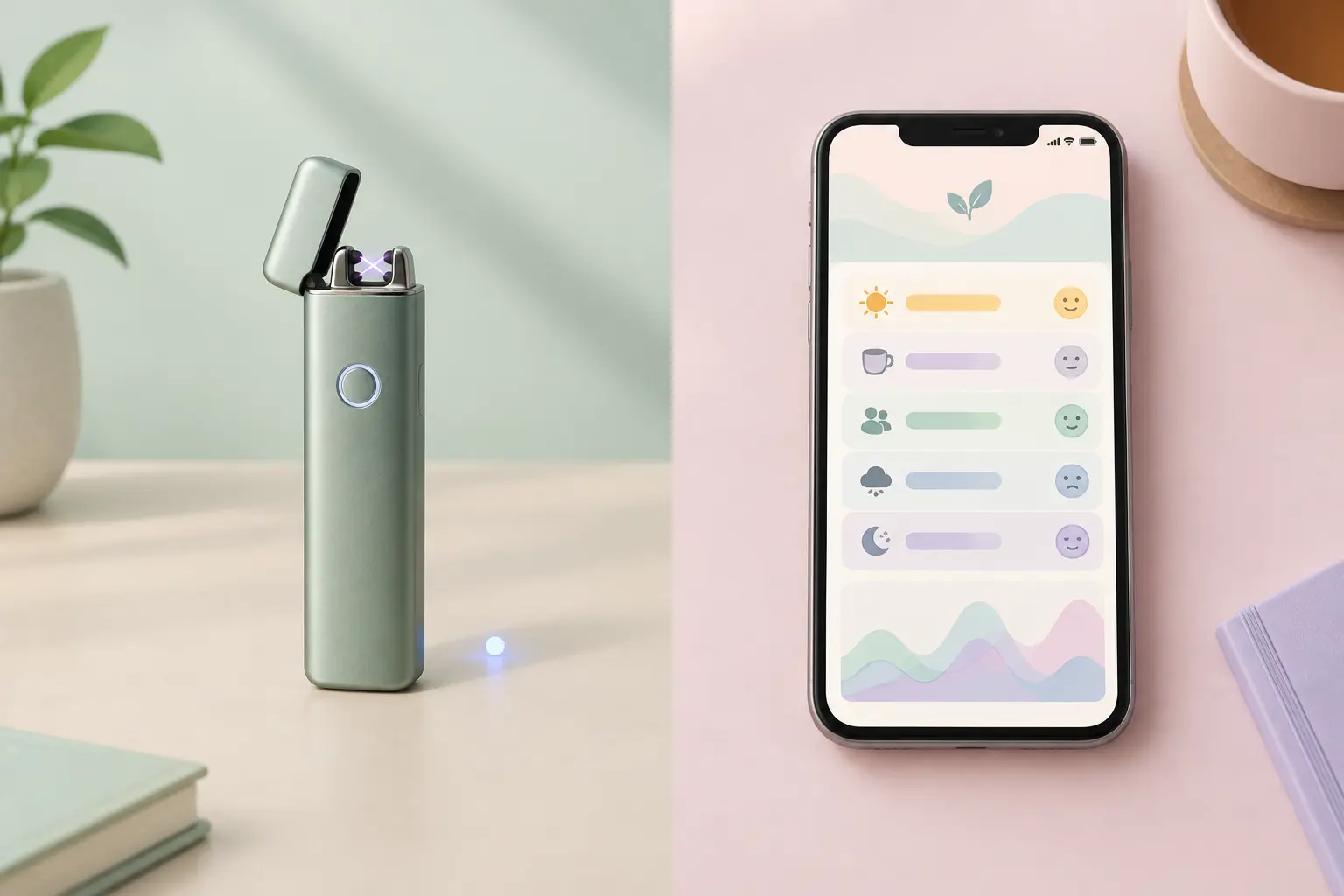
A smart lighter to quit smoking promises to log every cigarette you light, but in 2026 the honest picture is more complicated: we could not confirm that the best-known consumer example is still on sale, the research on these devices is about measuring smoking rather than stopping it, and a lighter cannot record anything once you quit. This guide explains what smart lighters do, what the studies found, and how a phone app that logs cravings compares.
What a Smart Lighter Is
A smart lighter is an electronic lighter with a sensor and a clock. Each time you use it to light a cigarette, it records the event and the time. In a 2019 pilot study, adult daily smokers “used an electronic, smart lighter to light and timestamp cigarettes for 14 days” (Addictive Behaviors, 2019). The appeal is tracking with little effort: in a 2025 study, participants considered smart lighters easy to use because they “minimize user burden in tracking smoking behavior.”
The best-known consumer example was Quitbit. When it was announced in 2014, New Atlas described a lighter with “a small display with a counter that ticks over every time they light up,” showing the time since your last cigarette, with Bluetooth to send data to a companion app (New Atlas, May 2014). Treat that as history: it is the 2014 product description, not a 2026 buying guide.
What a Smart Lighter Records
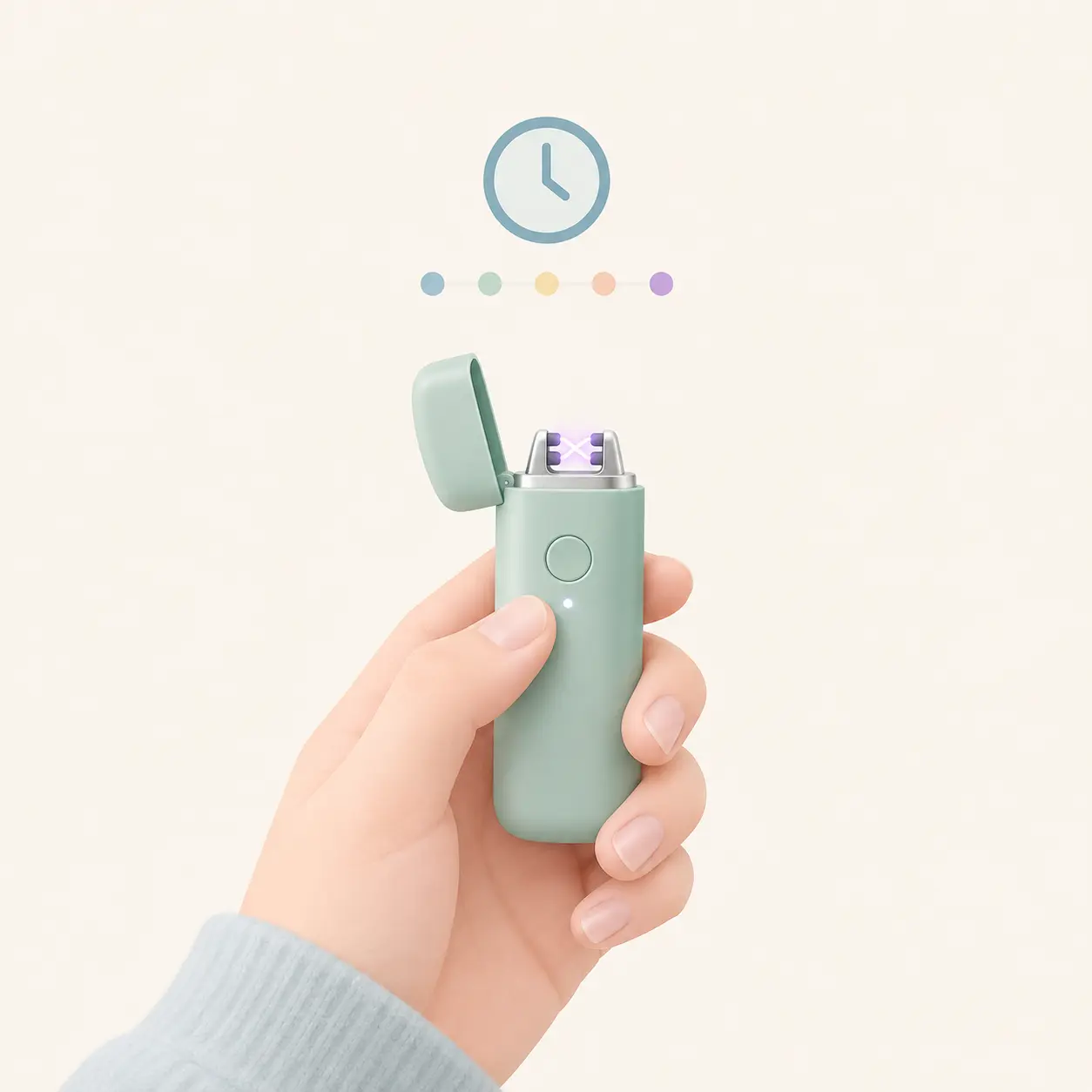
A lighter knows one thing: when you lit up. From that, an app can show:
- How many cigarettes you smoked each day.
- The time of day you smoke most.
- The gap between cigarettes.
Some designs also let you set a daily limit or reduce the count over time. The 2014 coverage of Quitbit described milestones, daily cigarette limits and tracking money spent or saved, and an option to disable the lighter “when they’re at their most vulnerable.”
What it cannot record is everything else. It does not know whether you were stressed, bored, drinking coffee or standing outside a pub. It does not know about cigarettes lit with someone else’s lighter, a match or the stove. A 2019 study noted that “additional technologies that augment data captured from the lighter may be necessary to reduce false negatives (missed cigarettes).” In that study participants reported using the lighter for 92% of their cigarettes on average, so some cigarettes still went unlogged even among people who had agreed to try it.
Price and Availability in 2026
This is the part we cannot give you cleanly. Our checks found:
- Quitbit’s original Kickstarter campaign in 2014 offered the lighter for a US$79 pledge, with shipping planned to begin that December (New Atlas, May 2014).
- When we requested quitbit.com on 4 October 2026, it returned an error page rather than a store.
- Our searches for smart lighters turned up only 2014-era coverage of Quitbit, with no current retailer and no 2026 price.
- Research versions, such as the inertial sensor plus smart lighter system described in a 2019 Sensors paper, are built for studies, not sold as retail products.
So we cannot quote a 2026 price, and we cannot name a smart lighter you can reliably buy. If you find one for sale, check that the maker is still supporting the app, because a lighter that depends on a discontinued app can quickly become a plain lighter. We simply could not confirm whether any consumer smart lighter is currently available, so check the seller yourself before you spend money.
Does Auto-Logging Help You Quit?
Short answer: we do not know, and the studies we found were not designed to find out. A search of Europe PMC for smart lighters returned feasibility, acceptability and detection studies, and we did not find a randomized trial showing that a smart lighter improves quit rates.
What the studies do show:
- It can measure smoking. In the 2019 pilot with 22 daily smokers, “Lighter-estimated CPD did not differ from daily diary-estimated CPD, but was significantly lower than TLFB estimates,” where TLFB is a retrospective recall method. 68% of participants reported liking the lighter.
- People are open to it, with caveats. In a 2025 study of 12 focus groups with 38 smokers aged 18 to 29, “Sentiment toward smart lighters was positive (54.36%),” while “Concerns about privacy, lack of awareness of smart lighters, and their unaffordability were the primary facilitating conditions discussed” (Digital Health, 2025).
- It might cue smoking. The same paper says skepticism “centered on the possibility of inadvertently triggering cravings and subsequent smoking,” and concludes: “Consideration must be given to their potential unintended effects as cueing smoking.” Smokefree.gov lists “Handling cigarettes, lighters, and matches” among withdrawal triggers (Smokefree.gov, Know Your Smoking Triggers).
The honest conclusion is that a smart lighter is a measurement tool. It can show you your pattern, which is useful before you quit, but nothing we found shows that carrying one helps you stop.
Smart Lighter vs App Logging
| Question | Smart lighter | Phone app with a craving log |
|---|---|---|
| What it records | When you light a cigarette | When and why you crave: triggers, intensity and mood |
| Works after you quit | No, because there are no cigarettes to light | Yes, cravings and slips can still be logged |
| Misses | Cigarettes lit with matches, borrowed lighters or the stove | Whatever you forget to log |
| Effort | Low once you carry it | A few taps per craving |
| Cost | No current price we could verify | iQuit is free to download on Google Play and the App Store |
| Privacy | Data goes to a maker app, a concern raised in the 2025 focus groups | Check any app’s privacy policy before you share health data |
| Extra tools | Depends on the maker; no current product confirmed | iQuit offers SOS tools, breathing and grounding, streak shields and an AI coach |
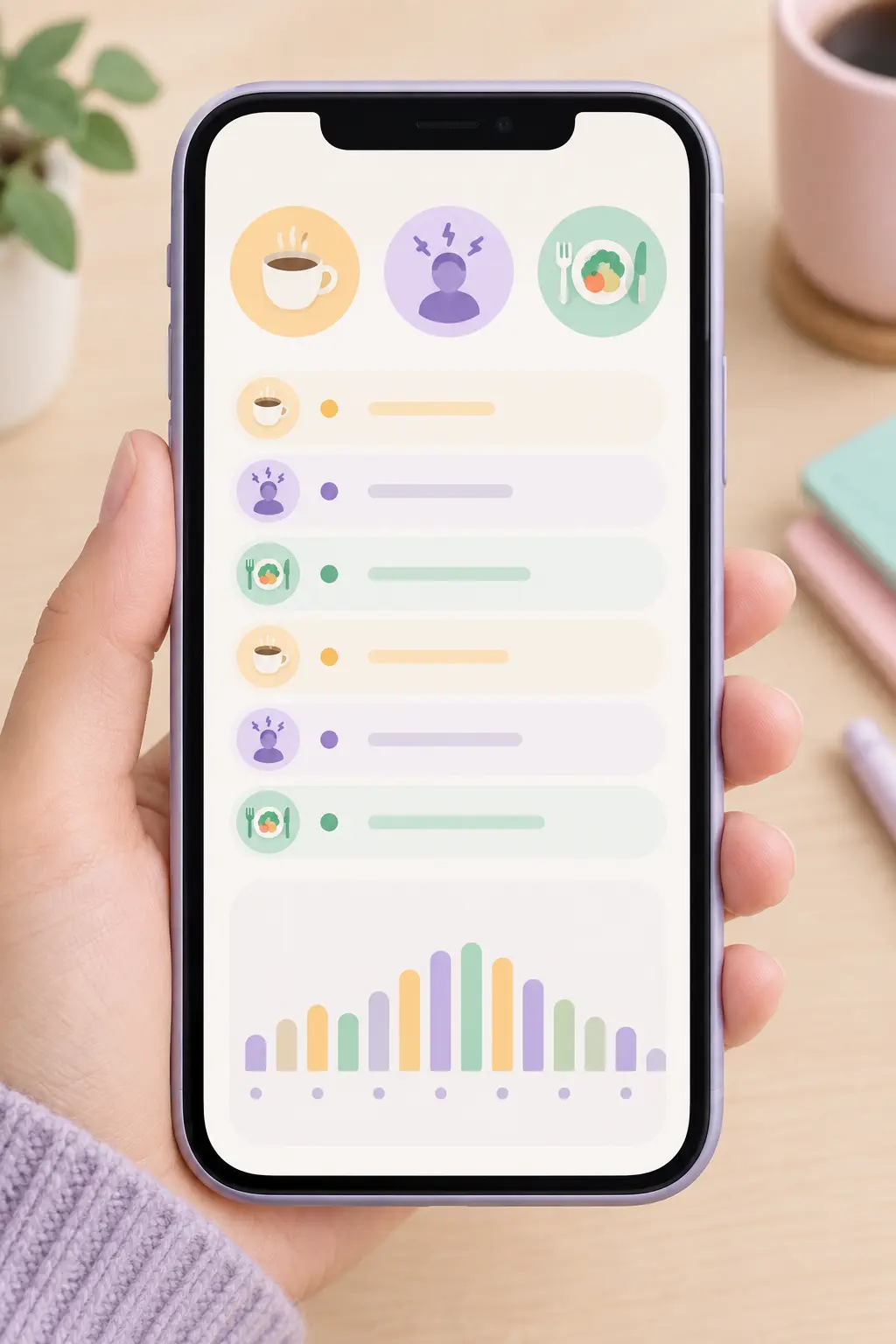
The key difference is what gets recorded. Smokefree.gov says “Knowing your triggers and having strategies to help you deal with them can help you control cravings and make it less likely that you will smoke.” A craving log is built for exactly that, because it records the situation behind the urge. A lighter records only the lighter.
iQuit is free on Google Play and the App Store. Its craving log records triggers and intensity so patterns become visible, you can quit gradually or cold turkey, and the SOS tools (breathing exercises, grounding, distraction tips and craving timers) are there at the moment of need. Streak shields and slip recovery help you pick up again after a slip. The dashboard shows days smoke-free, cigarettes avoided and money saved. For how the free app compares with a dedicated tracker, see our quit smoking tracker guide and habit trackers versus quit apps.
Can You Combine a Smart Lighter and an App?
If you already own a working smart lighter and like it, there is no reason to throw it away while you are still smoking. Be clear about one limit, though: iQuit does not sync with a lighter or any other device. If you use both, you would read the lighter’s numbers yourself and enter what you want in the app by hand, so you should not expect them to share data.
A cheaper way to get the same pre-quit insight is to log for a week with pen and paper or a notes app before you quit; our guide to tracking your smoking for a week before you quit walks through exactly what to record. That gives you your daily average, your peak hours and your top triggers, which are the three things a smart lighter would have told you.
Once your quit date arrives, the lighter has nothing left to record. That is when a craving log, a day counter and support tools take over. For a broader comparison of apps, see the best quit smoking apps of 2026, and for what the paid tier adds, read is iQuit Premium worth it. If you want to know how counting works in practice, our cigarette counter app guide shows how a day-by-day counter works.
Questions to Ask Before You Buy Any Tracking Gadget
Whether it is a smart lighter or any other device that promises to track your smoking, a few questions will save you money and disappointment:
- Is it still sold and supported? A gadget that depends on a company app is only as good as that app. If the maker has gone, the device may stop syncing or stop working.
- What happens to your data? Smoking habits are health information. The 2025 focus groups raised privacy as a main concern, so read the policy before you connect anything.
- What will it add to what you can already do? You can note the time and situation of each cigarette on your phone for free. A device is only worth buying if it clearly saves you effort you would otherwise skip.
- What happens on quit day? A tool that records only cigarettes has no job after your last one. Check what you will rely on when the cravings start.
- Does it risk becoming a cue? If handling a lighter makes you want a cigarette, a lighter-shaped gadget may not suit you during the quit attempt.
None of these questions rule a device out. They are a way to separate a tool that supports your plan from one that is simply another thing to carry.
What to Do This Week Instead
If you are weighing a smart lighter because you want to understand your smoking before you quit, you can get most of the benefit at no cost:

- Days 1 to 3: note the time, the situation and your mood each time you smoke, using your phone or a small notebook.
- Days 4 to 7: mark your three busiest hours and your three most common triggers.
- Day 7: write one replacement action for each trigger, then set your quit date.
Smokefree.gov groups triggers into emotional, pattern, social and withdrawal triggers and suggests practical replacements for each, from deep breathing to changing your routine (Smokefree.gov, Know Your Smoking Triggers). Once your week of notes is done, you will know more about your habit than a lighter’s timestamps would show you.
Frequently Asked Questions
What is a smart lighter for quitting smoking?
A smart lighter is an electronic lighter that records the time each cigarette is lit, so you can see how many you smoke and when. In a 2019 pilot, 22 smokers used one for 14 days to timestamp their cigarettes (Addictive Behaviors, 2019).
Can I still buy a smart lighter in 2026?
We could not confirm it. The best-known model, Quitbit, was announced on Kickstarter in 2014 for a US$79 pledge, and its website returned an error page when we checked on 4 October 2026. We found no current retailer or price.
Does a smart lighter help you quit smoking?
We found no randomized trial showing that it does. Studies we found covered feasibility, accuracy and acceptability, such as a 2025 focus-group study where sentiment was positive (54.36%) but some feared it might trigger cravings (Digital Health, 2025).
Is a smart lighter accurate?
In a 2019 pilot, smart-lighter counts matched daily diary counts but were lower than end-of-study recall, and participants used the lighter for 92% of cigarettes on average. The authors said missed cigarettes (false negatives) are possible (Addictive Behaviors, 2019).
Is a quit smoking app better than a smart lighter?
They do different jobs. A lighter records when you light up; an app can record why you crave and keeps working after you quit. Smokefree.gov says knowing your triggers can help you control cravings and make smoking less likely (Smokefree.gov).
Does iQuit work with a smart lighter?
No. iQuit does not sync with lighters or other devices. You can use a lighter alongside it, but you would enter any data yourself, and the app does not read the lighter.
What is a free alternative to a smart lighter?
Log every cigarette for a week before you quit, noting the time and what you were doing and feeling. That gives you your average, your peak hours and your top triggers without buying anything. Our week-before-you-quit guide explains the method.
Log Your Cravings With iQuit
iQuit is free on Google Play and the App Store. Log cravings with triggers and intensity, use the SOS tools when an urge hits, and watch your smoke-free days add up.
Download iQuit Free on Google Play
Download on the App Store