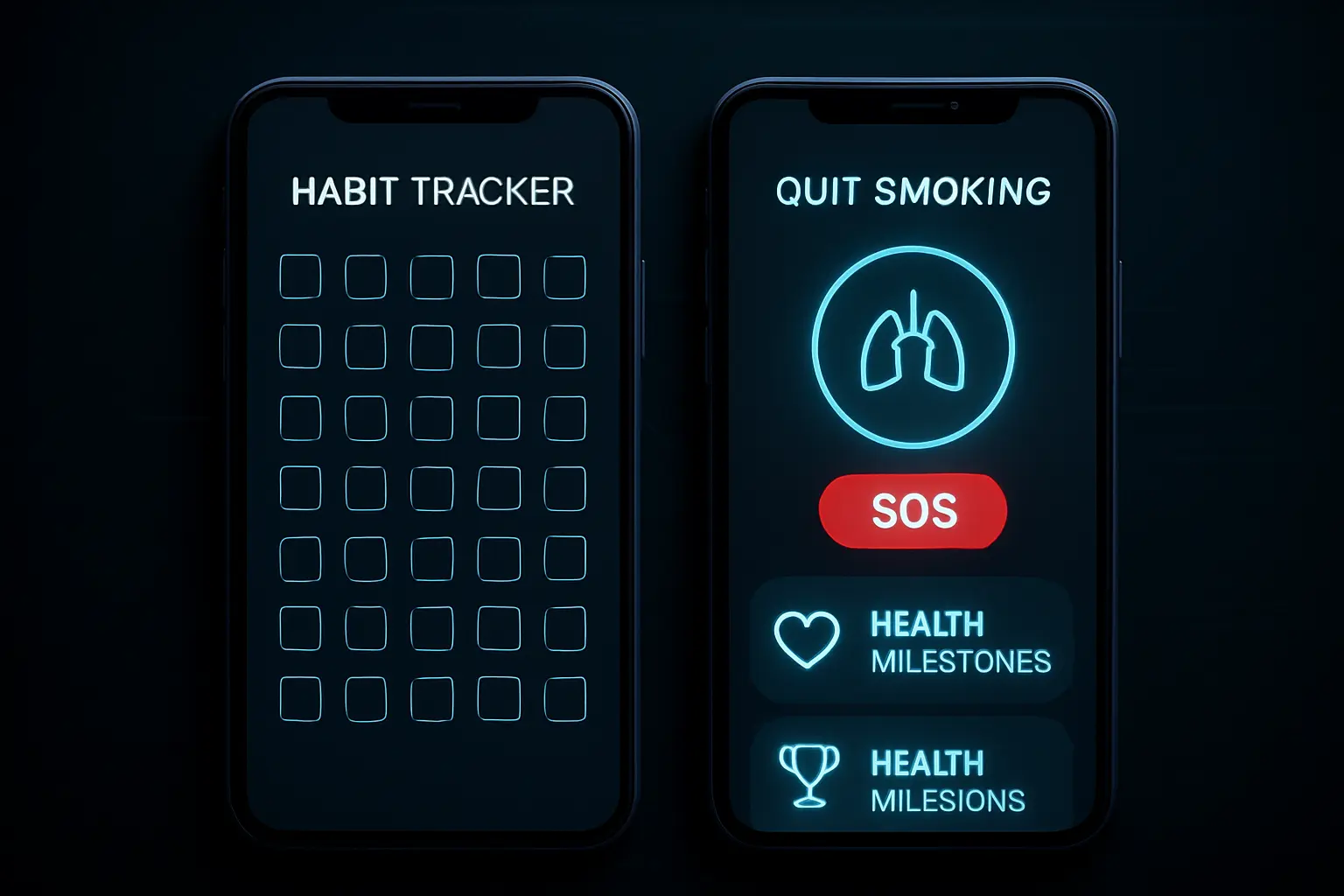
A habit tracker treats “don’t smoke” like “drink water”: a box to tick. And for the accounting side of quitting, it genuinely works — day counts, streaks, a satisfying grid of green squares. The problem is what happens at 9:47pm on day six, when a craving hits an 8/10 and your tool of choice offers you… a checkbox. Quitting smoking is an addiction with crisis moments, withdrawal chemistry and relapse dynamics. Trackers record behavior; quitting needs something that intervenes in it.
What generic trackers do well
Credit first. Habit trackers are excellent at visible consistency (streak grids motivate), zero setup friction, and bundling — your smoke-free tick next to gym and reading ticks builds an identity-level “person who keeps promises” loop. If you’re a light smoker with mild dependence and strong self-structure, a tracker plus willpower may honestly carry you. The data says most quitters aren’t in that category — but some are.
The five jobs a checkbox can’t do
- Crisis intervention. Cravings peak for ~3 minutes and decide everything. A quit app answers with guided breathing, 5-4-3-2-1 grounding, a virtual cigarette and quitline access behind one shake of the phone. A tracker answers with a grid.
- Pattern intelligence. Logging cravings with intensity and trigger builds your personal danger map — and powers forecasts that warn you before your trigger hours. Trackers don’t know cravings exist.
- Slip recovery. In a tracker, smoking one cigarette breaks the chain — the exact “all is lost” moment that converts lapses into relapses. Quit-specific design (streak shields, recovery plans, timed check-ins) exists precisely to defuse it.
- Domain accounting. Money saved at your pack price, 15 health milestones unlocking on the medical timeline, life regained at 11 minutes per cigarette — computed automatically from your smoking profile. A tracker shows you day 23; a quit app shows you what day 23 means.
- Cessation knowledge. Withdrawal guides, urge-surfing scripts, an AI coach fluent in CBT and trigger mapping. The difference between a notebook and a nurse.
Head to head
| Generic habit tracker | Quit-smoking app (iQuit) | |
|---|---|---|
| Streaks & day counts | Yes — its specialty | Yes, plus shields that survive a slip |
| Mid-craving help | None | SOS: breathing, grounding, virtual cigarette |
| Trigger learning & forecasts | None | Learns your hours, warns 15 min early |
| Slip handling | Chain broken, restart | Shield + recovery plan + check-ins |
| Health/money meaning | Manual notes | Auto: milestones, savings, life regained |
| Cost | Free–$5/mo | Free core; optional Premium |
The honest verdict
Use a habit tracker alongside your quit if you love the green grid — it stacks fine. But don’t ask it to be your only tool unless your dependence is genuinely mild. The moments that end quits are the craving spikes and the first slip — and those are precisely the moments a checkbox has nothing to say. Since iQuit’s core toolkit is free, the trade-off isn’t money; it’s whether your tool works during the three minutes that matter.
FAQ
Can a normal habit tracker help me quit?
For counting days, yes. For cravings, withdrawal and slips — the parts that end quits — it has no tools.
What’s the biggest single difference?
Crisis response: a quit app intervenes mid-craving; a tracker records history after the fact.
Can I use both?
Absolutely — tick your grid and keep a quit app for the hard moments. They stack.
Is the quit app more expensive?
No — iQuit’s core toolkit (SOS, logging, milestones, shields) is a free download.
Keep the grid; add the rescue kit: get iQuit free on Google Play.