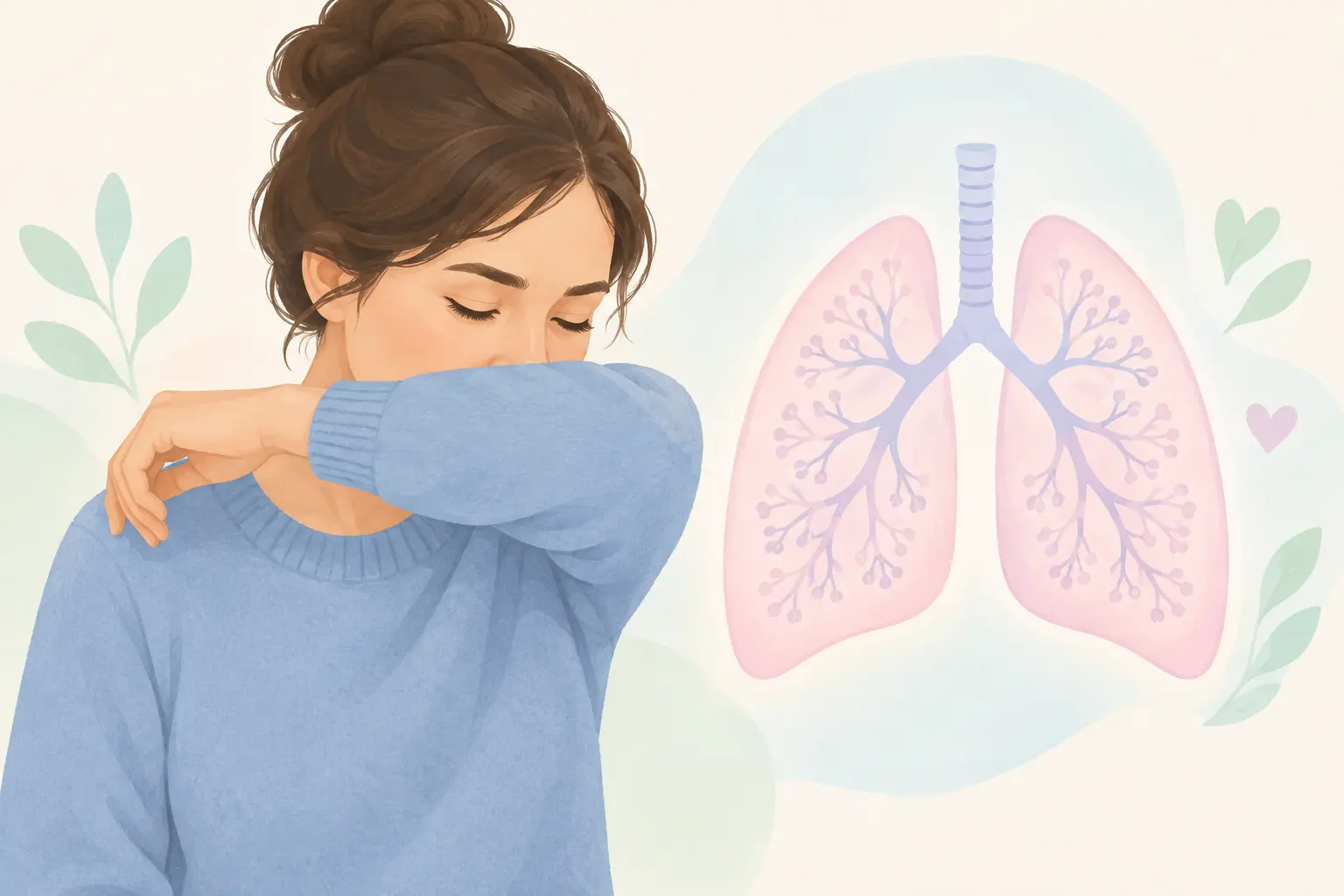
A smoker’s cough is the daily cough many smokers learn to live with, often worse first thing in the morning. It is common enough that people shrug it off, and that is exactly the risk. The NHS notes that some people dismiss a persistent chesty cough with phlegm as just a smoker’s cough, when it can be a symptom of chronic obstructive pulmonary disease (COPD). This guide explains what is going on in your airways, the red flags that mean you should see a doctor, and what the evidence says happens to the cough once you stop.
What smoker’s cough is
“Smoker’s cough” is not a formal diagnosis. It is a common name for a cough that goes on week after week in someone who smokes. The cause is usually irritation and inflammation of the airways from smoke, and the cough is the body’s attempt to clear it.
The NHS cough page lists smoking among the causes of a cough, alongside colds and flu, heartburn, allergies and infections like bronchitis. The same NHS page says a cough will usually clear up on its own within 3 to 4 weeks. A smoker’s cough does not behave that way. It hangs around, which is the first clue that something other than a cold is going on.
How common is a long-lasting cough? A 2021 study of 29,972 Canadian adults aged 45 to 85 found that 15.8% reported a daily cough over the past 12 months, and prevalence increased with age and with current smoking. The study measured self-reported daily cough, not diagnoses, but it shows how common the problem is.
Why it happens: inflamed airways and mucus
The American Lung Association describes bronchitis as a lung condition in which the bronchi, the large airways, become inflamed, causing coughing spells that bring up mucus or phlegm, wheezing, chest pain and shortness of breath. It explains that in chronic bronchitis, inflammation over time can cause sticky mucus to build up in the airways, leading to long-term breathing difficulties, and that cigarette smoking is a leading cause.
In plain terms, smoke irritates the airway lining every day, the airways respond with inflammation and extra mucus, and you cough to move it out. That is a simplified picture rather than a full mechanism, but it matches how the ALA and NHS describe the condition.
The morning cough pattern
Many smokers notice the cough is worst on waking. A morning cough that produces phlegm is a familiar story, and it is worth noticing how long it has lasted and whether it is changing. I have not found a reliable source that explains exactly why mornings are worse, so treat the pattern as something to report to a clinician, not as a way to judge how serious the cough is.
Keep a simple note for two weeks: how many mornings you cough, whether you bring up phlegm, what color it is, and whether you get breathless on stairs. That record will help a clinician and, if the cough eases after you quit, it will show you the progress. If you are curious about the phlegm itself once smoking stops, our guide to coughing up phlegm after quitting smoking covers that stage.
Red flags: when a cough is not “just a smoker’s cough”
This is the most important section. I will not tell you a cough is “probably nothing,” because nobody can know that without being examined. The NHS says a cough is rarely a sign of something serious like lung cancer, but for a smoker the symptoms below deserve a medical check. The NHS wording is quoted here as closely as possible, with the lung cancer symptoms page used for the emergency row.
| Level | NHS wording |
|---|---|
| See a GP | you’ve had a cough for more than 3 weeks (persistent cough); you’re losing weight for no reason; you have a weakened immune system |
| Urgent GP appointment or NHS 111 | your cough is very bad or quickly gets worse; you feel very unwell; you have chest pain; the side of your neck feels swollen and painful; you find it hard to breathe; you’re coughing up blood |
| Call 999 or go to A&E (lung cancer symptoms page) | you’re struggling to breathe – you are choking, gasping and unable to speak; you have pain in your chest or upper back |
The NHS page on lung cancer symptoms lists common symptoms as a cough that is not going away, shortness of breath, coughing up blood, chest or shoulder pain, often having chest infections or a chest infection that is not getting better, losing weight without trying, not feeling hungry, and feeling tired all the time. It adds that some of these symptoms are very common and can be caused by other conditions, so having them does not definitely mean lung cancer, but it is important to get checked. It also advises that if symptoms are caused by cancer, finding it early may mean it is easier to treat.
The NHS has published a short video on lung cancer signs and symptoms that is worth watching if your cough has lasted more than a few weeks.
Why a “just a smoker’s cough” explanation can mislead
A 2010 study in the British Journal of General Practice looked at 353 people over age 50 who saw their GP for a persistent cough and were not known to have COPD or asthma. After a full work-up with symptoms, signs and breathing tests, 102 of them (29%) were diagnosed with COPD, and 23 (7%) had asthma without COPD. The authors concluded that undetected COPD or asthma is frequently present in these patients. In other words, a cough that “everyone in the family just puts down to smoking” may have a treatable explanation that has gone undiagnosed.
That study does not say 29% of smokers have COPD. It describes people who went to the GP with a persistent cough, which is a different group. But it makes the practical point that a long-lasting cough deserves a proper assessment.

Smoker’s cough vs COPD and chronic bronchitis
The NHS describes COPD as the name for a group of lung conditions that cause breathing difficulties, including emphysema (damage to the air sacs) and chronic bronchitis (long-term inflammation of the airways). It says COPD mainly affects middle-aged or older adults who smoke, and that many people do not realize they have it. Its symptoms include shortness of breath, particularly when active, a persistent chesty cough with phlegm, frequent chest infections and persistent wheezing.
The American Lung Association gives a definition for chronic bronchitis: a productive cough that lasts at least three months and occurs over the course of two years, once other lung conditions such as asthma have been ruled out. It notes there is no cure for chronic bronchitis or COPD, though treatments include medicines that open the airways, quitting smoking, oxygen therapy and pulmonary rehabilitation.
The NHS also says the damage to the lungs caused by COPD is permanent, but that treatment can help slow the progression, and that if you have COPD and you smoke, stopping smoking is the most important thing you can do. Its advice is to see a GP if you have persistent symptoms of COPD, particularly if you are over 35 and smoke or used to smoke, and not to ignore them. A simple breathing test can help diagnose it. For population figures, see our page on COPD statistics 2026 prevalence deaths smoking.
If you already get out of breath more easily, our guide to breathlessness after quitting smoking timeline explains how that symptom can change once you stop.
What happens when you stop
The encouraging part is that the cough is one of the symptoms that tends to improve after quitting. Several health bodies describe the pattern:
- The National Cancer Institute says that within a few weeks, people who quit smoking have improved circulation, produce less phlegm and do not cough or wheeze as often.
- The NHS Better Health page says that after 3 to 9 months any coughs, wheezing or breathing problems will be improving as lung function increases by up to 10%.
- The American Lung Association timeline says that 1 to 9 months after quitting, your coughing and shortness of breath decrease.
Some people report that their cough feels different, or even worse, in the first days or weeks after the last cigarette. I do not have a sourced figure for how often that happens, so I will not give one; we cover the question in why do I cough more after quitting smoking. If a cough gets worse after you quit and also matches any of the red flags above, do not wait it out: see a doctor.
It is also worth knowing that quitting does not undo structural damage. The NHS says COPD damage is permanent, and the American Lung Association says chronic bronchitis symptoms may get better or worse but will never completely go away. Quitting is still the most important step, because it stops further damage. For the wider picture, read our what happens when you quit smoking complete health recovery guide, and for the early days see nicotine withdrawal timeline hour by hour day by day.
When to see a doctor, and what to say
Book an appointment if your cough has lasted more than 3 weeks, if you are over 35 and smoke or used to smoke and have a persistent chesty cough, or if you notice any of the red flags in the table. Seek urgent help if you cough up blood, have chest pain, or find it hard to breathe.
What to tell the clinician
- How long you have had the cough and whether it is changing.
- Whether you bring up phlegm, and whether there is ever blood in it.
- Any breathlessness, wheezing, chest infections, weight loss or tiredness.
- That you smoke, and for how long. This is not a lecture trigger; it is information that changes what tests make sense.
The NHS notes that the GP might listen to your chest, take a sample of any mucus, or order an X-ray or a test to see how well your lungs work. A breathing test is simple and can detect COPD early, when treatment helps most.
Quitting alongside the check-up
You do not have to wait for results to start. Many people find the appointment is the push they needed. Tell the doctor you want to stop, and ask what support is available.
The free iQuit app can help with the day-to-day. You can log cravings with their triggers and intensity, follow the health-recovery timeline as your smoke-free days add up, use SOS tools when a craving hits, and keep your streak going even after a slip. It supports quitting; it does not diagnose or treat a cough or any lung condition, so please still see a doctor for symptoms.
Frequently Asked Questions
How long does a smoker’s cough last?
For a current smoker it can last indefinitely. The NHS says a normal cough usually clears within 3 to 4 weeks, so a cough that outlasts that, and keeps going, should be checked by a GP rather than assumed to be harmless (NHS).
Is a smoker’s cough a sign of lung cancer?
Usually it is not, and the NHS says a cough is rarely a sign of something serious like lung cancer. But a cough that is not going away is also a listed lung cancer symptom, so a smoker with one should get checked (NHS).
When should I worry about a cough?
The NHS says to see a GP if you have had a cough for more than 3 weeks or are losing weight for no reason, and to get urgent help if you cough up blood, have chest pain, or find it hard to breathe (NHS).
Is a smoker’s cough the same as COPD?
No, but they can overlap. The NHS says some people dismiss a persistent chesty cough with phlegm as just a smoker’s cough when it is a symptom of COPD. Only a breathing test and a clinician can tell which it is (NHS).
Does a smoker’s cough go away after quitting?
It often improves. The NHS Better Health page says coughs and wheezing improve after 3 to 9 months, and the National Cancer Institute says many people cough less within a few weeks. Permanent lung damage, if present, does not reverse (NHS; NCI).
Why is my cough worse in the morning?
Many smokers notice that, though we found no source explaining exactly why. The American Lung Association describes inflamed airways and sticky mucus build-up in chronic bronchitis, so a persistent morning cough with phlegm is worth reporting to a doctor (American Lung Association).
What is the difference between chronic bronchitis and a smoker’s cough?
The American Lung Association defines chronic bronchitis as a productive cough lasting at least three months over two years, once conditions like asthma are ruled out. Smoker’s cough is an informal term and not a diagnosis (American Lung Association).
Can quitting smoking make a cough worse at first?
Some people report that it feels that way for a short time, but we found no source with a figure, so we give none. If a cough worsens or you have any red flag such as blood, chest pain or weight loss, see a doctor rather than waiting (NHS cough page).
Give Your Lungs a Chance to Recover
Every smoke-free day gives your airways a break. iQuit helps you track your streak, ride out cravings with SOS tools and see your health milestones add up, alongside the medical care you need.