The relationship between smoking and psoriasis is one of the better-documented lifestyle links in dermatology, and unlike most of them it runs in a direction you can act on. Smoking raises the risk of developing psoriasis, the risk climbs with how much you smoke, it is a recognized trigger for one particular form of the disease, and it appears to blunt how well some treatments work. What it does not do is cause every case, and quitting does not cure the condition.
The link in one paragraph
Psoriasis is an immune-mediated inflammatory disease. Smoking drives systemic inflammation, alters immune signaling and affects how skin cells behave. Put those together and the epidemiology is unsurprising: people who smoke get psoriasis more often, get it worse, and respond less well to some treatments. The NHS is blunt that psoriasis cannot be cured, only managed, so anything that shifts the odds in your favor is worth knowing about.
How strong is the association?
Consistent, moderate, and repeatedly replicated. That is a rarer combination than it sounds.
The most recent pooled estimate comes from a 2026 dose-response meta-analysis of 30 observational studies covering more than 25 million participants. It put the risk of psoriasis among smokers at 1.67 times that of non-smokers, with a confidence interval of 1.46 to 1.90. Former smokers were still elevated at 1.38, with an interval of 1.18 to 1.62.
| Study | Current or ever smokers | Former smokers |
|---|---|---|
| 2026 meta-analysis, 30 studies | 1.67 (1.46 to 1.90) | 1.38 (1.18 to 1.62) |
| 2020 meta-analysis | 1.63 current (1.48 to 1.80) | 1.36 (1.13 to 1.64) |
| Nurses’ Health Study II, 78,532 women | 1.78 (1.46 to 2.16) | 1.37 (1.17 to 1.59) |
Three different research groups, three different designs, and the numbers land in the same place. Note that these are relative risks on a condition that most people never develop, so a 67% increase in relative terms is a much smaller shift in absolute terms. It is real, but it is not a coin flip.
The same 2026 analysis looked at alcohol and found a weaker, less robust association, which is worth mentioning only because the two often get lumped together. The smoking evidence is the stronger of the pair.

Dose response: how much you smoke matters
A dose-response relationship is the strongest circumstantial evidence epidemiology offers, because chance associations do not usually line up neatly with exposure. Psoriasis has one.
The Nurses’ Health Study II tracked 78,532 women over fourteen years and documented 887 new cases of psoriasis. Compared with non-smokers, women with 11 to 20 pack-years of smoking history had a relative risk of 1.60, and women with 21 or more pack-years had a relative risk of 2.05. The 2026 meta-analysis reported the same positive dose-response pattern across its pooled data.
The practical reading is encouraging rather than fatalistic. If risk scales with cumulative exposure, then every cigarette you do not smoke stops adding to the total. Cutting down is not the goal, but it is not nothing either, and the the benefits timeline shows how many other systems start recovering on a much shorter clock.
There is also evidence on severity rather than just incidence. A 2016 systematic review found a relative risk of 1.88 for smoking among people with psoriasis compared with those without, and reported that eight of the eleven articles carrying severity data pointed the same way: severity tends to increase with smoking status. That part was a qualitative synthesis rather than a pooled figure, so treat it as a consistent signal rather than a precise number.
This explainer from Cleveland Clinic covers how psoriasis is treated and what the main options actually do, which is useful context for the treatment-response section below.
Palmoplantar pustulosis, the strongest link
If you have pustules on your palms or the soles of your feet rather than plaques on your elbows and knees, the smoking connection is considerably tighter.
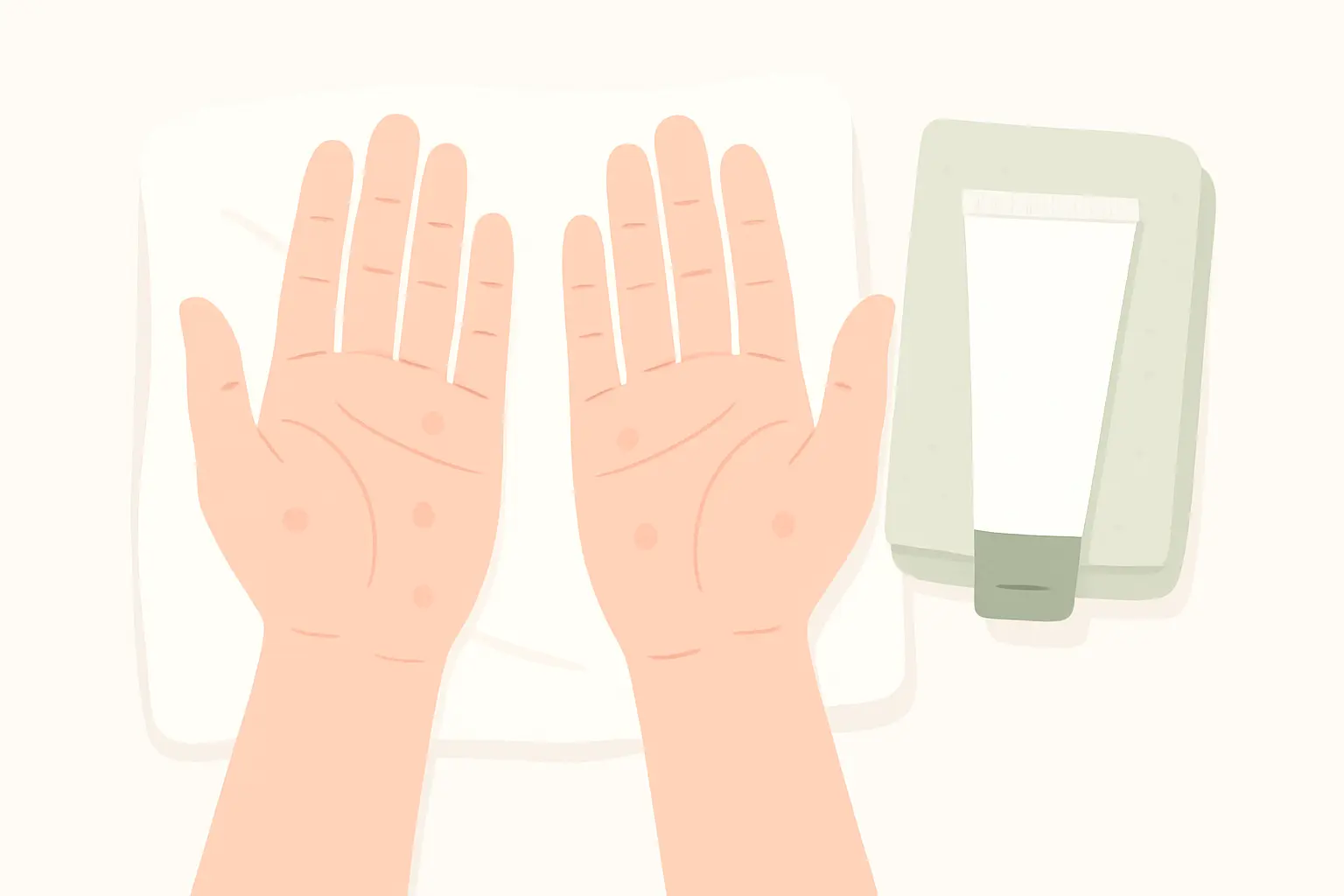
Palmoplantar pustulosis is a chronic, often painful inflammatory condition with sterile pustules on the palms and soles. A 2026 review describes it plainly: women are more frequently affected than men, and smoking is a major trigger. That is stronger language than dermatology usually applies to a lifestyle factor.
The cessation data backs it up. A Korean national cohort of 5,470,955 people, followed over 73.7 million person-years, identified 9,291 cases of palmoplantar pustulosis among 63,538 psoriasis cases overall. Quitters showed a lower risk of developing it than people who kept smoking, and unusually, that protection held up even among quitters who gained weight afterwards, with an adjusted hazard ratio of 0.67 and an interval of 0.57 to 0.79.
One caveat worth raising with your dermatologist rather than reading into: the same review notes that a paradoxical form of palmoplantar pustulosis can appear under biologic therapies, particularly TNF antagonists. Timing matters when working out what triggered a flare.
Why smoking may blunt your treatment
This is the finding most likely to change a decision, because it touches money and waiting lists as well as skin.
A 2020 meta-analysis on smoking and treatment efficacy found that ever-smokers were less likely than non-smokers to show disease improvement six months after starting a biologic agent, with a pooled odds ratio of 0.80 and a confidence interval of 0.67 to 0.95. The authors are explicit that the number of reports was limited and that more work is needed.
So this is a real but modest signal from a thin evidence base, not a reason to expect a biologic to fail. It is, however, a reason to mention your smoking honestly when a systemic treatment is being considered, because the response you get is what determines whether you stay on that drug or cycle to another.
Mechanistically it is plausible. Psoriasis is immune-mediated, smoking alters immune function, and a drug aimed at a specific immune pathway is operating in a system being pushed in another direction. Our overview of immune system recovery covers what is known about how that reverses.
What changes after you quit, and when
Here is where honesty matters most, because the timeline is longer than the one you will read about for lungs and heart.
For the risk of developing psoriasis in the first place, recovery is slow. The Nurses’ Health Study II concluded that risk among former smokers decreases nearly to that of never smokers twenty years after quitting. Twenty years. Every pooled analysis agrees that former smokers sit between current smokers and never smokers rather than snapping back.
For people who quit while already carrying the risk, the Korean national cohort is more encouraging on a shorter horizon. Compared with people who kept smoking, quitters without weight change had an adjusted hazard ratio of 0.85, and quitters who lost weight 0.88. Post-cessation weight gain attenuated the benefit, particularly for plaque psoriasis, but the authors conclude that quitting should be encouraged regardless, with weight management alongside it to get the full effect.
That weight caveat is worth taking seriously rather than worrying about. Our guide to avoiding weight gain when quitting covers the practical side, and the point from the psoriasis data is not that gaining weight cancels the benefit but that managing it makes the benefit larger.
For skin more broadly, the changes arrive much sooner than twenty years. Our skin recovery timeline covers circulation, color and healing, none of which is psoriasis-specific but all of which is happening in the same organ.
Withdrawal, stress and short-term flares
Stress is a recognized trigger for psoriasis flares, and quitting is stressful. It is entirely possible to quit smoking and have a worse few weeks of skin before anything improves.
This catches people out and it costs relapses, so plan for it. A flare in the first month is not evidence that quitting was the wrong call, and it is not the long-term trajectory the cohort data describes. Tell your dermatology team your quit date in advance so that a flare during that window is interpreted correctly rather than triggering a treatment change.
The same applies to any short-lived worsening around week two to four, which is also when nicotine withdrawal peaks for most people. Two things getting harder at once is a scheduling problem, not a verdict.
Quitting alongside your dermatology plan
Treat the quit attempt as part of your psoriasis management rather than a separate project, and the two reinforce each other.
- Tell your dermatologist before you quit, not after. They can interpret a flare correctly and may want to time a treatment change around it.
- Ask specifically about palmoplantar involvement. If pustules on palms or soles are part of your picture, the smoking link is tighter and the cessation benefit larger.
- Use the stop smoking service, not willpower alone. Combination nicotine replacement or a prescription medicine roughly doubles your odds, and nothing about psoriasis rules them out.
- Plan for weight. Not to avoid quitting, but because the psoriasis data suggests managing weight afterward makes the benefit bigger.
- Keep a record of flares against smoke-free days. Six months of that is worth more at a review appointment than any recollection.
Psoriasis sits alongside a set of other conditions that smoking affects, and seeing them together tends to be more motivating than any single figure. Our 11-condition risk view lays that out, and the piece on whether quitting boosts immunity covers the mechanism behind several of them at once.
For the record-keeping part, the free iQuit app is a reasonable fit: you can log cravings with their trigger and intensity, keep a daily mood journal, and see your smoke-free day count in the same place, so a flare and a hard week sit on the same timeline. It also shows disease-risk insights across eleven smoking-related conditions if the wider picture is what keeps you going.
Frequently asked questions
Does smoking cause psoriasis?
It raises the risk rather than causing it outright. A 2026 meta-analysis of 30 studies and more than 25 million participants put the risk among smokers at 1.67 times that of non-smokers, with a positive dose-response relationship. Psoriasis has strong genetic and immune components, and plenty of people who have never smoked develop it (Frontiers in Public Health, 2026).
Will quitting smoking clear my psoriasis?
No. Psoriasis cannot be cured, as the NHS states plainly, and no study shows quitting clears it. What the evidence supports is a lower risk of developing it, a better chance of responding to some treatments, and a particularly clear benefit for palmoplantar pustulosis. Quitting improves your odds; it is not a treatment.
How long after quitting does psoriasis risk drop?
Slowly. The Nurses’ Health Study II concluded that the risk of incident psoriasis among former smokers decreases nearly to that of never smokers twenty years after cessation. Shorter-term cohort data still shows quitters at lower risk than continuing smokers, so the benefit begins well before the twenty-year mark (Nurses’ Health Study II, 2007).
Does smoking make biologics work less well?
A 2020 meta-analysis found ever-smokers were less likely than non-smokers to show improvement at six months on a biologic, with a pooled odds ratio of 0.80 and a confidence interval of 0.67 to 0.95. The authors noted the number of reports was limited. Treat it as a reason to be honest with your prescriber, not a reason to expect failure.
Why is palmoplantar pustulosis different?
It carries the tightest smoking link of any form. A 2026 review describes smoking as a major trigger for it. In a Korean cohort of over five million people, the protective effect of quitting on palmoplantar pustulosis held up even in quitters who gained weight, with an adjusted hazard ratio of 0.67 compared with continuing smokers.
Will my skin get worse when I first quit?
It can. Stress is a recognized psoriasis trigger and quitting is stressful, so a flare in the first few weeks is possible and is not a sign you made the wrong decision. Tell your dermatology team your quit date beforehand so a flare in that window is read as a trigger rather than treatment failure.
Does weight gain after quitting cancel the benefit?
It reduces it rather than cancelling it. In the Korean national cohort, quitters without weight change had an adjusted hazard ratio of 0.85 versus sustained smokers, and post-cessation weight gain attenuated that benefit, particularly for plaque psoriasis. The authors still conclude that quitting should be encouraged, with weight management alongside (JEADV, 2026).
Does secondhand smoke matter for psoriasis?
The Nurses’ Health Study II found that prenatal and childhood exposure to passive smoke was associated with an increased risk of psoriasis. That is a single prospective cohort rather than a pooled body of evidence, so treat it as suggestive. It is still a reason to keep a home smoke-free while children live in it.
Should I use nicotine replacement if I have psoriasis?
Nothing about psoriasis rules out nicotine replacement or prescription stop-smoking medicines, and the combination of medication plus behavioral support gives you the best odds. If you use patches, apply them to clear skin and speak to a pharmacist about placement if plaques cover your usual sites. Your dermatologist and stop smoking service can coordinate.
Put your flares and your smoke-free days on one timeline
iQuit is free on Google Play and the App Store. Log cravings with their trigger and intensity, keep a daily mood journal, and watch smoke-free days, cigarettes avoided and money saved build up, so your next dermatology review has something real to work from.
Download iQuit Free on Google Play Download on the App Store
This article is general information, not medical advice. Psoriasis diagnosis and treatment decisions belong with your doctor or dermatologist. Further reading: NHS guidance on psoriasis.