Searching smoking and prostate cancer usually means one of two things: you have just been diagnosed and want to know if smoking played a part, or you are trying to understand your risk before a PSA test. The honest answer is more nuanced than a simple yes or no — and it still ends in a good reason to quit.
Does smoking cause prostate cancer? The honest answer
Here is the part most articles about smoking and cancer gloss over: prostate cancer is not on the American Cancer Society’s list of cancers smoking is established to cause. That list includes cancers of the mouth, larynx, pharynx, oesophagus, kidney, cervix, liver, bladder, pancreas, stomach, colon and rectum, plus acute myeloid leukaemia. Prostate cancer is not in it.
The American Cancer Society is direct about this: “Most studies have not found a link between smoking and getting prostate cancer.” Reviewing the same body of research separately, neither the National Cancer Institute’s prevention overview nor Cancer Research UK’s risks-and-causes page for prostate cancer lists smoking among the established risk factors for developing the disease — age, family history, race, and certain genetic changes dominate that list instead.
That is genuinely different from lung, bladder, or pancreatic cancer, where the causal evidence is settled. If you are a smoker who has just been diagnosed with prostate cancer, the fairest, most accurate thing to say is: smoking very likely did not cause it to start. What comes next in this article is where smoking’s role becomes much harder to dismiss.
Incidence vs. aggressiveness vs. mortality
The confusion around this topic almost always comes from collapsing three separate questions into one. They are not the same, and the evidence differs sharply between them:
| Question | What the evidence shows |
|---|---|
| Does smoking cause prostate cancer to develop? | Not established — most studies show no clear link (American Cancer Society) |
| Is smoking linked to more aggressive disease at diagnosis? | Global review found smokers had a greater prevalence of aggressive illness |
| Is smoking linked to dying from prostate cancer? | Small increased risk reported, though ACS notes this needs further confirmation |
| Does quitting after diagnosis change survival? | Yes — a measurable survival benefit was found for prostate cancer survivors who quit |
Framed this way, the honest headline is not “smoking causes prostate cancer.” It is: smoking appears to make the disease behave worse once it exists, and quitting measurably helps once you are in treatment.
What the data shows for smokers after diagnosis
A worldwide review of the evidence found that tobacco use remains a substantial factor in prostate cancer progression: smokers were more likely to present with aggressive disease than non-smokers, a pattern seen across multiple countries and study populations, not an isolated finding from one cohort. The review deliberately looked beyond a single country’s data, and noted that tobacco use patterns and prostate cancer risk showed broadly similar directional patterns worldwide, even as the exact magnitude varied by population and by how heavily and for how long people had smoked.
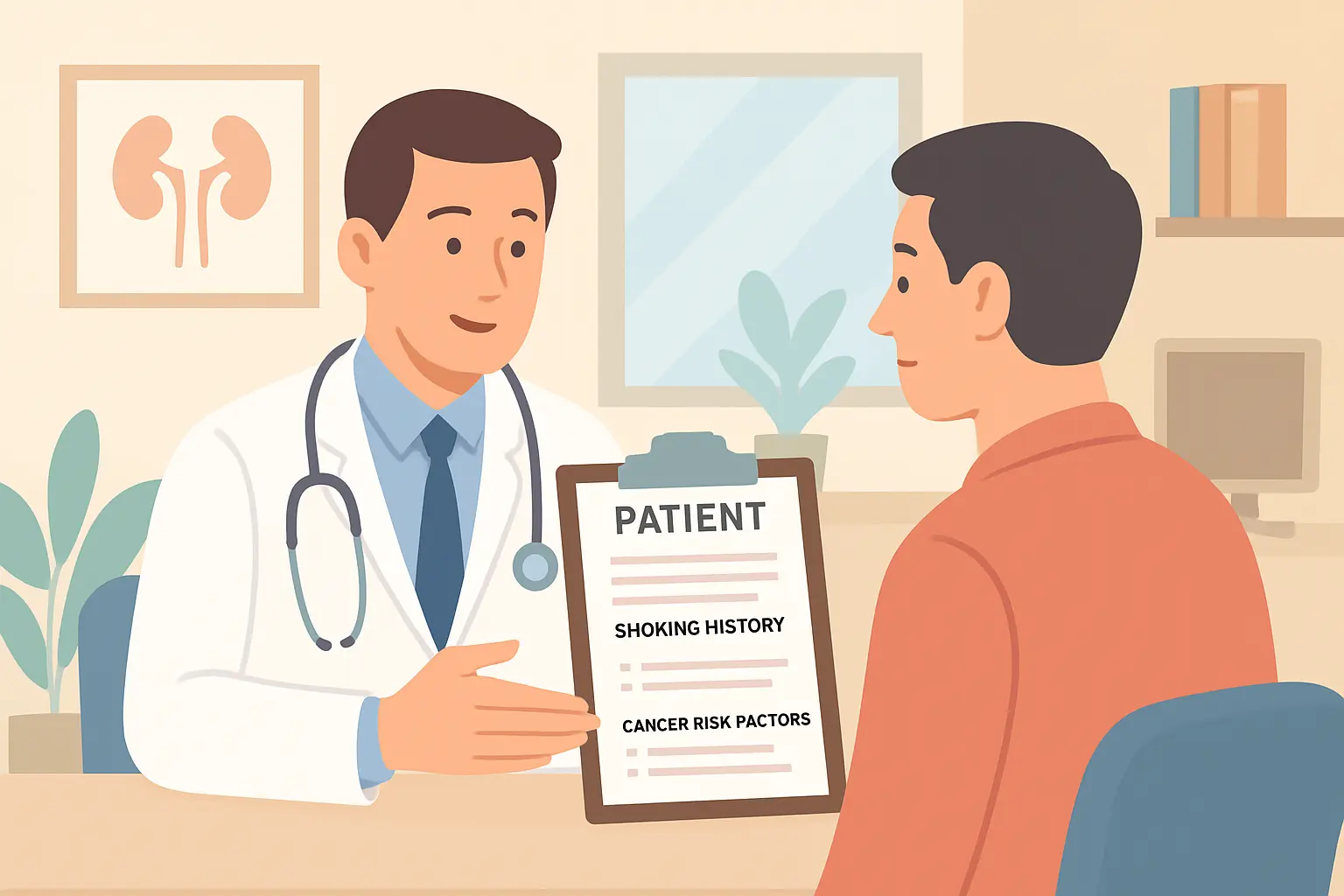
This distinction — risk of getting the disease versus how the disease behaves once you have it — is the single most important thing to take from this topic. It also explains why oncologists ask about smoking history at diagnosis even when they know smoking probably did not start the cancer: it is a modifiable factor that plausibly affects how the disease unfolds from that point forward.
It is worth being honest about the limits here too. Aggressiveness at diagnosis is influenced by dozens of factors — age, genetics, how early the cancer was caught, and the specific tumor biology — and smoking is one contributor among many, not the dominant one. No credible source claims that quitting alone will change a tumor’s underlying grade. What the evidence supports is narrower and still meaningful: smoking history is part of the risk picture your urologist weighs, and it is the one part of that picture you can still change after diagnosis.
Recurrence risk after treatment
The aggressiveness pattern matters most at the treatment stage. More aggressive disease at diagnosis generally carries a higher chance of recurrence after surgery or radiotherapy, which is the practical reason smoking status is now a routine part of a urologist’s pre-treatment conversation rather than a footnote. It is not that smoking is proven to independently cause recurrence in a vacuum — it is that it clusters with the more aggressive presentations that are themselves linked to higher recurrence.
Surgical recovery is another place smoking status genuinely matters, separate from the cancer biology itself. Smoking impairs wound healing and increases the risk of complications after major surgery in general — a well-established finding across surgical specialties, not specific to prostate cancer — which is one of several practical reasons a surgeon may raise quitting before a prostatectomy, alongside anaesthetic risk and post-operative recovery time.
If you are weighing treatment options, this is a fair, specific question for your care team: does my smoking history change which treatment path, or which follow-up schedule, you would recommend? A urologist can also tell you how your case specifically compares against population-level statistics like these, which describe averages across large groups and are not a prediction for any one person.
Does quitting change outcomes, and after how long?
This is where the evidence becomes genuinely encouraging. A large US cohort study using nationally representative survey data linked to death records followed over 8,000 adult cancer survivors. Roughly 1 in 5 cancer survivors who smoked quit within three years of their diagnosis. Compared with those who kept smoking, that group had a meaningfully longer median survival time and a lower overall risk of death — and prostate cancer was specifically named among the cancers where quitting showed a significant survival benefit, alongside lung and breast cancer.
The takeaway is not “quitting cures prostate cancer” — nothing in this research says that. It is that quitting after a cancer diagnosis is one of the few genuinely evidence-backed things a patient can still control, and the data shows it is associated with living longer, not just feeling better.
Smoking and PSA testing
Smoking is not established as something that directly skews a PSA (prostate-specific antigen) reading the way, for example, recent ejaculation or a urinary tract infection can. There is no evidence-based reason to delay or avoid PSA testing because you smoke, and no evidence that quitting shortly before a test changes the result. If you are due a PSA test as part of routine screening, smoking status should not change your decision to have it.
What smoking status does change is the broader risk conversation your doctor has with you around that test — family history, age, ethnicity, and now, increasingly, smoking history as a marker linked to more aggressive disease if cancer is found.
What to discuss with a urologist
If you smoke and are navigating a prostate cancer diagnosis, a PSA follow-up, or simply a family history that puts you at higher risk, these are worth raising directly:
- “Given what we know about smoking and disease aggressiveness, does my smoking history change your recommended follow-up schedule?”
- “If I quit now, is there a survival or recurrence benefit at this stage of my treatment?”
- “Are there other habits — diet, weight, alcohol — you would prioritize alongside quitting?”
It is also worth understanding which cancers smoking is actually established to cause, so you have accurate context for where prostate cancer does and does not fit, and how your overall picture compares using a disease-risk breakdown across 11 conditions linked to smoking.
Two related topics worth reading if you are recently diagnosed or in treatment: how quitting affects erectile function recovery, which many prostate cancer treatments already affect, and, if fertility is a concern for you or a partner, how quitting affects male fertility and sperm recovery. For the conversation itself, how to talk to your doctor about quitting smoking is a practical starting script, and the wider evidence-based health benefits of quitting put this single cancer topic in the context of everything else that improves once you stop.
None of this requires a perfect quit attempt to matter. The survival data described above measured people who quit within a three-year window after diagnosis, not people who never had a single lapse. If you have tried before and it did not stick, that history does not disqualify you from the benefit described here — it simply means today is as good a day as any to try again, ideally with your care team looped in on the timing.
Frequently Asked Questions
Does smoking cause prostate cancer?
Most research has not found a link between smoking and developing prostate cancer in the first place, according to the American Cancer Society. Prostate cancer is not on the list of cancers smoking is established to cause, unlike lung or bladder cancer.
If smoking doesn’t cause prostate cancer, why does it matter?
Because the evidence on aggressiveness and mortality is stronger than the evidence on incidence. A global review found smokers had a greater prevalence of aggressive prostate cancer, and some research links smoking to a small increased risk of dying from the disease (American Cancer Society; Genes and Environment, 2025).
Does quitting smoking after a prostate cancer diagnosis actually help?
Yes — a 2026 US cohort study of over 8,000 cancer survivors found that quitting within three years of diagnosis was linked to longer median survival and lower mortality risk, with prostate cancer specifically named among the cancers showing a significant benefit.
Does smoking affect PSA test results?
Smoking is not established as something that directly alters a PSA reading. There is no evidence-based reason to delay or avoid a PSA test because you smoke, or to expect quitting shortly before testing to change your result.
Is smoking linked to prostate cancer recurrence?
Smoking is not proven to independently cause recurrence, but it clusters with more aggressive disease presentations, which themselves carry higher recurrence risk after treatment. Ask your urologist whether your smoking history changes your recommended follow-up schedule.
What prostate cancer risk factors are actually established?
Age, family history, race, and certain inherited genetic changes are the consistently established risk factors, per both the National Cancer Institute and Cancer Research UK. Smoking is not currently on that core list, though it affects outcomes once cancer is present.
Give treatment the best possible odds
If you are managing a diagnosis, quitting is one of the few things fully within your control. iQuit tracks every smoke-free day so you and your care team can see real progress.
Download iQuit Free on Google Play
Download on the App Store