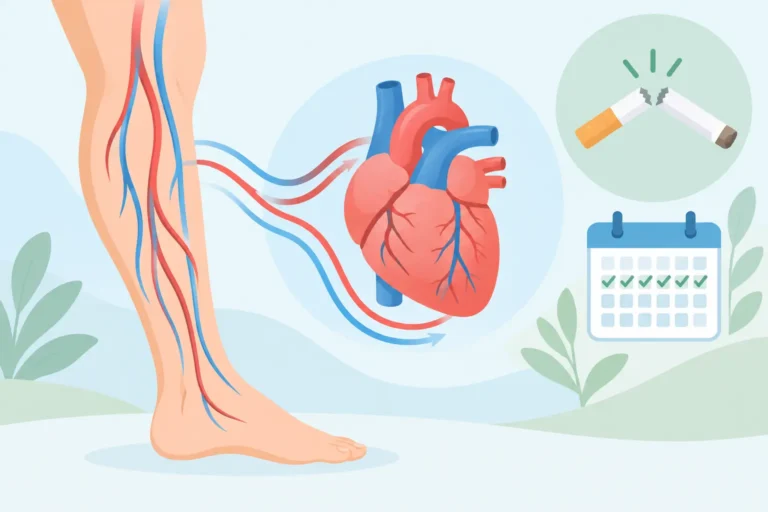
Does quitting smoking improve erectile dysfunction? Yes — smoking damages the blood vessels that supply the penis, and stopping lets that damage partly or fully reverse. Cleveland Clinic notes that men with mild erectile dysfunction can see improvement within several months of quitting. How complete the recovery is depends on your age, how long you smoked, and what other vascular conditions you have.
How does smoking actually cause erectile dysfunction?
An erection depends on healthy blood vessels dilating to fill the penis with blood, a process driven largely by nitric oxide relaxing the smooth muscle in the penile arteries. Smoking directly damages this system: cigarette smoke reduces nitric oxide availability, increases oxidative stress, and raises levels of endothelin, a chemical that constricts blood vessels.
This is endothelial dysfunction, not simply “poor circulation” in a general sense — the lining of the blood vessels themselves becomes less able to relax and dilate on demand. As Cleveland Clinic’s clinical overview of erectile dysfunction puts it, conditions that affect your body’s ability to deliver blood to the penis are the most common cause of ED, and smoking is listed among the risk factors that raise that likelihood.
The penile arteries are also unusually small in diameter compared with, say, the coronary arteries feeding the heart, which is one reason erectile symptoms often appear years before other cardiovascular warning signs become obvious — smaller vessels show the effects of endothelial damage sooner than larger ones do.
How fast does erectile function improve after quitting, and by how much?
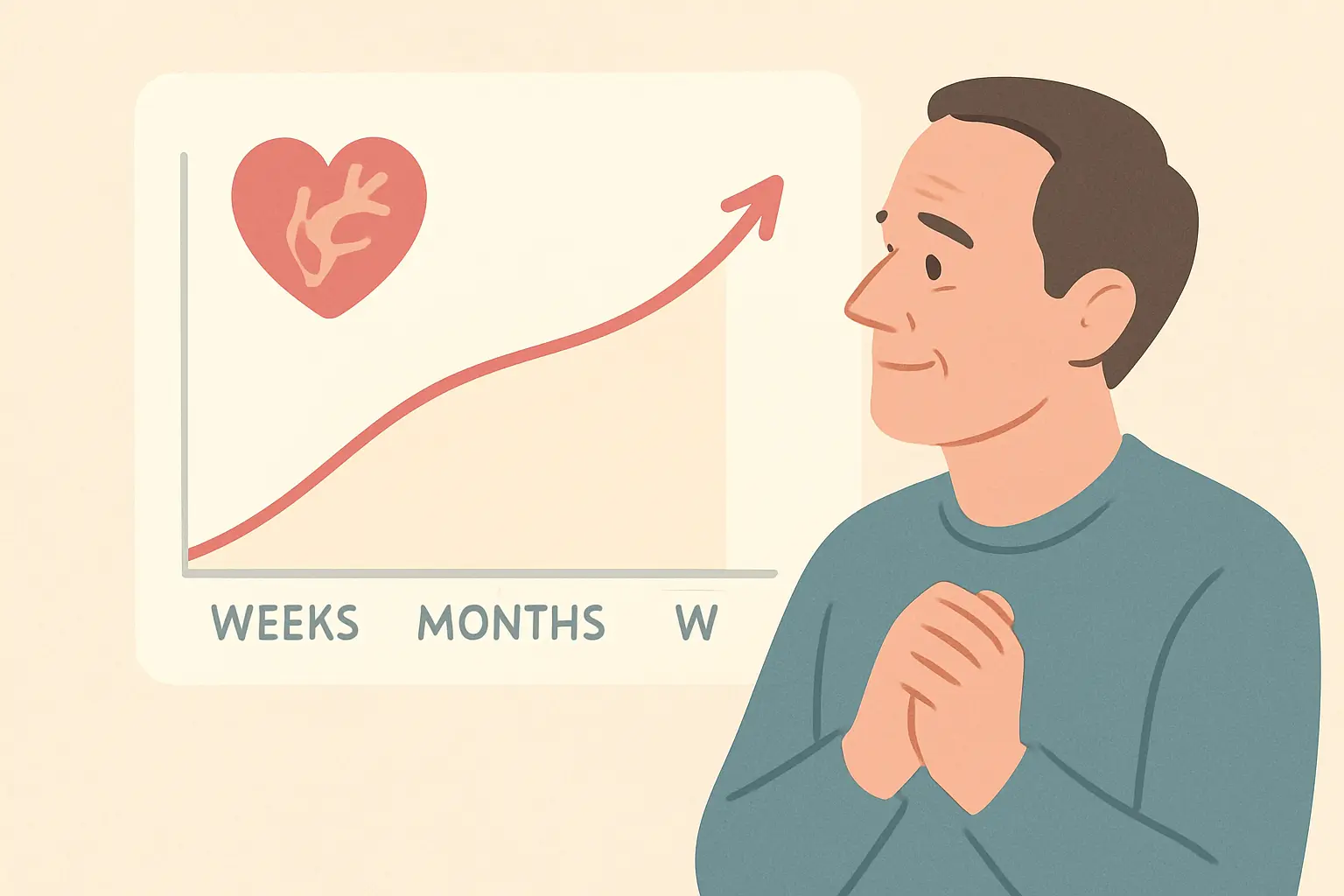
Recovery is measured in months rather than days. Cleveland Clinic states that for men with mild ED, quitting smoking can lead to improvement after several months — the same window in which endothelial function and nitric oxide signaling begin to recover more broadly after the last cigarette.
Prospective research in men with smoking-related ED points the same way: in one clinical study, erectile function had improved in roughly a quarter of the men who successfully quit when they were reassessed a year later, while none of the men who kept smoking showed improvement. Improvement is real and measurable, but it is gradual, partial for some men, and easiest to see in those who quit completely rather than cutting down.
In this Mayo Clinic explainer, a urologist covers the major risk factors behind erectile dysfunction, including smoking.
Does age change the answer?
Yes. Younger men and those with a shorter smoking history tend to see the fastest and most complete recovery, because less permanent vascular damage has accumulated. Long-term heavy smokers may still see meaningful improvement, but some vascular damage does not fully reverse, so recovery may be partial rather than complete.
Existing conditions matter too. Men with high blood pressure, diabetes, or high cholesterol alongside a smoking history tend to see slower or more limited improvement, since smoking compounds vascular injury that those conditions are already causing. That said, quitting still reduces the severity of ED and slows further deterioration at any age, so there is no point at which quitting stops being worthwhile.
Quitting also compounds well with other heart-healthy habits that support the same blood vessels: regular aerobic exercise, a diet lower in saturated fat, and managing blood pressure and blood sugar all support the same nitric oxide pathway that smoking damages. None of these substitute for quitting, but combined with it, they tend to shorten the timeline to noticeable improvement, particularly for men with additional cardiovascular risk factors.
Does vaping or nicotine alone still cause ED?
Yes — this is one of the more surprising findings in recent research. A study published in the American Journal of Preventive Medicine, analyzing US national survey data, found that men who vaped nicotine daily were roughly twice as likely to report erectile dysfunction as men who had never used e-cigarettes, after adjusting for age and cardiovascular risk factors.
Nicotine itself constricts blood vessels regardless of delivery method, and the association appears to strengthen with heavier use — meaning dual use of cigarettes and vapes compounds vascular strain rather than reducing it. This matters for anyone assuming that switching to vaping solves the problem: on this particular risk, it largely does not.

What if erectile function doesn’t improve after quitting?
If ED persists well beyond the typical recovery window, it’s worth having it evaluated rather than assuming quitting simply didn’t work. Cleveland Clinic is direct about why: in many cases ED can be the first symptom of another underlying problem, including heart disease, and is worth raising with a healthcare provider. Diabetes, hormonal imbalances, medication side effects, and psychological factors like stress or anxiety can all contribute independently of smoking history.
When to see a doctor: If ED is sudden, severe, or persists for more than a few months after quitting, or if it comes with chest pain, unusual fatigue, or other cardiovascular symptoms, see a doctor rather than waiting it out — it can be a useful early signal worth investigating, and effective treatments exist regardless of the cause. Never stop taking a prescribed medication because you suspect it is contributing to ED without first talking to the prescribing clinician.
Does ED medication still work while you smoke?
PDE5 inhibitors such as sildenafil and tadalafil still work pharmacologically in men who smoke. What smoking changes is the tissue these drugs act on: they work by amplifying nitric oxide signaling in the penile arteries, and smoking is precisely what degrades that signaling, so many smokers get a weaker functional response than non-smokers on the same dose.
Quitting doesn’t just help unmedicated erectile function — it improves the vascular environment that PDE5 inhibitors rely on to work well in the first place, which is why urologists frequently raise smoking cessation alongside an ED prescription rather than instead of one. Dosing decisions should always come from your prescribing clinician, not from an assumption that smoking calls for a higher dose.
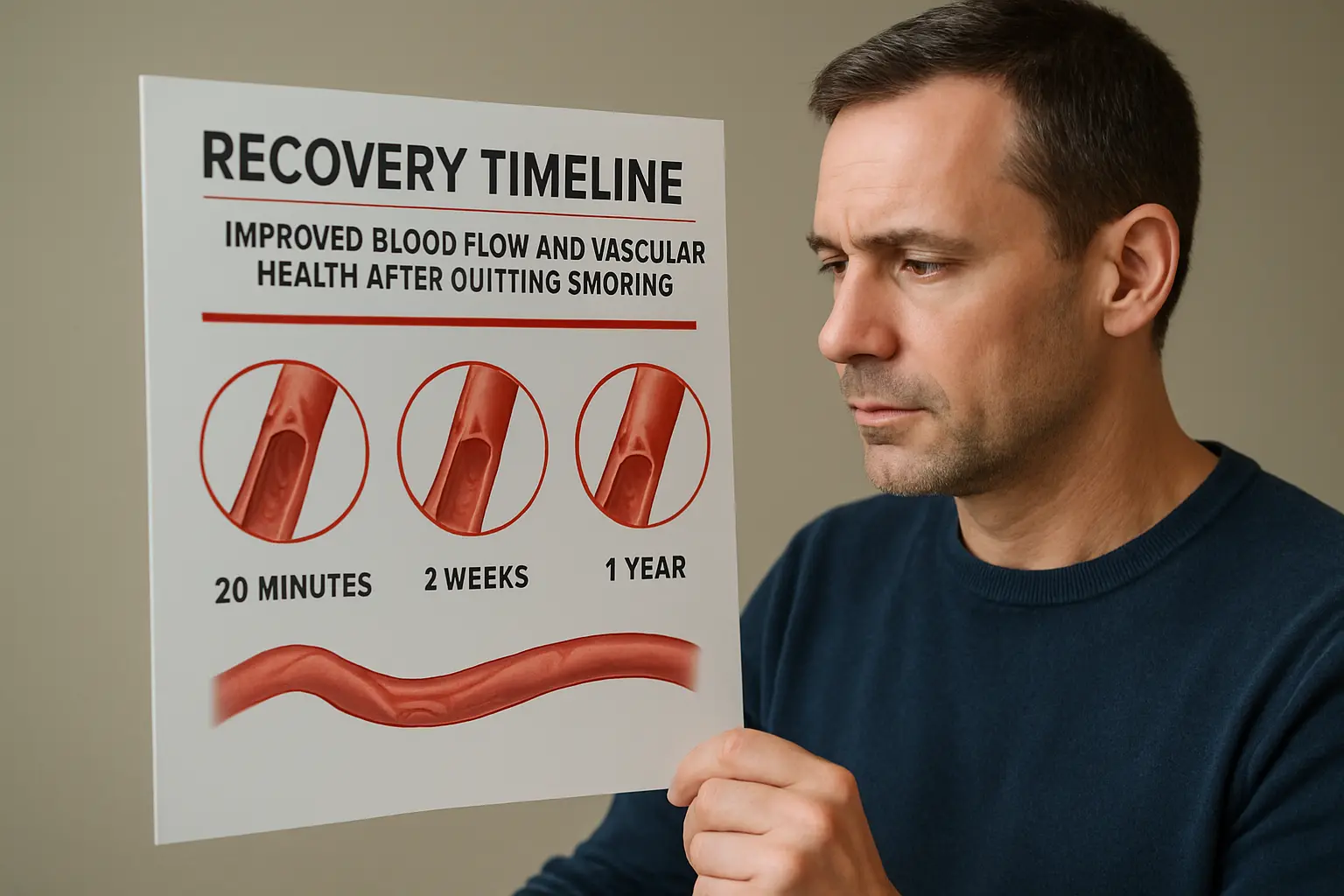
Recovery timeline at a glance
| Time since quitting | What typically improves |
|---|---|
| First days | Carbon monoxide clears and circulation begins to normalize; no erectile change expected yet |
| 2–4 weeks | Endothelial function starts recovering; some men notice early changes in erection quality |
| 2–3 months | Nitric oxide signaling continues recovering; Cleveland Clinic notes improvement in mild ED around this several-month window |
| 6 months | Clearer, more consistent improvement for many men, especially younger quitters with shorter smoking histories |
| 12 months | Continued improvement in a meaningful share of ex-smokers; long-term heavy smokers may plateau at partial recovery |
This recovery sits alongside everything else your body repairs after quitting — see what happens to your body when you stop smoking and, specifically for circulation, how circulation recovers after quitting, both of which track the same vascular healing process happening elsewhere in the body at the same time. Blood pressure, another major driver of vascular and sexual health, follows a similar arc — see blood pressure changes after quitting for specifics.
For men planning a family, it’s also worth knowing that smoking’s vascular and cellular damage extends to fertility — smoking, fertility and conception covers the sperm-quality evidence in more depth. And the app-based tools that help with cravings and consistency, including iQuit’s health-milestone tracker, work just as well whether your motivation is heart health, breathing, or this particular recovery — a full organ-by-organ recovery after quitting guide shows how it all connects, and if you’re one month in already, your 30-day smoke-free milestone is a good next check-in point.
Two other physical recoveries worth tracking alongside this one: breathlessness after quitting often improves on a similar few-month curve, and a lung age test can give you a concrete number for how much your overall vascular and respiratory age has already started to reverse. For the broader clinical picture on stopping, the NHS quit smoking hub sets out the support and medications available.
Frequently Asked Questions
Does quitting smoking reverse erectile dysfunction completely?
For many men, especially younger smokers with a shorter history, quitting can lead to substantial recovery of erectile function over months. Long-term heavy smokers may see meaningful but partial improvement, since some vascular damage does not fully reverse. Cleveland Clinic notes that men with mild ED can improve within several months of quitting.
How long after quitting smoking does ED improve?
Think in months rather than days. Endothelial function begins recovering in the first weeks, and Cleveland Clinic reports improvement in mild ED after several months of being smoke-free. Gains often continue through the first year, particularly in younger men and those who quit completely rather than cutting down.
How exactly does smoking cause erectile dysfunction?
Smoking damages the endothelium, the inner lining of blood vessels, reducing nitric oxide availability and increasing oxidative stress and endothelin, a vessel-constricting chemical. Since erections depend on blood vessels relaxing and filling the penis with blood, this endothelial damage directly impairs erectile function, and the risk rises with how much and how long a person smokes.
Does vaping cause erectile dysfunction the same way smoking does?
Research published in the American Journal of Preventive Medicine found that men who vaped nicotine daily were roughly twice as likely to report erectile dysfunction as never-users, after adjusting for age and cardiovascular risk. Nicotine constricts blood vessels regardless of how it is delivered, so switching from smoking to vaping does not remove this particular risk.
Do ED medications work less well in smokers?
PDE5 inhibitors work by amplifying nitric oxide signaling, and smoking is exactly what degrades that signaling, so many men who smoke get a weaker functional response than non-smokers on the same dose. Quitting improves the vascular environment these medications depend on. Any dose change should come from your prescribing clinician.
Is erectile dysfunction a warning sign of heart disease?
It can be. Cleveland Clinic notes that in many cases ED is the first symptom of another underlying problem, including heart disease, because the same small blood vessels are affected in both. That is why persistent ED is worth raising with a healthcare provider rather than treating as a private, isolated issue.
Is it too late to quit if I’ve smoked for decades?
No. While long-term heavy smokers may see more partial than complete recovery, quitting at any age reduces ED severity and slows further vascular deterioration. There is no point in a smoking history after which quitting stops improving erectile and overall vascular health.
Does quitting smoking also help with sperm quality and fertility?
Yes, alongside vascular recovery, quitting smoking improves several measures of sperm quality that cigarette toxins damage, including motility and DNA integrity. This runs on a broadly similar recovery timeline to other tissue-level improvements after quitting.
Can nicotine replacement therapy cause erectile dysfunction while I quit?
Nicotine does constrict blood vessels, but NRT delivers it at far lower peak levels than smoking and without combustion toxins, and it is used for a limited period. The net vascular effect of quitting with NRT is strongly favorable compared with continuing to smoke. If you have concerns, a pharmacist or doctor can advise on the right product for you.
Track this recovery alongside every other milestone
iQuit’s 15 health milestones show your progress from 20 minutes smoke-free through years of recovery, with craving tools and a private, judgment-free coach to help you stay consistent while your body heals.