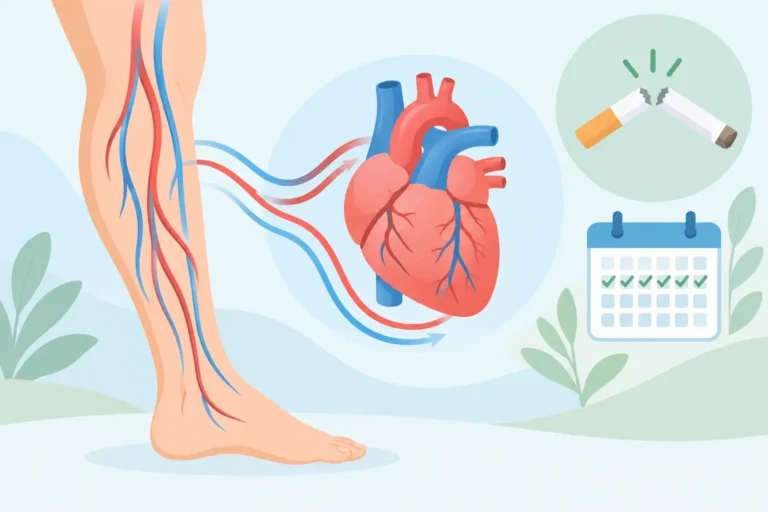
A surgeon has told you a date, and now you’re asking the practical question: stop smoking before knee or hip replacement — how long, exactly, do you need? There’s no single universal number, but there is a well-evidenced range, a clear mechanism for why it matters, and real data on what it changes.
How Long Before a Joint Replacement Should You Stop?
The most consistent, specific figure comes from patient guidance published by the American Association of Hip and Knee Surgeons (AAHKS), which covers both procedures with the same recommendation: quitting four to six weeks before surgery and continuing for four weeks after can reduce the risk of complications by up to 50%. That same figure and wording appears on their knee replacement guidance too.
Other sources describe somewhat longer or shorter windows, and your own surgeon’s number may differ based on your specific risk profile, how heavily you smoke, and their own protocol. Treat 4–6 weeks as the well-evidenced baseline to ask about, not a number to self-diagnose against — if your surgery is sooner than that, quitting for any amount of time before it is still worthwhile, and every additional smoke-free week appears to help.
Why Surgeons Ask: Infection, Healing, Fixation, Revision
This isn’t a lifestyle lecture — it’s tied to specific, measured surgical risks. A nationwide Japanese database study matched 52,551 smokers to an equal number of non-smokers having hip replacement and found smoking was associated with a meaningfully higher risk of early postoperative infection: an odds ratio of 1.31, meaning about 31% higher odds (cohort study, 2026). AAHKS explains the underlying mechanism plainly: “toxins in cigarette smoke affect the body’s inflammatory response, which in turn affect the body’s ability to heal,” while carbon monoxide and nicotine reduce how well blood carries oxygen to healing tissue.
For a joint replacement specifically, that reduced healing capacity matters in a way it might not for other surgeries: the implant needs surrounding bone and tissue to heal well enough to hold it securely (fixation), and a slow-healing wound is a more vulnerable entry point for the infections that can require a second, more complex revision surgery to fix. That’s the direct line from “stop smoking” to “your new joint stays in place and infection-free.”
Will They Cancel Your Operation?
Policies vary by hospital and surgeon, and some centers do use pre-operative smoking status as a factor in scheduling elective joint replacement, particularly where local protocols set a minimum quit period or require a negative cotinine or carbon monoxide test. This is not universal, and it isn’t something this article can confirm for your specific hospital — the only reliable answer is to ask your surgical team directly whether their policy requires a documented quit period, and if so, for how long and how it’s verified.
Whether or not cancellation policy applies to you, the clinical case for quitting stands on its own: the infection-risk data above applies regardless of whether your particular hospital enforces a rule about it.
A few things are worth doing early, whether or not your hospital has a formal policy:
- Tell your surgical team your current smoking status honestly at your first pre-operative appointment, not closer to the date. Earlier disclosure gives more time to plan around it.
- Ask specifically whether they test for nicotine or cotinine before surgery, and if so, what the cutoff and timeline are.
- Set your quit date working backward from surgery, aiming for the 4–6 week window if your timeline allows it.
- Ask what NRT policy applies at your specific hospital, since this varies (see below).
What 4 Weeks vs 8 Weeks Changes
The honest answer is that the exact dose-response curve — precisely how much extra benefit 8 weeks buys over 4 — isn’t cleanly established in a single study for joint replacement specifically. What is consistent across the sourced evidence is a “more is better, and there’s a meaningful floor” pattern: AAHKS names 4–6 weeks before surgery as the threshold tied to the roughly 50% complication-risk reduction, and continuing for 4 weeks after as part of that same recommendation.
If your surgery date gives you 8 weeks or more instead of the minimum 4–6, there’s no evidence that stopping earlier than necessary causes any downside — if anything, a longer smoke-free run before surgery gives your body more time to partially recover the oxygen delivery and inflammatory-response capacity that smoking impairs, and it’s also simply a longer head start on staying quit for good. If your surgery is inside 4 weeks, don’t treat that as a reason not to bother — the direction of benefit still points the same way even on a compressed timeline; ask your surgical team what they’d like you to prioritize given the time you have.
| When | What to focus on |
|---|---|
| As soon as surgery is scheduled | Tell your surgical team your smoking status; set a quit date |
| 4–6 weeks before surgery | The AAHKS-cited window associated with up to 50% lower complication risk |
| Day of surgery | Disclose any NRT use to anesthesia; follow their specific instructions |
| 4 weeks after surgery | Continue smoke-free through this window — healing relevant to infection and fixation is still ongoing |
| Through rehab (weeks to months) | Treat staying quit and completing physical therapy as one connected goal |
Using NRT Right Up to and After Surgery
A specific, common worry is whether nicotine replacement therapy (patches, gum, lozenges) is safe to use through the surgery itself, given that nicotine does have some vasoconstrictive effects of its own. This is a question for your anesthesia and surgical team specifically, since practice varies and some centers pause certain NRT forms for a short window immediately around the operation while others continue them through the perioperative period — the safest approach is to disclose your NRT use during pre-operative assessment and follow your team’s specific instructions rather than guessing.
What’s clear from the broader evidence is that NRT is a far smaller and better-characterized risk than continuing to smoke: the same toxin-driven inflammatory and oxygen-delivery problems that raise infection risk come overwhelmingly from the combustion products in cigarette smoke, not from nicotine alone. Stopping the cigarettes is the priority; how you manage the withdrawal around the surgery date is a conversation to have with your surgical team.
Pain Relief and Smoking After the Operation
The recovery period is a genuinely hard time to stay quit — you’re in pain, sleep-deprived, and out of your normal routine, all classic relapse triggers. It’s also exactly the window AAHKS’s guidance covers with its “continue for four weeks after” recommendation, because the healing that matters for implant fixation and infection prevention keeps happening well past the day of surgery.
If you’re relying on prescription pain medication after surgery, that’s a separate conversation to have with your surgical team about interactions and timing — this article doesn’t cover dosing. What is relevant here is that nicotine withdrawal and post-surgical pain can compound each other, so having a plan (NRT, support, distraction strategies) for the recovery window specifically, not just the pre-surgery weeks, meaningfully improves your odds of staying smoke-free through the period that matters most for healing.

Staying Quit Through Rehab
Physical therapy is where a hip or knee replacement’s success actually gets built — the implant is only half the outcome, and how well you rebuild strength and range of motion depends on consistent participation over weeks. Nicotine withdrawal fatigue and cravings can make it tempting to skip sessions or push through pain differently than you would smoke-free, so treating your quit attempt and your rehab plan as one connected effort, not two separate projects, tends to work better than treating them separately.
This surgery is also a useful moment to look at your other risk factors together. If bone health is part of your picture — common in candidates for joint replacement — see smoking and bone density for how smoking affects the bone your new implant relies on. For the general pre-surgery picture beyond joint replacement specifically, the site’s full pre-surgery quitting guide covers other procedure types, and if a dental procedure is also on your calendar, stopping smoking before a dental implant has its own specific timing considerations. If you’re also managing leg circulation concerns, smoking and peripheral artery disease covers a related vascular risk that shares some of the same mechanisms.
Whatever specific number your surgeon gives you, having the conversation matters more than guessing — see how to talk to your doctor about quitting smoking for a practical way to raise it, and the evidence-based health benefits of quitting for everything quitting changes beyond this one surgery.
Frequently Asked Questions
How many weeks before knee or hip replacement should I stop smoking?
AAHKS patient guidance recommends stopping 4–6 weeks before surgery and continuing for 4 weeks after, which is associated with up to a 50% lower risk of complications. Confirm the exact number with your own surgical team, since protocols vary.
Does smoking increase infection risk after joint replacement?
Yes. A study matching 52,551 smokers to non-smokers having hip replacement found smoking was associated with about 31% higher odds of early postoperative infection.
Will my surgeon cancel my joint replacement if I still smoke?
It depends on the hospital and surgeon; some centers set a minimum documented quit period for elective joint replacement and some don’t. Ask your surgical team directly about their specific policy.
Is nicotine replacement therapy safe to use around joint replacement surgery?
This should be confirmed with your anesthesia and surgical team, since practice on pausing or continuing NRT around the operation date varies by center. Disclose your NRT use during pre-operative assessment.
What happens if I only have 2 weeks before my surgery?
Quitting for any amount of time before surgery is still worthwhile even if it’s less than the 4-6 week benchmark — ask your surgical team how to prioritize your remaining time.
Does smoking affect how well the implant fixes to the bone?
Smoking impairs the inflammatory and healing response and reduces oxygen delivery to tissue, both of which are relevant to how well surrounding bone and tissue integrate with a new implant, according to orthopedic patient guidance from AAHKS.
Give Your New Joint the Best Start
A surgery date is a real, dated reason to quit — and the highest-intent moment you’ll get. iQuit tracks your smoke-free days through the weeks before surgery and the recovery that follows.
Download iQuit Free on Google Play
Download on the App Store