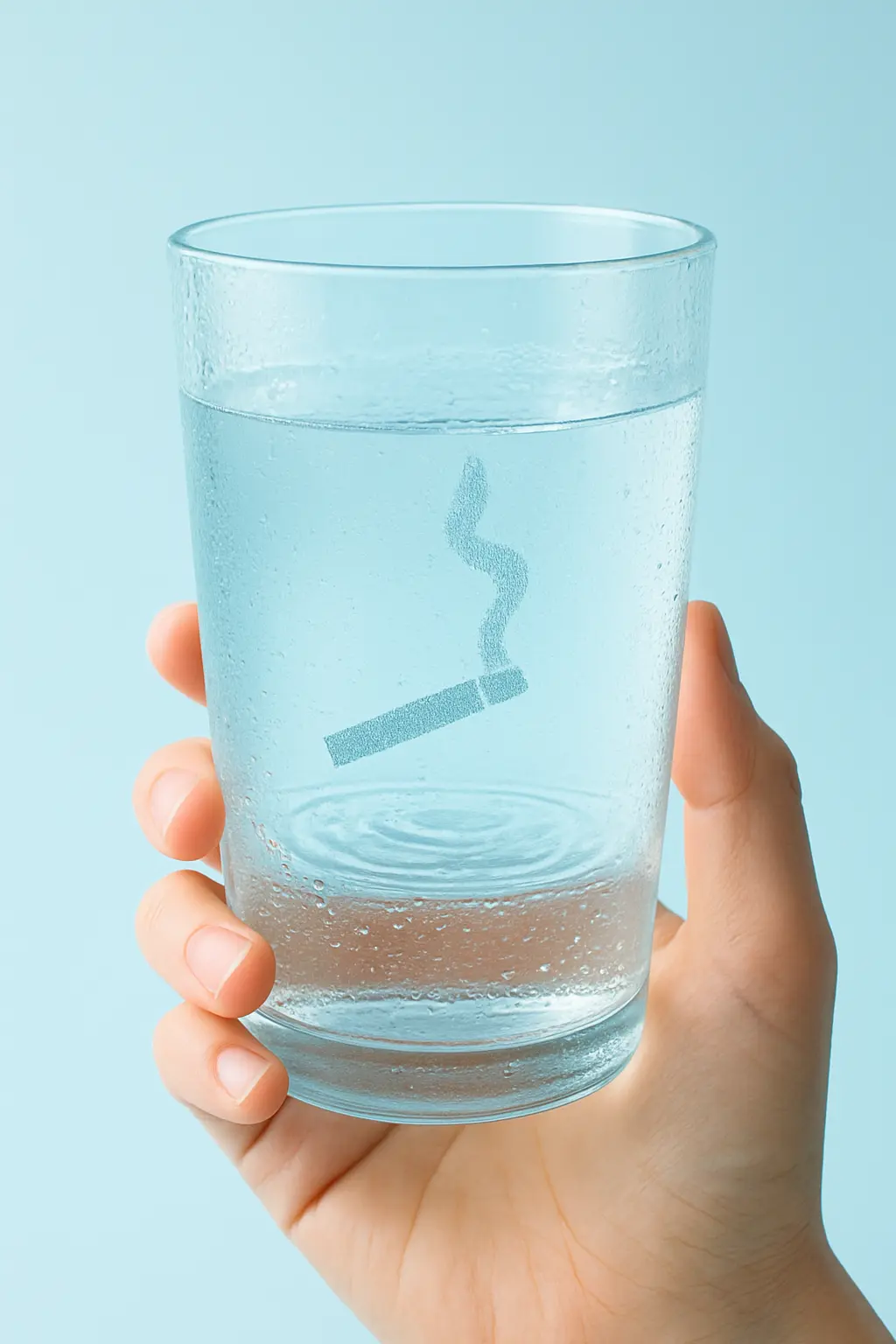
Every quit guide lists “drink water” and every reader skips it — which is a shame, because it’s the most mechanically over-performing item on the list. A slowly-sipped glass hits a craving from four directions simultaneously: it occupies the mouth and hands your ritual trained, it buys the delay that outlasts the urge’s peak, it corrects the dehydration that quietly amplifies withdrawal, and it acts as a diagnostic that unmasks cravings pretending to be hunger. Four mechanisms, zero cost, available everywhere. Here’s why it works better than it sounds.
Mechanism 1: the mouth and hands
Half of what you miss is choreography — hand to mouth, something held, something drawn in. A bottle or glass answers all three (which is why “hold your drink in your smoking hand” is such a reliable trick on a night out). Sip slowly and deliberately, not gulped: the pacing is the point, and it’s the same substitution logic behind the whole hand-replacement toolkit.
Mechanism 2: the delay engine
Cravings peak in 3–5 minutes. A glass of water sipped properly takes two to three — a delay disguised as an activity, which beats staring at a clock. It’s the “Drink water” and “Delay” of the classic 4 Ds collapsing into a single move.
Mechanism 3: the dehydration multiplier
Here’s the underrated part. Mild dehydration produces fatigue, headache, poor concentration and irritability — precisely the withdrawal symptoms you’re already fighting. Early quitters are frequently dehydrated (routines disrupted, coffee up, sleep bad), stacking dehydration symptoms on top of nicotine withdrawal and attributing the whole miserable sum to quitting. Rehydrating removes a layer you didn’t know was there. It’s also why the morning glass — before coffee — is the single highest-value water of the day: after eight dry hours, it blunts the wake-up craving at its loudest.
Mechanism 4: the honesty test
Post-quit appetite runs high and cravings routinely disguise themselves as hunger. Water first, then wait three minutes: real hunger persists and grows; a craving-in-costume peaks and fades. One glass, and you know which enemy you’re fighting — the test at the heart of the post-quit hunger guide.
Making it automatic
- Bottle within arm’s reach at all times — desk, car door, bedside, bag. Availability is the whole strategy; a glass in the kitchen you’d have to walk to loses to a craving every time.
- Pair it with the old cues: after meals, on the commute, at break time, when the phone rings. The cue fires, the water answers.
- Warm counts too. Evening cravings often want comfort more than distraction — a mug of herbal tea held in both hands mimics the ritual’s warmth beautifully, which is why so many ex-smokers become tea people.
- Log it. Note in the free iQuit app which cravings the water beat — most quitters are surprised how high the simplest tool’s success rate scores in their own data.
FAQ
Does water really help cravings?
Yes — four mechanisms at once: ritual substitution, delay, dehydration correction, and exposing fake hunger.
How much should I drink?
Regularly rather than to a fixed target: at every craving and every old smoking cue, bottle always within reach.
Cold or warm?
Cold for distraction and alertness; warm for evening comfort and ritual mimicry. Both work.
Does water flush out nicotine faster?
Modestly — it supports kidney clearance of metabolites, but the 72-hour timeline is mostly fixed. Its craving benefits are the real payoff.
Simplest tool, tracked properly: download iQuit free on Google Play.