
If nicotine has moved from your cigarettes into a small white pouch under your lip, you have probably already noticed that Zyn, Velo, and on! are not identical products sold under different names. They differ in strength labeling, flavor range, and — a fact that surprises most buyers — regulatory status with the FDA. This guide compares the three brands honestly, then points toward the exit rather than toward buying more.
The three brands at a glance
Zyn is made by Swedish Match, part of Philip Morris International. Velo is a British American Tobacco brand. On! (styled “on!”) is made by Helix Innovations LLC, owned by Altria. That means each of the three biggest names in nicotine pouches is backed by one of the world’s largest tobacco companies — this is not a category of independent startups, but a new product line from the same corporations that make cigarettes, which is worth keeping in mind when reading any brand’s own marketing about “cleaner” or “safer” nicotine.
All three make small, spit-free, tobacco-leaf-free nicotine pouches you tuck between your gum and lip, and all three are sold in multiple flavors and multiple nicotine strengths within their own product lines. Unlike cigarettes or vapes, there is no smoke or vapor at all — the pouch simply sits in place while nicotine is absorbed through the gum tissue, which is part of why these products can be used in places smoking and vaping cannot, and part of why they can be easy to use more discreetly and more often than either of those older habits.
If you already know pouches are where you ended up after trying to move away from cigarettes, our earlier piece on whether pouches are a safe way to quit smoking covers that broader safety question; this article focuses specifically on how the three biggest brands differ from each other.
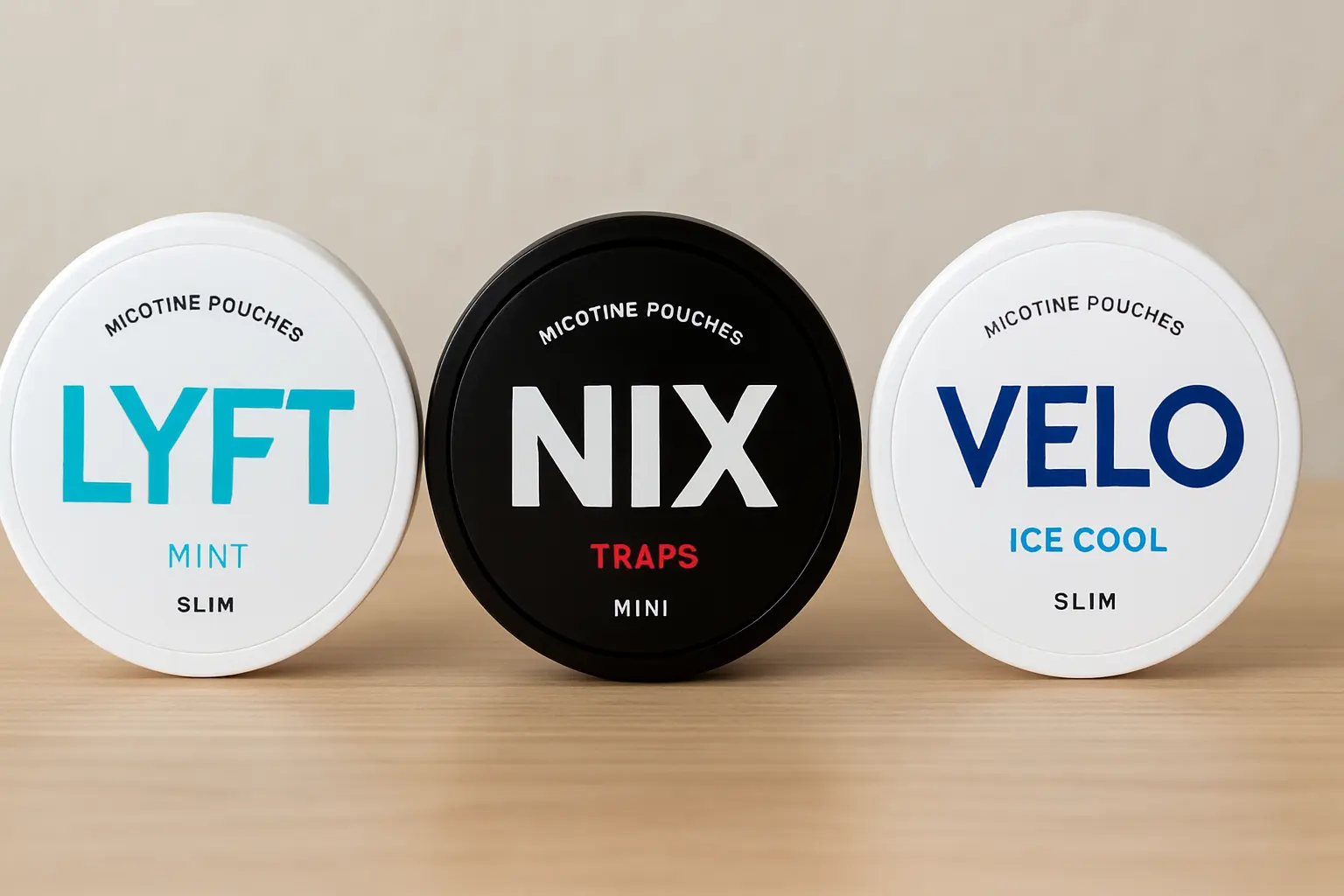
Nicotine strengths compared
Zyn’s own site confirms its core lineup is available in “3 mg and 6 mg,” with a separate “Ultra” line offering “9 mg and 11 mg strengths, and 20 pouches per can” for people who want a stronger hit. That gives Zyn a four-strength range across its two product families as of this check.
Velo and on! also sell multiple strength tiers, generally following a similar low-to-high pattern across the category, but this session could not verify their current specific strength lineups directly — both brand sites returned connection errors during research, and third-party retailer pages did not expose static strength data. Strength labeling and can sizes also change between markets and over time, so the reliable way to compare Velo or on! strengths against Zyn’s confirmed 3/6/9/11 mg range is to check the actual mg number printed on the specific can in front of you, not a number from memory or an old review.
Pouch size, format and feel
All three brands make a “mini” or slim format alongside a regular-size pouch, aimed at people who want a less noticeable bulge under the lip. Zyn’s Ultra format specifically markets itself on “comfort” and “convenience” alongside its higher strength, suggesting format and strength are often bundled together in a single product line rather than sold as fully independent choices — buying the “mini” version of a brand does not necessarily mean buying the lowest available strength.
Flavor range is another area where the brands compete heavily, with mint, citrus, coffee, cinnamon, and fruit variants common across all three, and each brand periodically retiring and launching new flavors. Flavor does not affect the nicotine dose in a pouch — a mint pouch and a citrus pouch at the same labeled strength deliver the same amount of nicotine — so flavor is purely a preference decision, not a strength decision, and shouldn’t be confused with one when you’re comparing cans at the counter.
Houston Methodist covers the documented side effects of nicotine pouches generally — relevant regardless of which of the three brands you’re comparing, since the side-effect profile comes from the nicotine itself, not the brand name on the can.
Regulatory status: FDA authorization compared
This is the most genuinely differentiating fact between the three brands, and it is not marketing — it is a matter of public record. The FDA keeps an official, continuously updated list of every authorized nicotine pouch product; checked directly on 2026-09-19, the FDA’s own authorized-products list, dated 08/21/2026, states plainly: “There are 43 nicotine pouch products authorized by the FDA.” Both Swedish Match USA (Zyn) and Helix Innovations LLC (on!) appear on that list. Velo does not appear anywhere on it.
Separately, the FDA’s June 30, 2026 announcement states: “the U.S. Food and Drug Administration (FDA) issued modified risk granted orders to Swedish Match USA, Inc. for 20 ZYN nicotine pouch products,” and at that time “FDA has authorized 26 nicotine pouch products” overall. Twenty of the currently authorized Zyn products may legally carry a specific modified-risk claim about lower comparative risk versus cigarettes — a claim that applies only to those named products, not to nicotine pouches as a category and not to any other brand. On!’s own authorizations came later: an FDA announcement dated August 4, 2026 confirms four more on! products (Rich Berry 2 mg, Cappuccino 2 mg, Cappuccino 4 mg, and Autumn Spice 2 mg) received marketing authorization, made by Helix Innovations LLC.
Velo, by contrast, does not currently hold a marketing authorization on the FDA’s own list checked above; the FDA has also issued warning letters over unauthorized Velo Mini listings at retail. A marketing granted order is not the same thing as the FDA declaring a product safe or endorsing it for quitting smoking — it means the FDA determined that authorizing the sale of that specific product is “appropriate for the protection of public health” compared with the counterfactual of it being sold without authorization, a narrower and more technical bar than “safe” or “approved.”
None of this changes the core picture: a nationwide Truth Initiative study found that “the rate of pouch-driven initiation among nicotine-naive respondents aged 15–30 years more than doubled between 2021 and 2024,” specifically naming “oral pouches like Zyn, On!, and Velo” as the products driving that trend, published in the American Journal of Public Health. FDA marketing authorization is about comparative risk for existing users switching from cigarettes — it is not a statement that any of these three products is a safe way to start using nicotine, and none of them should be treated as a starter product by someone who wasn’t already using tobacco or nicotine.

Which is hardest to quit, and why strength matters
There is no published brand-by-brand ranking of “hardest to quit,” and it would be dishonest to invent one. What is well established is that higher nicotine strength and higher use frequency both make dependence more likely and withdrawal more uncomfortable regardless of brand — so a person using Zyn Ultra at 11 mg several times a day is likely to have a harder taper than someone using a 2–3 mg pouch of any brand occasionally. The strength printed on your specific can, and how many you use per day, matters far more to how hard quitting will be than which of the three companies made it.
Switching brands vs stepping down
Switching from one brand to another at a similar or higher strength does not reduce your nicotine intake — it just changes which company you’re buying from. This matters because “switching brands” can feel like progress when it isn’t: someone who moves from a 6 mg Zyn to an unverified higher-strength Velo or on! pouch because it was on sale, or because a friend recommended it, may end up increasing their nicotine intake while believing they made a neutral swap.
If your goal is actually to use less nicotine over time, the meaningful move is stepping down in strength within a consistent routine (for example, moving from an 8–9 mg range down toward 2–3 mg over a period of weeks) or reducing how many pouches you use per day, not brand-hopping. Sticking with one brand and one strength while you reduce frequency is usually easier to track honestly than juggling multiple brands and strengths at once, since it removes one variable from an already difficult process. For a full taper approach built specifically around this category, see how to quit nicotine pouches: a taper plan.
How to get off pouches entirely
If you’re ready to stop rather than switch, a structured plan beats willpower alone. Track how many pouches you actually use per day for a week before changing anything — most people underestimate their own count. From there, a gradual step-down in either strength or frequency, or a firm quit date with a cold-turkey approach, are both legitimate paths depending on how dependent you are; our taper plan guide covers the gradual route in detail. For context on how pouches compare with vaping if you’re weighing which nicotine source to tackle first, see nicotine pouches vs vaping, and if you’re curious how pouches relate to older oral tobacco products, what is snus, and is it safer than smoking explains the distinction. For current pouch usage data across the category, see our nicotine pouch statistics page, and if you’d rather have a dedicated app track your specific taper, see using an app to quit Zyn and track a pouch taper.
Track pouches the same way you’d track cigarettes
iQuit logs your daily count and cravings whether your nicotine source is a cigarette, a vape, or a pouch — and shows the money you’re no longer spending as the count drops. It’s free on both app stores.
Download iQuit Free on Google Play Download on the App Store
Frequently Asked Questions
Is Zyn, Velo, or on! the strongest nicotine pouch?
Zyn’s confirmed range tops out at 9-11 mg in its Ultra line. Velo and on! strength lineups vary and should be checked on the specific can, since this could not be verified live for those two brands.
Has the FDA approved Zyn, Velo, and on!?
Zyn and on! both appear on the FDA’s own list of 43 authorized nicotine pouch products, checked 2026-09-19 (list dated 08/21/2026). Velo does not appear on that list. A marketing authorization is not the same as an FDA safety approval.
Is any nicotine pouch brand safe?
None is risk-free — all deliver nicotine, an addictive substance. FDA authorization reflects a comparative-risk judgment for existing users switching from cigarettes, not a safety endorsement or approval to start using nicotine.
Does switching brands help me use less nicotine?
Not by itself. Switching brands at the same or higher strength doesn’t reduce your nicotine intake; stepping down in strength or frequency within a consistent plan does.
Are young people using these pouches more?
Yes. A Truth Initiative study found pouch-driven nicotine initiation among 15-30 year olds more than doubled between 2021 and 2024, naming Zyn, On!, and Velo specifically.
What’s the difference between Zyn Ultra and regular Zyn?
Zyn Ultra is a separate, stronger product line at 9-11 mg with 20 pouches per can, compared with the standard 3-6 mg lineup.