If you smoke Black & Milds and wonder are black and milds worse than cigarettes, the honest answer is that they are not a safe alternative and, on some measures, are worse. You may have picked them because they feel more like a cigar than a cigarette and you do not think of yourself as a regular smoker. The National Cancer Institute (NCI) fact sheet on cigars does not treat them that way, and neither do the studies we opened. This guide compares the two on tobacco, nicotine, inhalation, disease risk, flavors and cost, and says clearly what we could not verify. For cigars in general, see large cigars vs cigarettes.
What a Black & Mild is
Black & Mild is a brand name, and the products are commonly classed as cigars. We did not fetch a manufacturer page for the brand, so we are not quoting weights or nicotine for its own products. What we can do is use the NCI’s size categories, which cover the type of product these belong to.
The NCI describes three cigar sizes sold in the United States. Large cigars measure more than 7 inches and “typically contain between 5 and 20 grams of tobacco.” Cigarillos “are a little bigger than little cigars and cigarettes and contain about 3 grams of tobacco.” Little cigars “are the same size and shape as cigarettes” and “contain about 1 gram of tobacco.” Cigarettes “contain less than 1 gram of tobacco each” (NCI fact sheet on cigars).
So a cigarillo-sized product holds roughly three times the tobacco of a cigarette. That alone changes the comparison before anyone mentions inhaling.
Tobacco and nicotine versus a cigarette
| Product | Tobacco per unit (NCI) | Notes from the NCI |
|---|---|---|
| Cigarette | Less than 1 gram | Uniform size; blends of tobacco that are never fermented; paper wrapper |
| Little cigar | About 1 gram | Same size and shape as a cigarette; some have filters |
| Cigarillo | About 3 grams | A type of smaller cigar |
| Large cigar | 5 to 20 grams | Can take 1 to 2 hours to smoke |
On nicotine, the NCI says: “A single cigar can potentially provide as much nicotine as a pack of cigarettes.” It adds that “even if the smoke is not inhaled, high levels of nicotine … can still be absorbed into the body,” by inhalation into the lungs and by absorption through the lining of the mouth. “Either way, the smoker becomes addicted to the nicotine that gets into the body.”
We did not find a verified nicotine figure for a Black & Mild, so we give none. Nicotine varies by product, and the NCI’s statement is about cigars as a class. If the exact number matters to you, read the manufacturer’s information rather than relying on a secondhand figure.
The NCI also explains why the smoke itself is a concern. During the fermentation of cigar tobacco, “high concentrations of cancer-causing nitrosamines are produced,” and the nonporous cigar wrapper means burning is “less complete than the burning of cigarette tobacco,” so cigar smoke “has higher concentrations of toxins than cigarette smoke.”
Do people inhale them?
The NCI says that “most cigar smokers do not inhale,” unlike nearly all cigarette smokers. Cigar smokers do show lower rates of lung cancer, heart disease and lung disease than cigarette smokers, as the next section sets out. But two things undercut the idea that not inhaling makes cigarillos safe.
First, exposure happens without inhaling. The NCI says “all cigar and cigarette smokers, whether or not they inhale, directly expose their lips, mouth, tongue, throat, and larynx to smoke and its toxic and cancer-causing chemicals,” and that swallowed saliva exposes the esophagus too.
Second, people who smoke cigarillos are often cigarette smokers as well. In a 2015 analysis of two US surveys, “over 60% of male and 70% of female adolescent/young adult cigar smokers also smoked cigarettes in 2011.” The authors noted that little cigars and cigarillos “may resemble cigarettes” and are sometimes less expensive and sold singly in flavored varieties (Nicotine and Tobacco Research, 2015). We did not find a source that measures how often Black & Mild smokers specifically inhale, so we will not give a percentage.
Cancer and heart risk
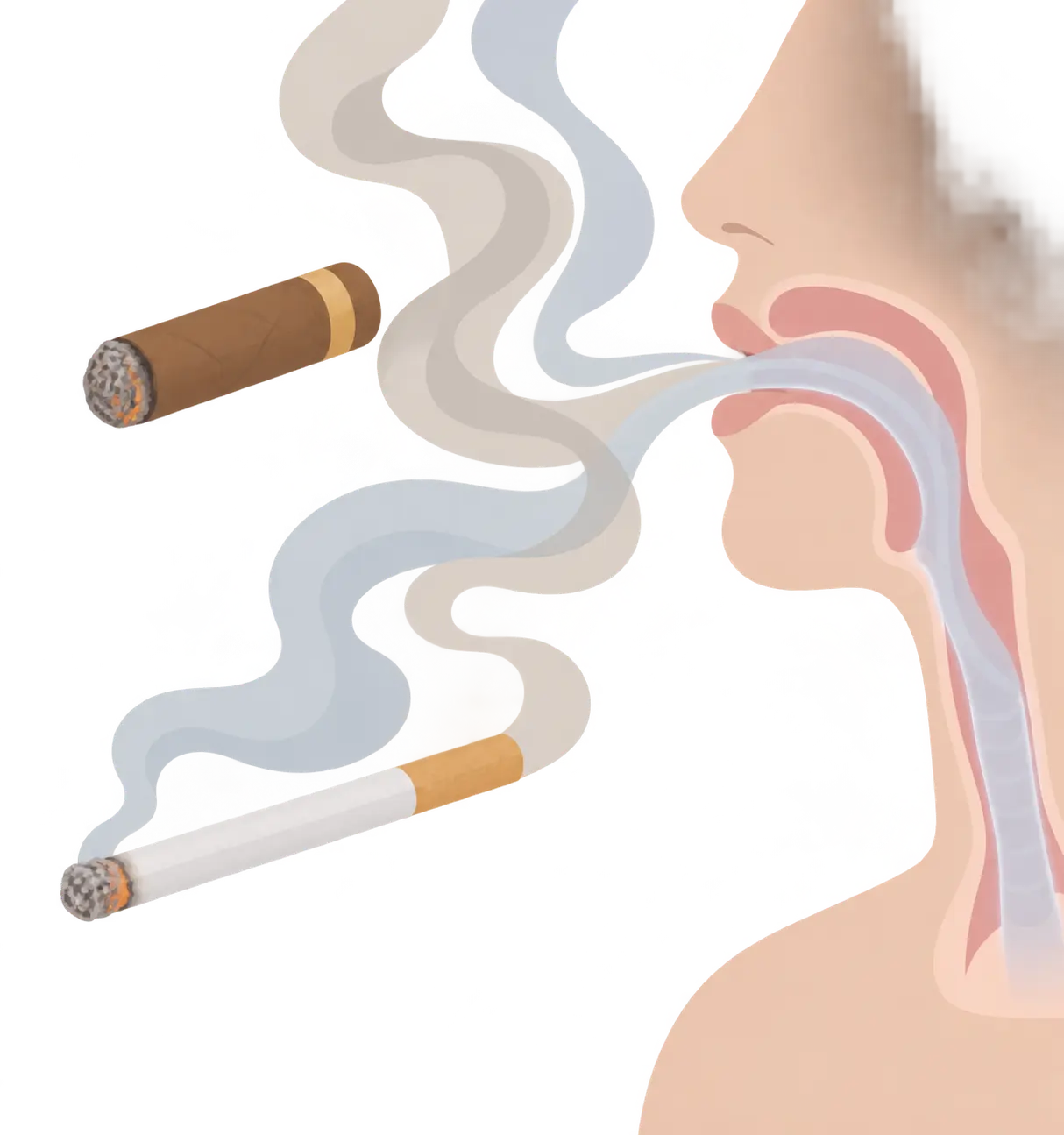
The NCI is direct: “Cigar smoking causes cancer of the oral cavity, larynx, esophagus, and lung. It may also cause cancer of the pancreas.” Daily cigar smokers, “particularly those who inhale, are at increased risk for developing heart disease and other types of lung disease.”
It compares the two products carefully rather than flatly. “Although cigar smokers have lower rates of lung cancer, coronary heart disease, and lung disease than cigarette smokers, they have higher rates of these diseases than those who do not smoke cigars.” And for the mouth and esophagus, “regular cigar smokers and cigarette smokers have similar levels of risk for oral cavity and esophageal cancers.”
That is the useful way to read the evidence. For lung disease, an occasional cigarillo user who does not inhale may carry a lower risk than a daily cigarette smoker. For the mouth, throat and esophagus the risks are comparable, and neither is close to the risk of not smoking. For a fuller picture of the illnesses involved, see our guide to the cancers smoking causes, and for the death toll see how many people smoking kills each year.
We did not find a source that compares Black & Mild users specifically with cigarette smokers on heart disease, so we do not state a number for it. The NCI says “there is no safe level of tobacco use.”
Flavored cigars and the regulation status
Flavor is a large part of cigarillo appeal. A national survey published in 2016, of 141 current little cigar and cigarillo users drawn from 5,717 US adults, found that “flavors were cited as important reasons for use, especially among younger users, as were favorable comparisons with affordability and burn time of cigarettes.” Most users did not consider themselves addicted: 73.6% said “not at all” (Tobacco Regulatory Science, 2016).
The FDA published a proposed rule in the Federal Register on May 4, 2022 that would have prohibited characterizing flavors, other than tobacco, in all cigars. In that proposal, the agency cited national survey data that “more than half (58.3 percent) of youth cigar smokers, or approximately 550,000 youth, reported using a flavored cigar during the past 30 days” (Federal Register, May 4, 2022).
Here is the status as we could verify it. The Public Health Law Center’s tracker lists the proposal as withdrawn and states: “The FDA officially withdrew this rule on January 21, 2025 and will no longer move forward with the rule at this time” (Public Health Law Center tracker). We searched the Federal Register and did not find a withdrawal notice there, and we did not locate one on the FDA’s site, so the January 21, 2025 date rests on that secondary source alone. The practical point is that flavored cigarillos have not been banned federally by that rule. State and local flavor laws vary, and we did not research them.

Cost per day
Price is the second reason people give for choosing cigarillos. The 2015 survey analysis notes that little cigars and cigarillos “may be less expensive and can be purchased singly” (Nicotine and Tobacco Research, 2015). A 2017 commentary argues that little cigars and filtered cigars, which differ “very little physically from cigarettes,” are sometimes sold at a lower cost partly because of regulatory and tax differences (Tobacco Control, 2017).
We did not find a verified price per stick for Black & Milds, so we give no figure. Instead, work out your own number: multiply what you pay per cigarillo by how many you smoke in a day, then by 365. The result is often larger than people expect. For a benchmark against cigarettes, our guide to what a pack of cigarettes costs in 2026 gives the per-pack side.
iQuit’s money dashboard lets you enter your own per-unit cost, so the number is yours rather than an average. Seeing the yearly total beside your savings goals is often more persuasive than any statistic.
Dual use and why it matters
If you smoke both cigarillos and cigarettes, you have more exposure, not less. The survey data above shows that dual use is common, and the 2017 Tobacco Control commentary describes little cigars as “pseudo-cigarettes” that smokers can buy “at a lower cost.” The NCI’s guidance for anyone using any tobacco product is the same: “People who use any type of tobacco product should be encouraged to quit.”
The same logic applies to a cigarillo that you tell yourself is a treat. Nicotine from the mouth still builds dependence. The 2016 survey found most users do not see themselves as addicted, which can make quitting harder to start. If you notice cravings after meals, with drinks or when you are with certain friends, that pattern is worth logging.
If you are curious how other tobacco forms compare, see our comparison of hookah and cigarettes.
How to quit cigarillos
There is less research on quitting cigarillos than cigarettes. The NCI says: “Limited research has been completed to determine the usefulness of NRT for people who smoke cigars,” while “strong and consistent evidence shows that NRT can help people quit smoking cigarettes.” Its advice is to “ask your doctor or pharmacist about NRT, as well as about individual or group counseling, telephone quitlines, or other methods.”
The NCI lists its Smoking Quitline as 1-877-44U-QUIT (1-877-448-7848) for individual counseling, and Smokefree.gov for a step-by-step guide. If you want a plan for cigarillos specifically, see our guide to quitting cigars and cigarillos.

iQuit does not treat any condition, and it is not a replacement for medical advice. What it offers is a quit method that fits you (cold turkey or gradual reduction), a craving log for triggers and intensity, SOS tools including breathing exercises and craving surfing, and a dashboard that shows days smoke-free and money saved.
Frequently Asked Questions
Are Black and Milds worse than cigarettes?
Not safer. The NCI says cigar smoke is possibly more toxic than cigarette smoke and that cigar smokers have similar oral and esophageal cancer risk to cigarette smokers. Lung disease rates are lower for cigar smokers than cigarette smokers but higher than for non-smokers (NCI cigars fact sheet).
How much tobacco is in a cigarillo?
The NCI says cigarillos contain about 3 grams of tobacco, little cigars about 1 gram and cigarettes less than 1 gram. We did not verify a brand-specific figure for Black & Milds (NCI cigars fact sheet).
Is it okay if I do not inhale a cigarillo?
Not inhaling lowers lung exposure but does not remove risk. The NCI says all cigar and cigarette smokers expose their lips, mouth, tongue, throat and larynx to smoke, and nicotine is absorbed through the lining of the mouth (NCI cigars fact sheet).
Can a cigarillo contain as much nicotine as a pack of cigarettes?
The NCI says a single cigar can potentially provide as much nicotine as a pack of cigarettes. It is a statement about cigars as a class, and we did not verify the nicotine in any specific Black & Mild product (NCI cigars fact sheet).
Are flavored cigars banned in the US?
The FDA proposed a rule in May 2022 to prohibit characterizing flavors in cigars. A Public Health Law Center tracker says the FDA withdrew it on January 21, 2025; we could not confirm that date in the Federal Register or on FDA’s site. State and local laws vary and we did not research them (Federal Register; Public Health Law Center).
Do cigarillo smokers also smoke cigarettes?
Often. A 2015 analysis of two US surveys found over 60% of male and 70% of female adolescent and young adult cigar smokers also smoked cigarettes in 2011 (Nicotine and Tobacco Research, 2015).
Does nicotine replacement help cigar smokers quit?
The NCI says strong evidence supports NRT for quitting cigarettes but limited research has tested it for cigar smokers. It advises asking a doctor or pharmacist about NRT, counseling and quitlines (NCI cigars fact sheet).
Where can I get help quitting cigars?
The NCI offers a Smoking Quitline at 1-877-44U-QUIT (1-877-448-7848) and a step-by-step guide at Smokefree.gov. A pharmacist or doctor can also advise on quitting (NCI cigars fact sheet).
Quit cigarillos with iQuit
iQuit is free to download on Google Play and the App Store. Enter your own cigarillo cost, log each craving and its trigger, use the SOS tools when an urge hits, and watch your days smoke-free and money saved grow.
Download iQuit Free on Google Play Download on the App Store