You have a prescription, a sore chest or a throbbing tooth, and a craving. So can you smoke while taking antibiotics? The practical answer is that the NHS sources reviewed here do not list smoking as affecting common antibiotics, and no antibiotic appears on the NHS Specialist Pharmacy Service list of medicines with specific smoking interactions. But smoking can make a chest infection worse, and it can affect other medicines you take. This guide separates what the official sources actually say from the myths, and shows how a sick week can become the start of a smoke-free life.
The short answer: no antibiotic on the list, but smoking still hurts when you are ill
Start with the reassuring part. The NHS Specialist Pharmacy Service (SPS) publishes a list of medicines for which a smoking interaction is recorded in the British National Formulary, in Stockley’s Interactions Checker or in the manufacturer’s product information. That list names about forty medicines, including clozapine, warfarin, theophylline, olanzapine and methadone. No antibiotic is among them (SPS, Managing specific interactions with smoking).
Now the not-so-reassuring part. “No known interaction” does not mean “no downside.” The NHS chest infection page tells you, in plain words, “do not smoke – it can make your symptoms worse” (NHS, Chest infection).
So the honest summary is: none of the official sources used here say that smoking stops an antibiotic from working, but smoking works against the reason you are taking it. We do not claim either way beyond what those sources say, so check your own prescription with a pharmacist.
How smoking affects medicines in general
To understand why the question comes up at all, it helps to know the mechanism. The SPS explains that ingredients in tobacco smoke induce cytochrome P450 enzymes in the liver, which are involved in metabolizing medicines. The enzymes affected include CYP1A1, CYP1A2, CYP1B1, CYP2B6, CYP2C19, CYP2E1 and CYP3A4. Medicines handled by those enzymes may be cleared from the body more quickly in people who smoke (SPS, Considering drug interactions with smoking).
That matters for specific drugs, not for everything. The SPS notes that in many cases the interaction is not expected to be clinically significant in practice, and that for most medicines dose adjustment will not be required when a person stops smoking. It singles out clozapine as a medicine where a clinically relevant interaction can be predicted and dose adjustment will be necessary with the specialist team.
| Question | What the source says |
|---|---|
| Does smoking affect how the body handles some medicines? | Yes. Tobacco smoke induces liver enzymes, which can clear some medicines faster (SPS). |
| Is an antibiotic on the SPS list of specific smoking interactions? | No antibiotic is named on the list. |
| Do vapes or nicotine replacement cause the same effect? | The SPS says there is no direct interaction with vapes or NRT, because the enzyme induction comes from components of tobacco smoke rather than nicotine. |
| How fast does the effect reverse after quitting? | Effects may be seen within three days; full reversal may take two to four weeks (SPS). |
| Do most people need a dose change on quitting? | For most medicines, no, but some need monitoring (SPS). |
If you take any regular medicine, a short conversation with your pharmacist when you start or stop smoking is cheap insurance. Our guide on quitting smoking and medication dose changes goes through which drugs are worth asking about.
What the NHS antibiotic pages say
Another way to check is to read what the NHS says about common antibiotics themselves. We looked at three commonly prescribed ones. In each case, the page lists the medicines that may not mix well with the antibiotic, and smoking is not among them.
- Amoxicillin. The NHS lists methotrexate, warfarin, the gout medicines probenecid and allopurinol, and other antibiotics (NHS, Taking amoxicillin with other medicines).
- Ciprofloxacin. The list includes antacids, methotrexate, phenytoin, steroids, theophylline or aminophylline, tizanidine and warfarin (NHS, Taking ciprofloxacin with other medicines).
- Doxycycline. The page names anticoagulants such as warfarin, antacids and indigestion treatments, acne medicines, and iron or zinc supplements (NHS, Doxycycline).
One detail is worth a careful read rather than a leap. Warfarin and theophylline appear both on those antibiotic pages and on the SPS smoking-interaction list. That overlap does not show that smoking changes how an antibiotic works. It is a reason to tell your prescriber and pharmacist about both your medicines and your smoking status if you take either drug, especially if you are about to quit. Never adjust a dose yourself.

Smoking and the infection you are treating
This is where the real answer lives. Antibiotics treat bacteria, but your body still has to do the recovering, and smoke is an irritant sitting right on top of an inflamed airway.
The NHS chest infection page lists “do not smoke – it can make your symptoms worse” in its self-care advice. It also lists “try to quit smoking if you smoke” among the ways to reduce your chance of getting a chest infection in the first place. If you are coughing and wheezing already, a cigarette is the wrong tool for the job, even though the craving says otherwise.
For the longer story of how smoke interferes with your defenses, read how smoking weakens your immune defenses. If your current illness is a chest infection, our guide on quitting smoking with a chest infection covers what to expect.
What about a dental infection?
Antibiotics are also prescribed for dental problems. The NHS dental abscess page lists “do not smoke” among the things you can do to help prevent dental abscesses (NHS, Dental abscess). If you have had a tooth taken out or a procedure, ask your dentist or surgeon for aftercare advice specific to you, because this article cannot give it.
Use the sick days as day one
Being ill is one of the few times when you are already slowed down, staying home and thinking about your health. That makes it a natural moment to start. Cravings and illness can overlap, so it helps to plan.
- Pick today. Treat the first day of your antibiotic course as day one if you are ready. You do not need a perfect plan.
- Know what withdrawal looks like. Irritability, restlessness and coughing can blur with illness. Our nicotine withdrawal timeline hour by hour helps you tell them apart.
- Expect a change in your cough. Many people notice their cough changes when they quit. Our piece on smoker’s cough signs and red flags explains what is normal and when to call a clinician.
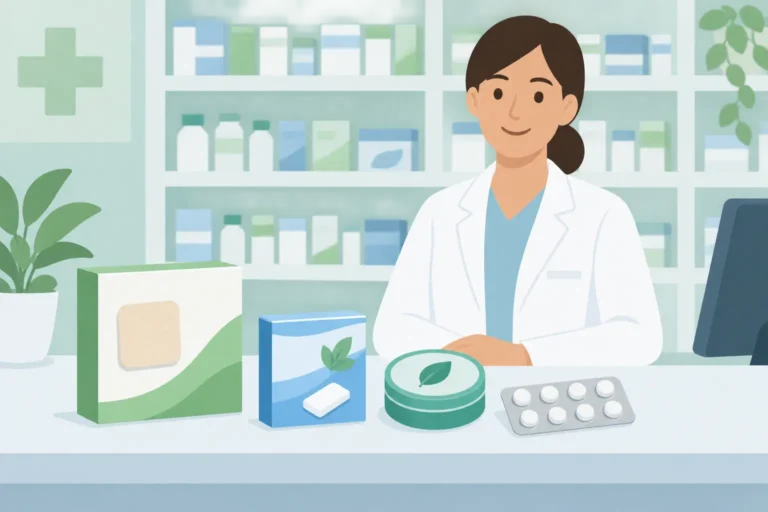
- Consider nicotine replacement. The SPS says the liver-enzyme effect comes from tobacco smoke rather than nicotine, so patches and gum do not carry the same medicine-clearance effect. Ask your pharmacist which product suits you.
- Tell the pharmacist about your quit date. If you take any regular medicine, they can tell you whether it needs watching once you stop.
Our smoker’s flu timeline after quitting is also worth a read, because feeling unwell in the first weeks is common and not a sign that quitting is going wrong. And to see what you are building toward, see what happens to your body when you stop smoking.
Five questions to ask your pharmacist or doctor
Because this article cannot see your prescription or your health history, the most useful thing it can do is help you ask better questions. A pharmacist can usually answer these in a couple of minutes.
- “Does anything I take interact with smoking, or with stopping smoking?”
- “I plan to quit around now. Does any of my medicine need monitoring in the first few weeks?”
- “Is it fine to use nicotine patches, gum or lozenges alongside this antibiotic?”
- “What symptoms mean I should call you or my doctor rather than wait?”
- “Can you point me to free stop smoking support near me?”
The SPS notes that it is good practice for clinicians to check for changes in smoking status when prescribing new medicines or doing a medication review. You can make that easy by telling them upfront whether you smoke, whether you vape, and whether you have started or stopped recently.
When to get medical help
Quitting does not replace medical care. The NHS chest infection page says to see a GP if you feel very unwell or your symptoms get worse, and it tells you to complete the whole course of antibiotics as advised by the GP, even if you start to feel better. Take antibiotics as directed on the packet or the leaflet, or as instructed by your GP or pharmacist.
If you have trouble breathing, chest pain that is severe or a high fever that will not settle, seek urgent help through your local emergency number or urgent care service. Smoking is not a reason to delay.
Using iQuit while you recover
iQuit is a free quit-smoking app on Google Play and the App Store. When you are ill and at home, it can give your first smoke-free days some structure. The dashboard counts days smoke-free, cigarettes avoided and money saved. Log each craving with its trigger and intensity, and use the SOS tools when one hits: breathing exercises, a grounding exercise, craving surfing and a virtual cigarette.
If you slip, streak shields and slip recovery are there to help you restart after a rough night. iQuit is a support tool and not medical advice, so keep your prescriber involved in anything to do with your medicines.
Make this sick week day one
Track your smoke-free days, log cravings and use SOS tools while you recover. iQuit is free on Google Play and the App Store.
Download iQuit Free on Google Play
Download on the App Store
Frequently Asked Questions
Can you smoke while taking antibiotics?
No common antibiotic appears on the NHS SPS list of medicines with specific smoking interactions, so the sources reviewed do not list a smoking interaction for common antibiotics. But the NHS says not to smoke with a chest infection because it can make symptoms worse. Ask your pharmacist about all your medicines (SPS; NHS).
Does smoking make antibiotics less effective?
The sources reviewed do not say so. The NHS pages for amoxicillin, ciprofloxacin and doxycycline do not list smoking among the things that affect them, and no antibiotic is on the SPS smoking-interaction list. That is not a green light to smoke while ill (NHS; SPS).
Does smoking slow recovery from a chest infection?
The NHS says not to smoke when you have a chest infection because it can make your symptoms worse, and advises trying to quit smoking to reduce the chance of getting one. Smoking is an irritant on an airway that is already inflamed (NHS, Chest infection).
Which medicines do interact with smoking?
The SPS list names about forty, including clozapine, warfarin, theophylline, olanzapine and methadone. Tobacco smoke induces liver enzymes that can clear some medicines faster. For most medicines, the SPS says dose adjustment will not be required when a person stops smoking (SPS).
Do nicotine patches or vapes affect my medicines the same way?
The SPS says there is no direct interaction with vapes or NRT, because the enzyme induction is caused by components of tobacco smoke rather than nicotine. If you take interacting medicines and switch from smoking, follow the advice for stopping smoking and ask your pharmacist (SPS).
Will quitting smoking change my other medicines?
Sometimes. The SPS says enzyme induction reverses after stopping, with effects seen within three days and full reversal taking two to four weeks. For most medicines no change is needed, but some need monitoring. Tell your prescriber before you quit (SPS).
Should I quit smoking while I am ill?
Many people find illness a natural moment to start because they are already resting. The NHS advises not smoking with a chest infection. Plan for withdrawal symptoms that can overlap with illness, use nicotine replacement if suitable, and ask a pharmacist or doctor for support (NHS; SPS).