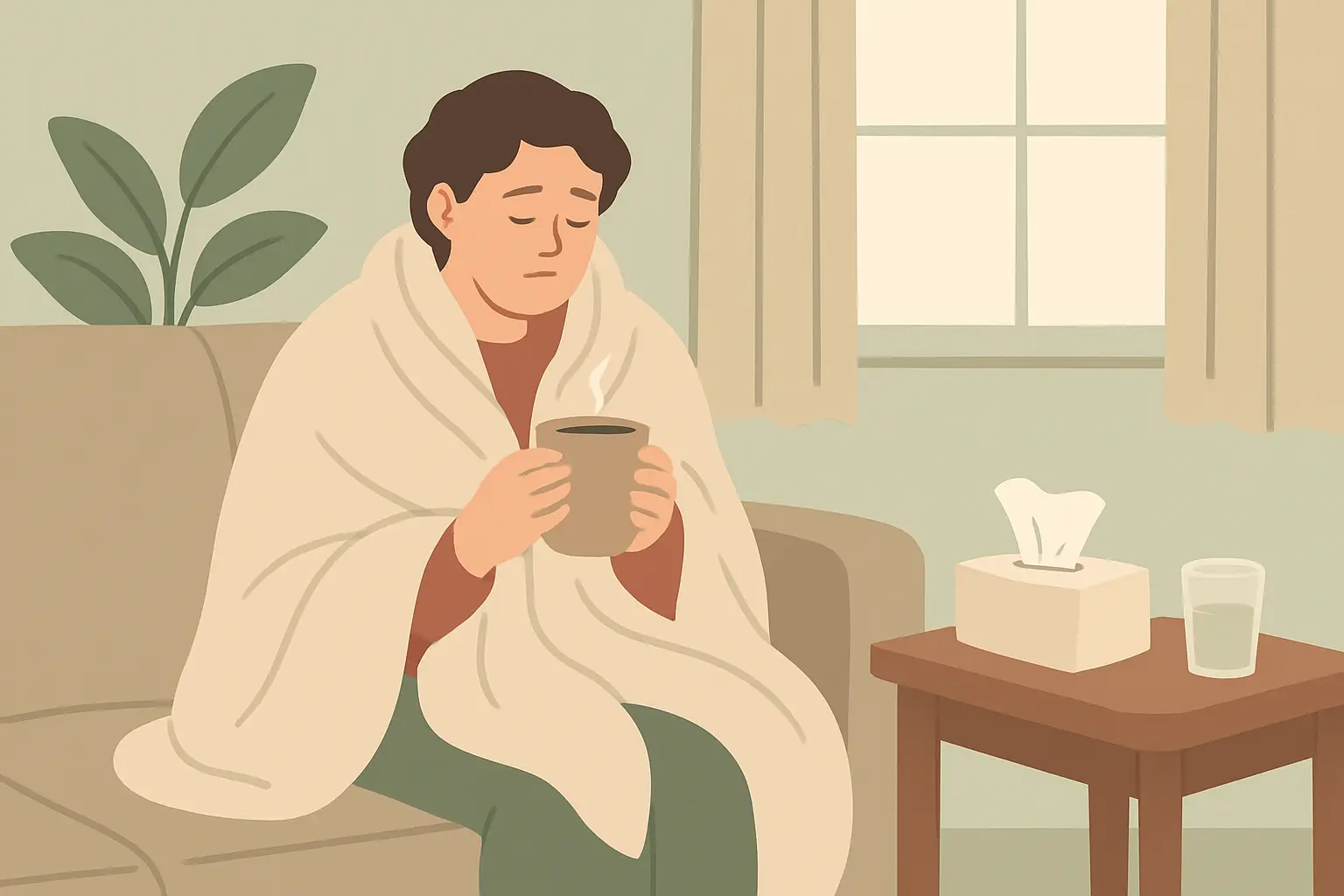
You are three days into a chesty cough, you feel awful, and cigarettes taste like nothing. Part of you thinks this is the perfect moment to stop. Another part thinks your body has enough to deal with. Quitting smoking with a chest infection is a question people put to their GP every winter, and the answer from every health service that addresses it is the same: there is no reason to wait, and several reasons not to. This guide covers what changes while you are ill, how to tell a withdrawal cough from an infection cough, what to do about nicotine replacement, and the red flags that mean you need a doctor rather than a quit plan.
The Short Answer
Stop now. The NHS chest infection page has a short list of things not to do while you are ill, and “do not smoke” is on it, with the plain reason that it can make your symptoms worse. Its bronchitis page gives the same one-line instruction. The NHS also lists quitting among the ways to avoid getting chest infections in the first place, alongside the flu and pneumococcal vaccines.
Two honest caveats before you read on. First, nothing we could find claims that stopping mid-infection will make this particular infection clear faster. The case for quitting now is about not adding smoke to an inflamed airway, and about using a moment when your habit is already broken. Second, quitting is not treatment. If your symptoms match the warning signs further down this page, the priority is getting seen, not getting a patch.
Most chest infections follow a cold or flu and, according to the NHS, usually get better on their own in about 7 to 10 days, though the cough and mucus can last up to 3 weeks. That is a long stretch to spend both ill and smoking.
What Smoking Does to an Already Infected Airway
A chest infection means the lungs or large airways are inflamed and producing extra mucus. Smoke lands on exactly that surface. The practical effect is more irritation, more coughing and a harder job clearing mucus at the point when clearing mucus is the whole recovery.
The background risk data is stark. A systematic review and meta-analysis pooling 27 studies and 460,592 participants found that current smokers were more than twice as likely to develop community-acquired pneumonia as people who had never smoked (pooled odds ratio 2.17, 95% confidence interval 1.70 to 2.76). Ex-smokers sat in between, at a pooled odds ratio of 1.49 (1.26 to 1.75) (Baskaran et al., PLoS ONE, 2019).
Outcomes differ too. A hospital study of adults admitted with community-acquired pneumonia in Barcelona reported that current smokers had a greater systemic inflammatory response, a higher risk of pleural complications, and more often needed invasive ventilation and intensive care than non-smokers (Crisafulli et al., Journal of Clinical Medicine, 2020).
Cleveland Clinic explains the difference between bronchitis and pneumonia, which is the distinction that decides how closely your chest infection needs watching.
Those figures describe risk over years, not what happens to you this week. They are still the reason every respiratory service asks about smoking. If you already have a lung condition on top of the infection, our step-by-step plan for quitting with COPD and our page on COPD and cessation cover the extra considerations.
Why Being Ill Is a Real Quit Window
Illness strips out most of what keeps a smoking habit running. You are not at work, not in the pub, not standing outside with colleagues. Cigarettes taste wrong. You are already doing things differently, which is exactly what a quit attempt asks of you.
The best evidence for illness as a quit moment comes from hospitals. A 2024 Cochrane review pooled 82 studies covering 42,273 people who smoked and were admitted to acute hospitals. Counselling that started in hospital and carried on for more than a month after discharge raised quit rates compared with no support, with a risk ratio of 1.36 (95% confidence interval 1.24 to 1.49) across 28 studies and 8,234 participants. In plain terms, the reviewers put that at roughly 76 extra quitters per 1,000 people (Streck, Rigotti et al., Cochrane Database of Systematic Reviews, 2024).
Read that carefully: those were hospitalised patients, not people on the sofa with bronchitis, and the thing that worked was support continuing after the illness passed. That second point is the one to borrow. A quit that lasts only as long as the cough is not a quit.
NICE guidance makes the same general point in one line, telling clinicians to explain the short- and long-term benefits of stopping smoking at any time, not at some better time later. If a planned operation is also on your horizon, our guide to quitting before an operation covers that timeline.
Withdrawal Cough or Infection Cough?
This is the question that sends people back to cigarettes. You quit, you are still coughing, and it feels like proof that quitting made things worse. Usually it is proof of nothing except that you had a chest infection, which the NHS says can leave a cough and mucus for up to 3 weeks on its own.
What the NHS timeline does say about quitting is that within about 48 hours your lungs start clearing out mucus, and that by 72 hours breathing feels easier as the bronchial tubes relax. Longer term, at 3 to 9 months, coughs, wheezing and breathing problems improve as lung function increases by up to 10% (NHS Better Health). Many people do report more clearing and coughing in the first days after stopping, as that mucus moves. We could not find a source that quantifies how common that is, so treat it as a description, not a statistic.
| Feature | Infection cough | Post-quit clearing cough |
|---|---|---|
| Started | With or after a cold or flu | In the days after your last cigarette |
| Company it keeps | High temperature, aching muscles, headache, tiredness | Cravings, irritability, poor sleep, restlessness |
| Mucus | Often green or yellow, can be heavy | Usually clearing rather than worsening |
| Usual course | Better in 7 to 10 days; cough up to 3 weeks | Easier breathing reported from around 72 hours |
| When to act | Any red flag below, or cough beyond 3 weeks | Same red flags apply; never assume it is “just quitting” |
The important line in that table is the last one. A cough you have labelled as a quitting cough still gets the same red-flag rules. If you want the full picture of what else the first weeks bring, read the withdrawal stages.
Using Nicotine Replacement While You Are Ill
Nicotine replacement is not a lung irritant and does not need to wait until you feel better. The Cochrane review of hospitalised patients found that starting nicotine replacement helped more people quit than placebo or no medication, with a risk ratio of 1.33 (95% confidence interval 1.05 to 1.67) across 8 studies and 3,838 participants, which the reviewers translated as about 62 extra quitters per 1,000.
Some practical points for the week you are unwell:
- A sore throat changes the format. If gum, lozenges or a mouth spray sting an inflamed throat, a patch does the same job without touching it.
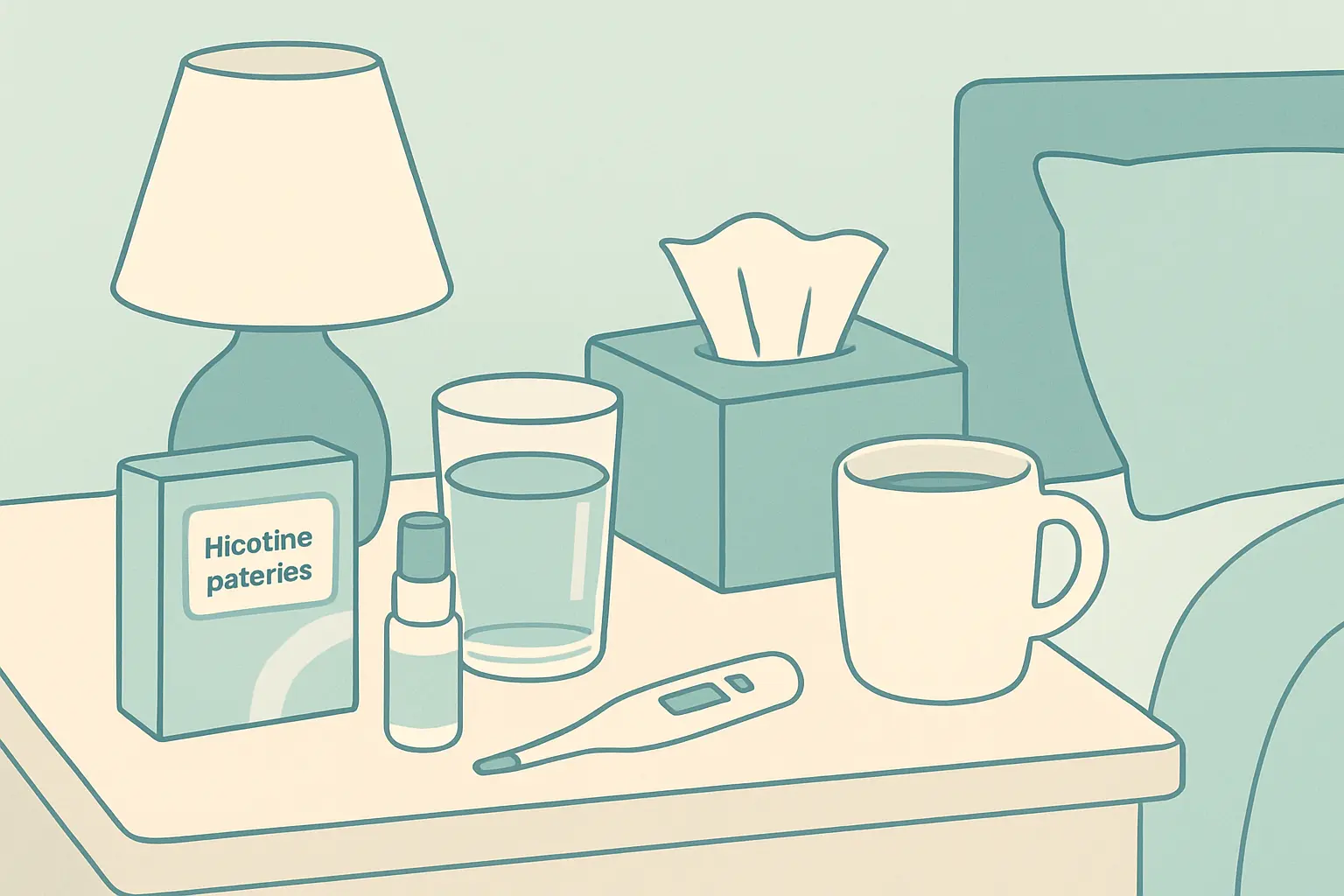
- Keep it within reach. Cravings arrive when you are too tired to go looking. Put the patches and a fast-acting product on the bedside table before you need them.
- Do not under-dose. Cravings do not shrink because you are ill. If a patch alone is not holding you, ask a pharmacist about adding a fast-acting product.
- Tell the pharmacist what else you are taking. Cough medicines, painkillers and any prescription you have been given are all worth mentioning in the same sentence as “I have just stopped smoking”.
Your immune system is also part of this story over the longer run. We cover what the evidence shows in how your immune system recovers and in does quitting boost immunity.
Red Flags That Need a Doctor, Not a Quit Plan
Nothing in this article replaces getting assessed. The NHS lists these as reasons to see a GP about a chest infection, and the bronchitis guidance treats several of them as urgent, meaning an urgent GP appointment or NHS 111.
- You feel very unwell, or your symptoms are getting worse.
- You cough up blood or blood-stained mucus.
- You have had a cough for more than 3 weeks, or it is not getting better.
- You have chest pain that comes and goes, or pain when breathing or coughing.
- You are short of breath.
- You are pregnant, or over 65.
- Your immune system is weak, for example because of a condition like diabetes or because you are having chemotherapy.
- You have a long-term heart, lung or kidney condition.
- You are too unwell to do your usual daily activities.
The NHS bronchitis page also lists symptoms that mean calling 999: struggling to breathe, choking, gasping or unable to speak; lips or skin turning very pale, blue or grey; sudden confusion, such as not knowing where you are; or being unable to wake a baby or finding them floppy. It adds that you should not drive yourself to A&E.
Severe symptoms may mean pneumonia rather than a mild chest infection, which the NHS says explicitly. None of that is a reason to start smoking again. It is a reason to be seen today.
Antibiotics, Medicines and Smoking
Whether you need antibiotics is a decision for the clinician who assesses you, and nothing here should be used to second-guess it. What the NHS states plainly is worth knowing before the appointment: a chest infection can be viral, like viral bronchitis, in which case it usually clears by itself over a few weeks and antibiotics will not help, or bacterial, like pneumonia, in which case a GP may prescribe them and asks you to finish the course even once you feel better. A blood test or a mucus sample is sometimes used to work out which.
What is worth raising yourself is the fact that you have stopped smoking. Stopping can change how your body handles some medicines, so if you are on anything regular, say so at the appointment or to the pharmacist and let them decide whether anything needs reviewing. That is a five-second sentence that saves a lot of guesswork.
A pharmacist can also recommend cough medicines to loosen the mucus and make it easier to cough up, which the NHS notes are not suitable for children under 6. The self-care basics from the same page still apply: rest, plenty of water to loosen the mucus, extra pillows to sleep propped up, and painkillers for a high temperature or aches.
Holding the Quit Once You Feel Better
The risky moment is not day two of the infection. It is the first good day afterwards, when the old routine is available again and the reason you stopped has faded.
The Cochrane finding is the useful lesson here: what raised quit rates was support that continued past the illness. Patients offered both counselling and medication after discharge did better than those given help only while they were in hospital (risk ratio 1.23, 95% confidence interval 1.09 to 1.38).
So set the next step while you are still on the sofa.
- Book support for the week after. A local stop-smoking service, a pharmacy appointment or a scheduled call, arranged now rather than when you feel fine.
- Get enough treatment to last. Nicotine replacement courses run for weeks, not days. Make sure you have the supply before the motivation dips.
- Name the first three triggers. The commute, the first coffee, the first drink with friends. Decide now what happens instead.
- Re-date your quit, not your infection. Count from your last cigarette. That number is yours to keep whether or not the cough has gone.
Sleep is often the other thing still not right by then, and it has its own causes. Our article on quitting, snoring and sleep apnea covers the airway side of that.
If you want the counting handled for you, iQuit tracks days smoke-free, cigarettes avoided and money saved, and its SOS craving tools sit one tap away for the afternoons when you are too flattened to distract yourself any other way.
Frequently Asked Questions
Should I quit smoking while I have a chest infection, or wait until I am better?
Quit now. The NHS self-care advice for a chest infection includes “do not smoke”, because smoking can make the symptoms worse, and the same page lists quitting among the ways to avoid getting chest infections. Being ill also removes most of your usual smoking cues, which makes the first days easier than they would otherwise be (NHS chest infection guidance).
Will quitting make this infection clear up faster?
We could not find a source that says so, and you should be skeptical of pages that promise it. The NHS says a chest infection usually improves in about 7 to 10 days with the cough lasting up to 3 weeks, whatever you do. The case for stopping now is that you are not adding smoke to an inflamed airway, and that your habit is already disrupted.
Can I use nicotine patches or gum while I am ill?
Yes, and a Cochrane review of hospitalised patients found nicotine replacement helped more people quit than placebo or no medication, with a risk ratio of 1.33 (95% CI 1.05 to 1.67). If a sore throat makes gum, lozenges or spray uncomfortable, a patch avoids the throat entirely. Tell the pharmacist what else you are taking (Cochrane, 2024).
Is my cough from quitting or from the infection?
An infection cough usually arrives with a temperature, aches and tiredness and often brings green or yellow mucus. The NHS says the cough and mucus can last up to 3 weeks on their own. After quitting, the NHS timeline describes the lungs clearing mucus from around 48 hours and breathing feeling easier by 72 hours. Either way, the red-flag rules are identical.
When should I see a doctor about a chest infection?
The NHS says see a GP if you feel very unwell or are getting worse, cough up blood or blood-stained mucus, have had a cough for more than 3 weeks, are pregnant or over 65, have a weakened immune system, or have a long-term heart, lung or kidney condition. Shortness of breath and chest pain on breathing are urgent (NHS chest infection and bronchitis guidance).
Do I need antibiotics for a chest infection?
That is a decision for the clinician who assesses you, and we do not give medication advice. The NHS states that antibiotics are only used for bacterial chest infections, that they do not work for viral ones such as flu or viral bronchitis, and that if a GP does prescribe them you should finish the whole course even once you start to feel better.
Does smoking increase my risk of pneumonia?
Yes. A meta-analysis of 27 studies and 460,592 people found current smokers had a pooled odds ratio of 2.17 (95% CI 1.70 to 2.76) for community-acquired pneumonia compared with never-smokers, with ex-smokers at 1.49 (1.26 to 1.75). The NHS also lists quitting among the steps for people who keep getting chest infections (Baskaran et al., PLoS ONE, 2019).
How do I avoid going back to cigarettes once I feel better?
Arrange support that outlasts the illness. In the Cochrane review, patients offered both counselling and medication after leaving hospital did better than those helped only while admitted (risk ratio 1.23, 95% CI 1.09 to 1.38). Book a stop-smoking appointment for the following week now, make sure your nicotine replacement supply lasts, and plan for your first three triggers.
Turn a Bad Week Into Day One
iQuit counts your days smoke-free, cigarettes avoided and money saved from your last cigarette, logs cravings with their triggers and intensity, and puts SOS craving support one tap away for the days you are not leaving the sofa. Free on Google Play and the App Store.
Download iQuit Free on Google Play Download on the App Store