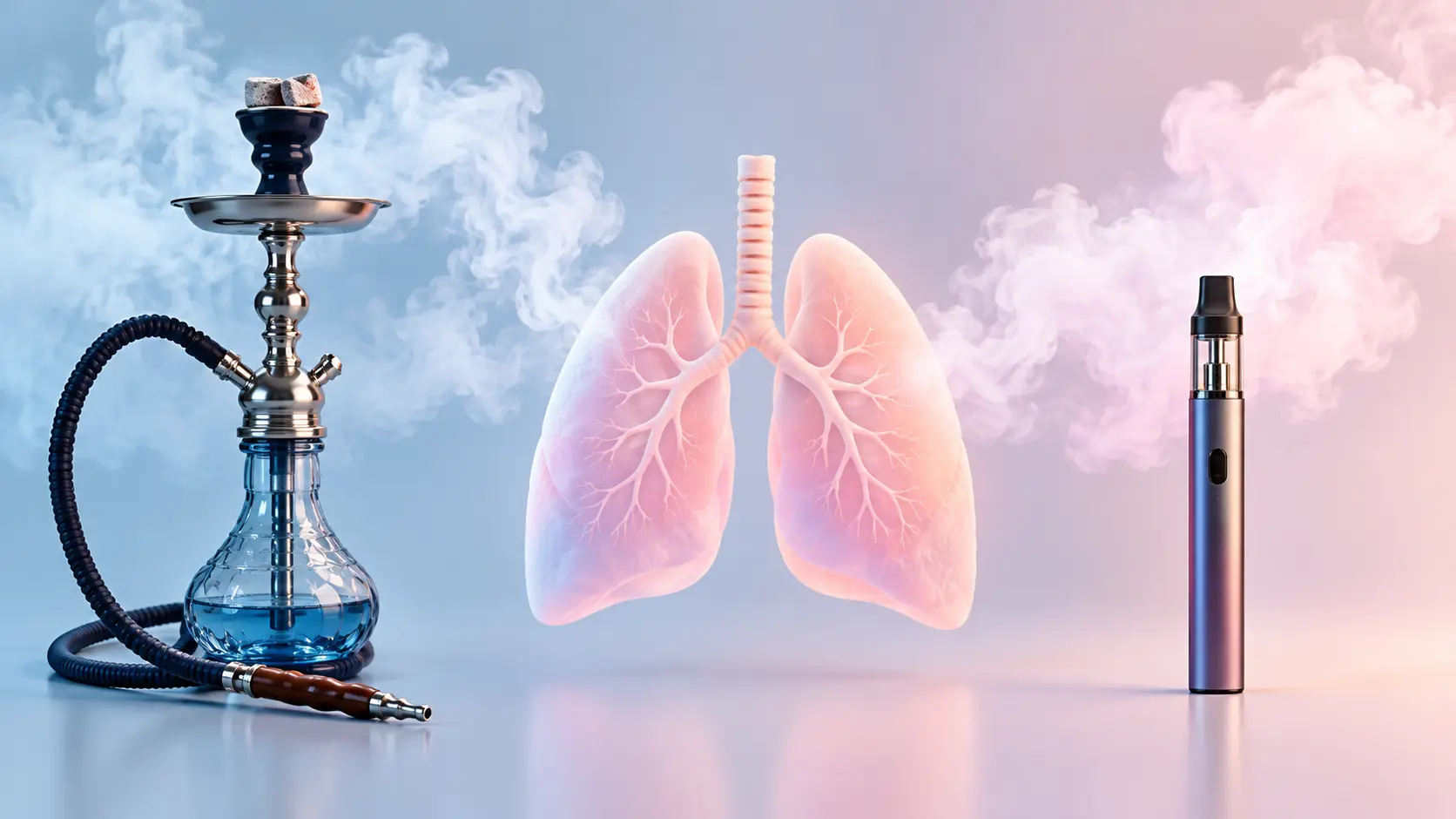
Social smokers often ask hookah vs vape as if one of them has to be the safer night out. The honest answer from the public-health sources is that neither is safe, but they fail in different ways: hookah is combustion, with charcoal and tobacco smoke, while a vape is a heated liquid with its own mix of chemicals and a lot of nicotine. This guide compares them point by point using the CDC, a 2019 American Heart Association statement and peer-reviewed measurements, and it ends with what to do if you want to step away from both.
Hookah vs Vape: The Short Answer
If you want one sentence: hookah is the better-documented harm, and a vape is the less-documented one, which is not the same as safer. The CDC states plainly that “hookah smoking is NOT a safe alternative to smoking cigarettes,” and that e-cigarette aerosol “is NOT harmless ‘water vapor.’” Nobody has a long-run head-to-head study of regular hookah users and regular vapers, so we will not pretend to give you a winner. What we can do is compare what each one puts in your lungs.
| Point | Hookah | Vape (e-cigarette) |
|---|---|---|
| What is inhaled | Tobacco smoke plus charcoal smoke | Aerosol from heated liquid |
| Carbon monoxide | High; CDC says nearly 9 times a single cigarette per session | Not addressed on the CDC e-cigarette page |
| Nicotine | CDC: about 1.7 times a single cigarette per session | Usually present; CDC says nicotine salts let people take in high levels |
| Cancer-causing chemicals | Yes (tobacco smoke and charcoal) | CDC lists cancer-causing chemicals in aerosol |
| Shared equipment | Often a shared hose or mouthpiece | Usually personal, but can be passed around |
Hookah vs Vape: What You Inhale
A hookah burns charcoal to heat flavored tobacco, and the smoke passes through water before you breathe it. The CDC is clear that the water does not rescue the situation: “The water in a hookah does not filter smoke. Even after the hookah smoke passes through the water, the smoke has high levels of toxic agents.” It adds that hookah smoke “contains many of the same harmful components found in cigarette smoke, such as nicotine, tar, and heavy metals.”
A vape heats a liquid into an aerosol. The CDC lists what that aerosol can contain: nicotine, “a highly addictive chemical that can harm adolescent brain development,” cancer-causing chemicals, heavy metals such as nickel, tin and lead, tiny particles that can be inhaled deep into the lungs, volatile organic compounds, and flavorings such as diacetyl, “a chemical linked to a serious lung disease.” It also warns that “it is difficult to know which substances e-cigarettes contain.” For a wider look at vapes versus cigarettes, read is vaping worse than smoking.
If you want to see how the legal vape market works, our guide to FDA authorized vapes explains what “authorized” does and does not mean.

Carbon Monoxide
This is the clearest place where the two differ. The CDC says “the charcoal used to heat the hookah tobacco can also produce high levels of carbon monoxide, metals, and cancer-causing chemicals.” Per session, it says “a person using a hookah can be exposed to nearly 9 times more carbon monoxide and 1.7 times more nicotine than from a single cigarette.”
A study of 16 people who smoked a water pipe on a research ward measured the effect directly. It found “increases in carbon monoxide levels that are much higher than those typically observed from cigarette smoking,” and urinary markers of a tobacco-specific nitrosamine and of polycyclic aromatic hydrocarbons increased significantly after the session (Cancer Epidemiology, Biomarkers & Prevention, 2011).
For vapes there is no comparable official figure. The CDC e-cigarette page does not discuss carbon monoxide, so this guide makes no numeric comparison. Carbon monoxide comes from burning, and a vape does not burn charcoal, but “not measured here” is not “zero.”
Nicotine per Session
The CDC puts hookah nicotine at about 1.7 times that of a single cigarette per session. The 2011 water pipe study found “substantial increases in plasma nicotine concentrations, comparable to cigarette smoking,” and concluded that “absorption of nicotine in amounts comparable to cigarette smoking indicates a potential for addiction.” A 2019 review adds that nicotine levels in hookah “are extremely variable as they depend on the type of tobacco used.”
Vapes vary even more. The CDC notes that e-cigarettes “typically contain nicotine,” and that nicotine salts “allow people to consume high levels of nicotine.” If you are choosing based on how much nicotine reaches you, the label on the liquid or pod matters more than the device. Either way, repeated sessions build dependence.
Shared Hoses and Group Sessions
The CDC describes a typical modern hookah as having “a flexible hose with a mouthpiece,” and hookah is commonly smoked in a group around a single pipe. A 2019 review of hookah and cardiovascular health says that hookah users “are at risks of infections, cancers, lung disease, and other medical conditions.” This guide does not put a number on infection risk from a shared hose. The practical point is that a group session is a different exposure from a personal device, and it is one more reason a hookah night is rarely a “one pull” event.
Hookah is also social, and so are its triggers. Our guide to hookah and shisha health covers the culture side, and is hookah worse than cigarettes goes deeper on the cigarette comparison.
Lung and Heart Evidence
For hookah, the evidence base is wide. The CDC says hookah smoking “may increase the risk of heart disease” and notes that hookah smoking “has been directly associated with lung cancer in some studies.” A 2019 American Heart Association scientific statement found that water pipe smoking “affects heart rate, blood pressure regulation, baroreflex sensitivity, tissue oxygenation, and vascular function over the short term,” and that “long-term water pipe use is associated with increased risk of coronary artery disease.” It also notes that several harmful substances in cigarette smoke are present in water pipe smoke, “often at levels exceeding those found in cigarette smoke.”
For vapes, the CDC e-cigarette page lists cancer-causing chemicals, heavy metals, fine particles and diacetyl but does not give a heart-disease verdict. The honest summary is that hookah’s harms are better documented, and that a vape’s long-term harms are still being measured. That is a gap in knowledge, not a clean bill of health.
What about occasional use?
Many people tell themselves that a hookah night once a month does not count. The honest answer is that the evidence on occasional use is thin. The American Heart Association statement says future studies on “the long-term adverse health effects of intermittent water pipe tobacco use are critical,” which is another way of saying nobody has proved that a low-frequency habit is harmless. The same statement reports that “water pipe tobacco smokers have a higher risk of initiation of cigarette smoking than never smokers.” In other words, a social habit can be a doorway to a daily one.
The CDC also tracks how common the habit is among young adults. Citing the Monitoring the Future survey, it reports that smoking tobacco with a hookah in the past 12 months fell from 20.6% in 2014 to 8.0% in 2022 among young adults aged 19 to 30. That is a big drop, but 8.0% is still roughly one in twelve, and the people who still use it are often the ones with social reasons to keep going.
Cost per Session
There is no official price list for hookah lounges or for vaping, and costs vary widely by city, device and liquid. So track your own: write down what you spend per night out on hookah and per week on pods or liquid, then multiply by 52. Many people are surprised by the yearly total, and seeing it is a quiet motivator for quitting.
Quitting Either One
The CDC’s advice on hookah is direct: “People who use tobacco should quit all tobacco products to reduce health risks.” If you vape, the same logic applies to nicotine. A few practical steps:
- Name your triggers. For hookah it is usually a place and a group; for a vape it is the habit loop of phone, break and boredom.
- Change the setting first. Skip the lounge for two weeks rather than testing your willpower with the hose in front of you.
- Plan your hands and mouth. A drink, a snack or a pen gives you something to do.
- Use support. Our step-by-step guide to how to quit hookah covers the first weeks, and a quit app for hookah smokers explains what to look for in an app.

If you smoked cigarettes before moving to hookah or vape, or you are not sure how much nicotine you are getting, talk to a pharmacist or doctor about nicotine replacement. The guidance on what is approved belongs to your own health authority.
Frequently Asked Questions
Is hookah worse than vaping?
Hookah has the stronger documented harm: the CDC says its smoke is at least as toxic as cigarette smoke. Vapes are not harmless either, and the CDC says their aerosol is not water vapor. No head-to-head long-term study exists, so neither is safe (CDC).
How much carbon monoxide is in a hookah session?
The CDC says that in a single session a person using a hookah can be exposed to nearly 9 times more carbon monoxide than from a single cigarette. It also notes that the charcoal used to heat the tobacco can produce high levels of carbon monoxide (CDC).
Does the water in a hookah filter the smoke?
No. The CDC states that the water in a hookah does not filter smoke, and that even after it passes through the water the smoke has high levels of toxic agents (CDC).
Is vape aerosol just water vapor?
No. The CDC says e-cigarette aerosol is not harmless water vapor and can contain nicotine, cancer-causing chemicals, heavy metals such as nickel, tin and lead, and tiny particles that reach deep into the lungs (CDC).
Does hookah contain as much nicotine as a cigarette?
The CDC says a hookah session can expose a person to 1.7 times more nicotine than a single cigarette. A 2011 study found plasma nicotine increases comparable to cigarette smoking after one water pipe session (CDC; Cancer Epidemiol Biomarkers Prev, 2011).
Can hookah smoking affect the heart?
A 2019 American Heart Association statement says water pipe smoking affects heart rate, blood pressure regulation and vascular function over the short term, and that long-term use is associated with increased risk of coronary artery disease (AHA, 2019).
What is the best way to stop hookah and vaping?
The CDC advises that people who use tobacco should quit all tobacco products to reduce health risks. Beyond that, practical steps include avoiding the usual setting, planning replacements for your hands and mouth, tracking cravings and asking a pharmacist or doctor about nicotine replacement.
Get Through Social Triggers With iQuit
The hardest part of leaving hookah or a vape is the night out. iQuit gives you a craving log with triggers and intensity, SOS support for strong urges, predictive craving forecasts, and a real-time dashboard of your progress and money saved. It supports cold turkey or gradual reduction and is free on Google Play and the App Store.
Download iQuit Free on Google Play Download on the App Store
Sources: CDC: hookahs, CDC: about e-cigarettes (vapes), American Heart Association scientific statement on water pipe smoking (2019), Nicotine, carbon monoxide, and carcinogen exposure after a single use of a water pipe (2011); also cited: “The effects of hookah/waterpipe smoking on general health and the cardiovascular system,” Environmental Health and Preventive Medicine (2019).