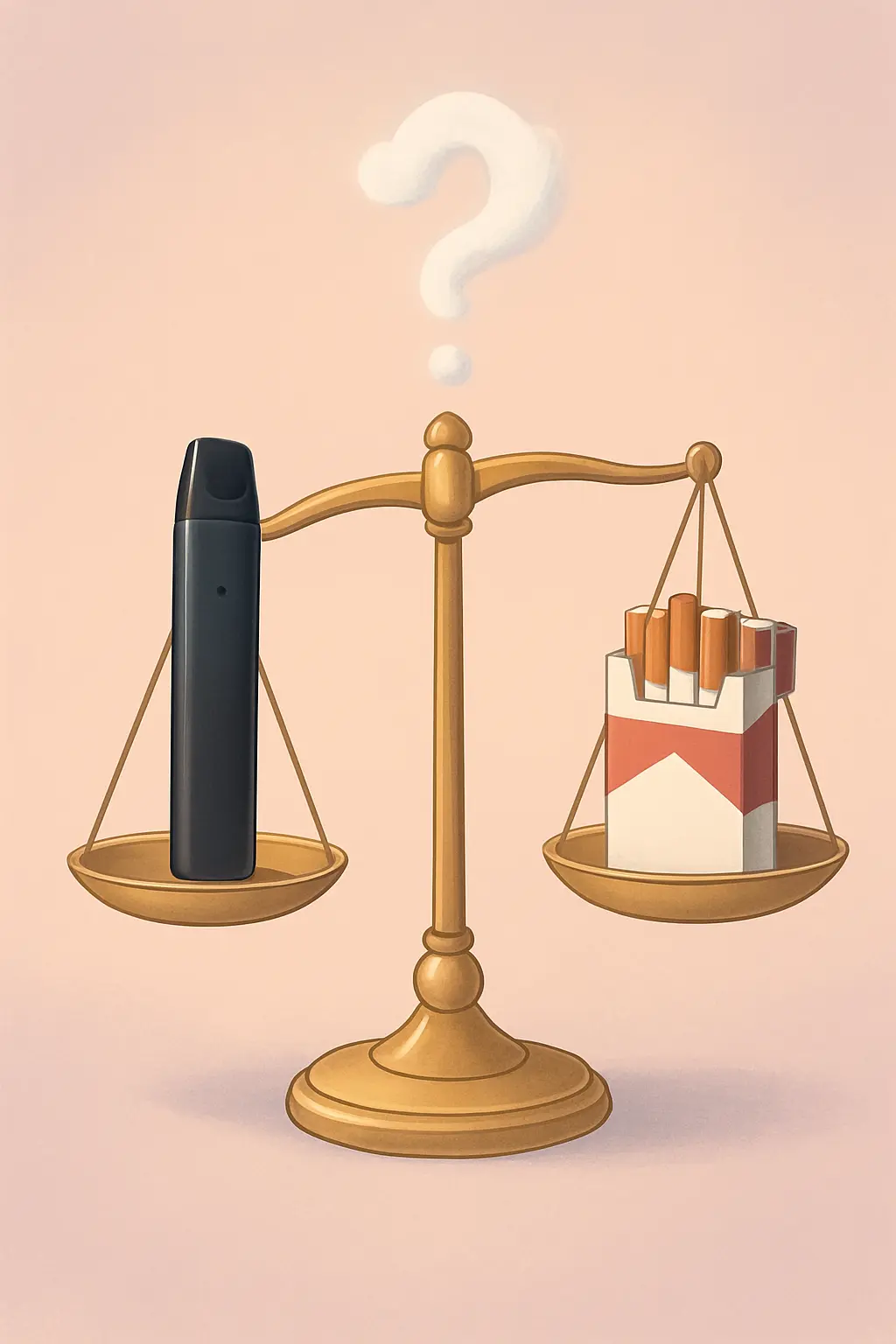
There is no fixed answer to how many cigarettes is a vape, because a vape does not hold a set number of “cigarettes” of nicotine. The best independent estimate is for a strong 5% pod of the kind sold in the US: studies suggest one pod can deliver roughly the nicotine of 13 to 30 cigarettes, or about a pack. A lower-strength UK or EU pod usually delivers less. How much you actually absorb depends on the liquid strength, the device, and how you puff.
This guide explains why the nicotine in the liquid is not the nicotine you absorb, what legal strength limits mean, what research says about pods and puffs, and how to use a rough estimate to plan a taper or pick a nicotine replacement product without fooling yourself.
Short answer: is one vape pod a pack of cigarettes?
For some pods, roughly yes. A 2022 review in Tobacco Control looked at the popular JUUL pod, which in the US contains 5% nicotine by weight. The manufacturer describes each pod as containing about 40 mg of nicotine and as “approximately equivalent to about 1 pack of cigarettes.” Independent lab tests in the review found 39.3 to 48.3 mg of nicotine in the liquid of each pod.
Liquid is not the same as dose, so the reviewers also looked at how much nicotine reaches the vapor. Using measurements from aerosol studies, they estimated that a pod vaped over 200 puffs delivers the nicotine equivalent of 13 to 30 cigarettes. A study that measured nicotine in people who switched to the pod for five days found an equivalence of about 18 cigarettes. Their conclusion: one pod appears capable of delivering about a pack’s worth of nicotine, with variability.
That estimate applies to a high-strength pod. Most vapes are different, so the honest answer for your own device is “it depends,” and the rest of this guide explains on what.
Nicotine in a cigarette vs nicotine you absorb
The tobacco in a cigarette contains far more nicotine than a smoker takes in. According to a review by Benowitz and Henningfield in Tobacco Control, smokers absorb about 10% of the nicotine in the cigarette, with a typical intake of 1 to 2 mg of nicotine per cigarette. The rest is burned, lost in sidestream smoke, or left in the butt. Our explainer on nicotine in one cigarette goes deeper into those numbers.
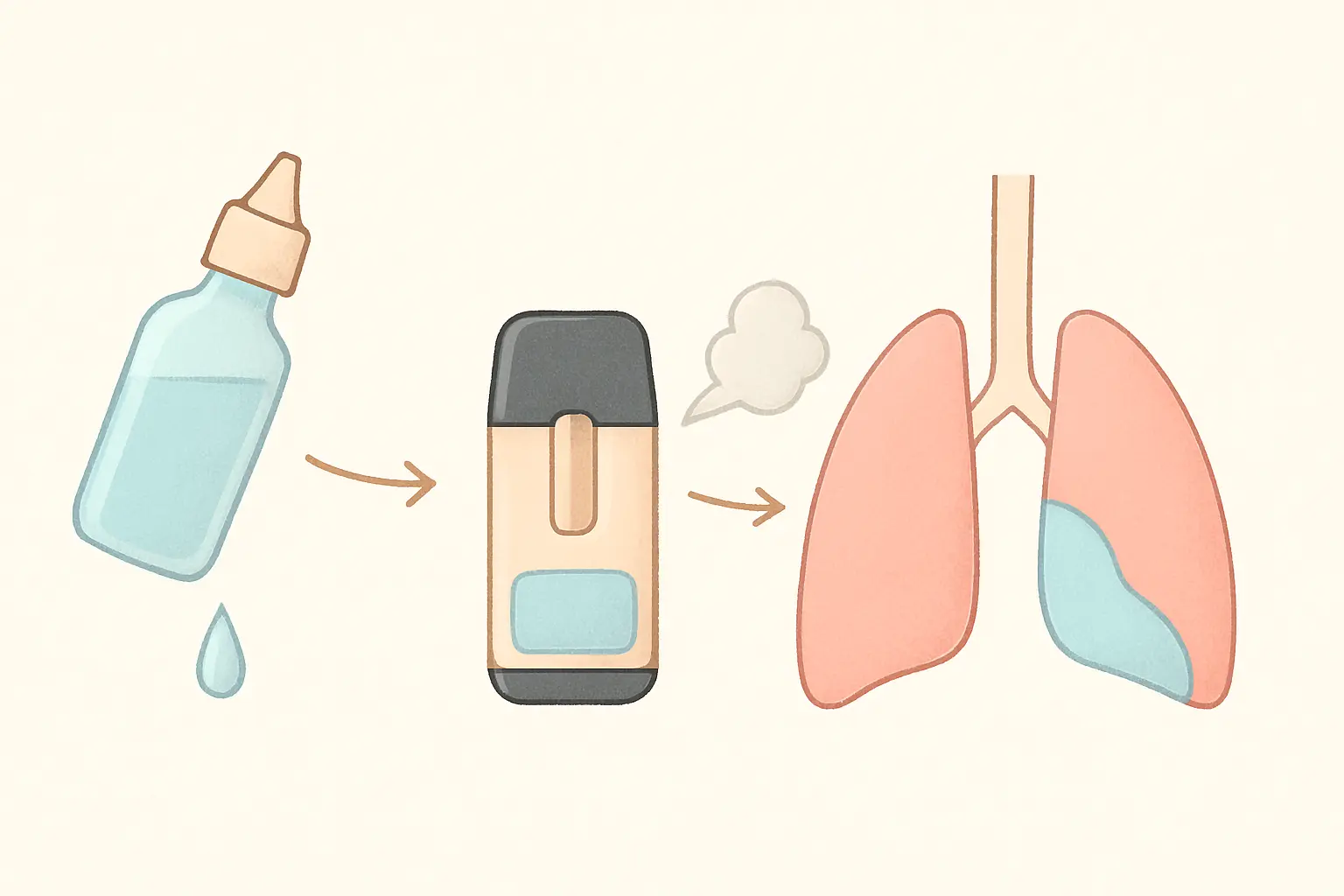
Vaping works in a similar way. The number printed on the bottle tells you how much nicotine is in the liquid, not how much ends up in your blood. Some nicotine stays in the device, some is breathed back out, and the amount turned into vapor depends on the coil, the power setting and how long and hard you draw.
This is why milligram-for-milligram comparisons mislead. Saying “my pod has 40 mg and a cigarette has 1 to 2 mg, so my pod is 20 to 40 cigarettes” treats all the liquid nicotine as absorbed, which it is not. It also ignores how quickly the nicotine arrives, which matters for cravings and dependence.
E-liquid strengths and legal limits
Where you live changes what strength you can buy. In the UK, the Tobacco and Related Products Regulations 2016 set clear limits, summarized in GOV.UK guidance on e-cigarette regulations:
- Nicotine strength of no more than 20 mg/ml.
- Tanks with a capacity of no more than 2 ml.
- Refill containers of no more than 10 ml of nicotine-containing liquid.
- Child-resistant and tamper-evident packaging.
Some quick arithmetic shows the upper limit of what a UK device can hold: a full 2 ml tank at 20 mg/ml contains at most 40 mg of nicotine in the liquid. That is similar to the liquid content of a US 5% pod, yet research shows a 20 mg/ml pod delivers far less nicotine to the user (see below).
In the US, the research studies above used a JUUL pod at 59 mg/ml, almost three times the UK cap, which shows that much stronger products have been sold there. If you vape a product bought outside the UK or EU, check the label rather than assuming a limit applies.
A final caution: the CDC notes that some e-cigarettes marketed as containing zero nicotine have been found to contain it. Labels on unregulated or illicit products may not be accurate.
| Product | Nicotine in the product | Nicotine a user typically gets | Source |
|---|---|---|---|
| One cigarette | Much more than is absorbed (about 10% is taken in) | About 1 to 2 mg | Benowitz and Henningfield, 2013 |
| US 5% JUUL pod (about 59 mg/ml) | About 39 to 48 mg per pod in lab tests | Estimated 13 to 30 cigarettes’ worth over 200 puffs | Prochaska et al., 2022 |
| UK/EU maximum (20 mg/ml) | Up to 40 mg in a full 2 ml tank | Varies; the 20 mg/ml JUUL delivered much less than the US version | GOV.UK; Phillips-Waller et al., 2021 |
| Nicotine patch | 7, 14 or 21 mg delivered over 24 hours | Slow, steady levels, no spikes | NicoDerm CQ label |
Pods, disposables and puff counts
Many people try to convert with puff counts, treating a set number of puffs as one cigarette. That shortcut is shaky for three reasons.
- Puffs vary in size. Aerosol studies in the 2022 review measured between 72 and 164 micrograms of nicotine per puff from the same type of pod, more than a twofold range, depending on the puffing method and equipment.
- People adjust their puffing. Vapers tend to take more or longer puffs when their liquid is weaker, as explained below.
- Puff counts on packaging are estimates. A disposable’s advertised puff number depends on assumed puff length and is not a measure of the nicotine you take in.
A more useful approach is to track how long a pod, tank or disposable lasts you. If a pod that used to last three days now lasts one, your intake has gone up, whatever the equivalence number says. The vaping statistics we have compiled show how common daily use has become, and daily use is where intake quietly climbs.
Nicotine salts vs freebase
Traditional “freebase” nicotine liquids feel harsh on the throat at high strengths. Nicotine salts are a different chemical form that feels smoother. The CDC explains that many e-cigarettes contain nicotine salts, which allow people to consume high levels of nicotine without the harshness of freebase nicotine.
That matters for the cigarette comparison. A laboratory study of nicotine salt e-cigarettes, published in 2019, found that nicotine reached the bloodstream as quickly as from a cigarette, although total delivery did not exceed a cigarette’s. It also found that results depended on the device, not just the liquid. In a separate 2020 study in Addiction, the 59 mg/ml US JUUL pod, which uses nicotine salts, produced a blood nicotine peak close to a cigarette’s. The peak came at about 4 minutes versus 6 minutes for the cigarette, sooner and higher than with other e-cigarette products tested.
Speed is part of what makes a product feel satisfying and part of what makes it habit-forming. A high-strength salt pod can feel much more like smoking than an older, low-strength refillable device, even when the milligrams on the label look similar.
This short NHS Smokefree video compares what smoking and vaping do in the body, a helpful reminder that nicotine dose is only one part of the picture.
What studies say about vapes and cigarettes
Research comparing vapes and cigarettes gives a consistent message: the answer changes with the product and the person.
Experience changes the result
In the 2022 JUUL review, peak nicotine levels from the pod were half to three-quarters of a cigarette’s in industry-run studies of people new to the device. In independent studies of experienced vapers, levels were comparable to or greater than a cigarette’s. Experienced users learn to get more from each puff.
Strength changes the result
A 2021 study in Psychopharmacology compared the EU version of the JUUL pod (20 mg/ml) with the US version (59 mg/ml). The EU pod delivered much less nicotine than the US pod, less than participants’ own cigarettes, and less than refillable e-cigarettes. Its peak blood nicotine level was 3.8 ng/ml, compared with 21.1 ng/ml for the US pod.
People compensate for weaker liquid
A 2018 real-world study in Addiction gave 20 experienced vapers low-strength (6 mg/ml) and high-strength (18 mg/ml) liquid. With the weaker liquid, they took more puffs and used more liquid, and they reported stronger urges to vape. Nicotine intake was still higher on the stronger liquid, so compensation was partial. The authors also cite earlier research in which vapers’ liquid strength fell over eight months while their cotinine levels, a marker of nicotine intake, stayed stable.
The practical takeaway: switching to a lower-strength liquid does not guarantee a lower dose. If you simply vape more, you can end up in a similar place.
Using the estimate to plan a taper or NRT
A rough equivalence is still useful, as long as you use it as a starting point rather than a prescription.
If you want to cut down or quit vaping
- Measure your real use for a week. Note how many pods, tanks or disposables you finish, and the strength.
- Watch your behavior, not just the label. If you step down in strength, check that you are not finishing liquid faster.
- Reduce in stages. Lower strength or volume gradually, and give each step time before the next.
- Expect withdrawal. Our vape withdrawal timeline explains what the first days and weeks feel like.
Our step-by-step plan for how to quit vaping turns this into a full schedule. If money is part of your motivation, our breakdown of whether vaping is cheaper than smoking puts numbers on it.
If you are thinking about nicotine replacement
Nicotine patch labels base the starting strength on cigarettes, not vaping. The US NicoDerm CQ label advises a 21 mg patch for people who smoke more than 10 cigarettes a day and 14 mg for 10 or fewer. There is no official conversion for vapers. A heavy user of strong pods may need more support than a light user of low-strength liquid, which is why a pharmacist or stop smoking service should help you choose. Our guide to matching patch strength explains the options.
If you vape to stay off cigarettes
The NHS advises smokers who use e-cigarettes to quit to use them as much as they need, with the right strength of nicotine for how much they smoked. Vaping is not recommended for non-smokers. If you switched from cigarettes, getting off cigarettes completely is the priority, and you can plan to come off nicotine later.

Tracking makes all of this easier. iQuit, free on Google Play and the App Store, lets you log each craving with its trigger and intensity, and its predictive craving forecasts learn your risky hours so you get a nudge before an urge peaks. If you would like to compare options, see our round-up of the best apps to quit vaping.
Vape vs Cigarette Nicotine FAQ
How many cigarettes is one vape pod?
It depends on the pod. For a strong US 5% JUUL pod, a 2022 review estimated nicotine delivery equal to about 13 to 30 cigarettes over 200 puffs, roughly a pack. Lower-strength pods usually deliver less, and your puffing style changes the result (Prochaska et al., Tobacco Control 2022).
How much nicotine do you get from one cigarette?
Smokers typically absorb about 1 to 2 mg of nicotine per cigarette, around 10% of the nicotine in the tobacco. The rest is burned, lost to the air or left in the butt (Benowitz and Henningfield, Tobacco Control 2013).
Is 20 mg/ml of nicotine a lot?
It is the legal maximum for nicotine e-liquid in the UK, where tanks are limited to 2 ml. In a study, a 20 mg/ml pod delivered much less nicotine than the 59 mg/ml US version and less than a cigarette. Delivery also depends on the device and how you vape (GOV.UK; Phillips-Waller et al. 2021).
Is vaping more addictive than smoking?
There is no simple yes or no, because products differ. A 59 mg/ml nicotine salt pod produced blood nicotine levels close to a cigarette’s and peaked quickly, while weaker devices delivered less. The CDC notes nicotine salts let people take in high levels of nicotine with less harshness (Hajek et al. 2020; CDC).
Does switching to a lower nicotine strength reduce my intake?
Not always. In a real-world study, vapers on weaker liquid took more puffs, used more liquid and felt stronger urges, though intake stayed lower than on stronger liquid. Track how fast you finish liquid when you step down, and reduce gradually (Dawkins et al., Addiction 2018).
What nicotine patch strength should a vaper use?
There is no official vape-to-patch conversion. Patch labels base strength on cigarettes: 21 mg for more than 10 a day, 14 mg for 10 or fewer. Ask a pharmacist or stop smoking service to help match a product to how much and how strongly you vape (NicoDerm CQ label).
Can a nicotine-free vape contain nicotine?
It can. The CDC reports that some e-cigarettes marketed as containing zero percent nicotine have been found to contain nicotine. If you want to avoid nicotine entirely, be cautious with unregulated products (CDC, About E-Cigarettes).
See your real nicotine habit, then shrink it
Log cravings with their trigger and intensity, get forecasts for your riskiest hours, and watch smoke-free days and money saved add up. iQuit is free on Google Play and the App Store.
Download iQuit Free on Google Play
Download on the App Store