
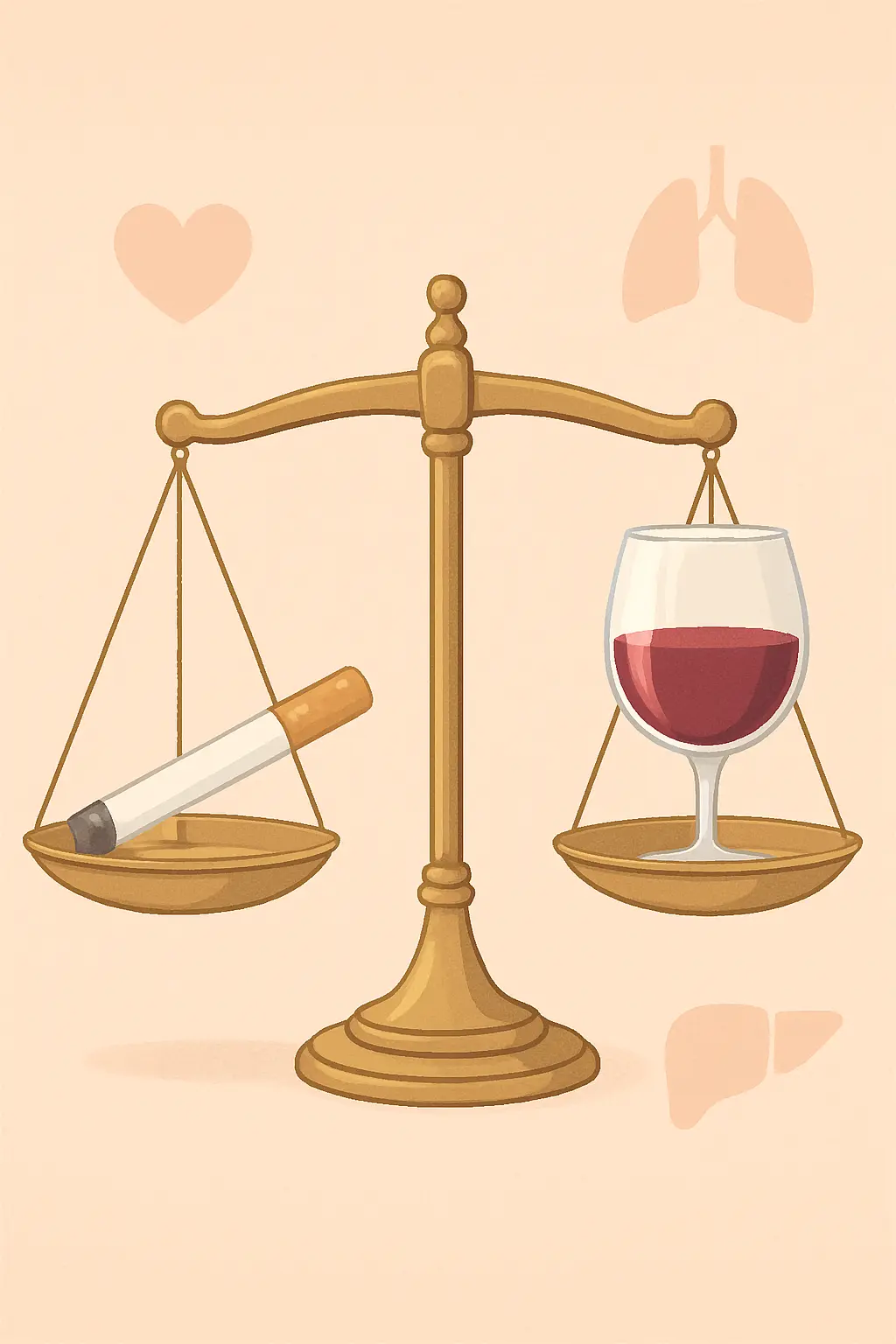
Is smoking worse than drinking? On almost every measure, yes. Smoking kills more people each year, both worldwide and in the US, and even one cigarette a day carries a large share of the heart risk of a full pack. Alcohol is also a serious cause of cancer, liver disease and injury, and no amount is completely risk-free. The two together are worse than either alone, especially for mouth and throat cancer. Here is how the risks compare, with the sources behind every number.
Smoking vs drinking at a glance
This table puts the headline evidence side by side. Figures come from the World Health Organization, the CDC, the NHS and peer-reviewed studies, checked on September 15, 2026. Note that the global death estimates come from different years, so treat the comparison as a broad picture rather than an exact ratio.
| Measure | Smoking | Alcohol |
|---|---|---|
| Deaths worldwide | More than 7 million a year, including over 1.6 million non-smokers (WHO) | About 2.6 million in 2019 (WHO) |
| Deaths in the US | More than 480,000 a year, including secondhand smoke (CDC) | About 178,000 a year from excessive drinking (CDC) |
| Safe level | No safe level of exposure (WHO) | No safe level for health (WHO Europe); under 14 units a week is “low-risk” (NHS) |
| Cancer | More than 20 types or subtypes (WHO) | At least 7 types (WHO Europe) |
| Main organs harmed | Heart, blood vessels, lungs | Liver, heart, brain and mental health |
| Harm to others | Secondhand smoke deaths | Injuries and road crashes caused by drinking |
| Using both | Greater than multiplied risk of head and neck cancers (pooled analysis, 2009) | |
Deaths each year from smoking and from alcohol
The WHO tobacco fact sheet, updated in June 2026, says tobacco kills more than 7 million people each year. That total includes over 1.6 million non-smokers exposed to secondhand smoke. WHO’s alcohol fact sheet puts alcohol-caused deaths at about 2.6 million worldwide in 2019. Of those, 1.6 million were from noncommunicable diseases and 700,000 from injuries.
The US picture has the same shape. The CDC says cigarette smoking and secondhand smoke cause more than 480,000 deaths a year. It puts deaths from excessive drinking at about 178,000 a year, based on 2020 to 2021 data. In both cases smoking accounts for roughly two and a half to three times as many deaths as alcohol.
Years of life lost
The two agencies measure lost life differently, so the numbers are not a direct match. The CDC says people who died from excessive drinking lost an average of 24 years of life. For smoking, the landmark 50-year study of British doctors found that men who kept smoking cigarettes died about 10 years younger than lifelong non-smokers. The same study found that stopping at 30 avoided almost all of that excess risk. For more detail on smoking deaths, see our breakdown of deaths from smoking.
Is there a safe amount of either?
Smoking: no safe level
WHO states plainly that “there is no safe level of exposure” to tobacco. A 2018 BMJ meta-analysis of 141 cohort studies shows why cutting down is not enough. Men who smoked about one cigarette a day had 46% of the excess heart disease risk of men who smoked 20 a day, and women had 31%. The authors concluded that no safe level of smoking exists for cardiovascular disease. Our guide on whether one cigarette a day is safe goes further.
Alcohol: lower risk, but not no risk
For alcohol, advice has two layers. The NHS guidance on drinking says men and women should not regularly drink more than 14 units a week, spread over three or more days. It calls drinking below 14 units “low-risk,” while also saying there is no “safe” drinking level. WHO’s European office goes further, stating in 2023 that “no level of alcohol consumption is safe for our health.”
The practical difference is in how risk rises with amount. Light drinking carries smaller risks that climb as intake grows. Smoking, by contrast, carries a large share of its heart risk from the very first cigarettes of the day.

Cancer risk compared
Both tobacco and alcohol are classified as Group 1 carcinogens by the International Agency for Research on Cancer, the highest risk category. But their reach differs. WHO links tobacco to more than 20 types or subtypes of cancer. WHO’s European office says alcohol causes at least seven, including bowel cancer and female breast cancer. In 2019, WHO attributed 4.4% of cancers diagnosed worldwide, and 401,000 cancer deaths, to alcohol.
The US National Cancer Institute gives a sense of scale for heavy drinking. Its fact sheet says heavy drinkers are about 5 times as likely to develop mouth and throat cancer, and 2 times as likely to develop liver cancer, as people who do not drink. Even light and moderate drinking slightly raises breast cancer risk. For tobacco, see our full guide to cancers caused by smoking.
A Mayo Clinic specialist answers whether smoking or drinking raises the risk of colorectal cancer.
Heart, lungs and liver
- Heart and circulation. WHO calls tobacco a major risk factor for cardiovascular disease. The BMJ analysis above found that even one cigarette a day raised heart disease risk far more than expected. Alcohol also harms the heart: WHO estimates it caused 474,000 cardiovascular deaths in 2019.
- Lungs. Smoking is the clear leader here. WHO lists respiratory disease among tobacco’s major harms.
- Liver. Alcohol is the clear leader. WHO links drinking to liver diseases, and the NCI says heavy drinking roughly doubles liver cancer risk.
- Brain and mental health. WHO links alcohol to depression, anxiety and alcohol use disorders. It estimates about 400 million people aged 15 and over live with an alcohol use disorder.
Harm to other people
Both habits hurt people who never chose them. WHO says secondhand smoke kills more than 1.6 million people a year. For alcohol, WHO says 156,000 of the 298,000 road crash deaths linked to alcohol in 2019 were caused by someone else’s drinking.
Why smoking and drinking together multiply risk
Using both is worse than simply adding one risk to the other. The NCI alcohol and cancer fact sheet says people who use both have much greater risks of cancers of the mouth, throat, voice box and esophagus than people who use either alone. For mouth and throat cancers, it says the harms are multiplicative, greater than adding the two together.
A large pooled analysis published in 2009 drew on 17 case-control studies with more than 11,000 head and neck cancer cases. It found a “greater than multiplicative” joint effect of tobacco and alcohol. It estimated that 72% of head and neck cancers in the data were attributable to tobacco, alcohol or both. That breaks down to 33% from tobacco alone, 4% from alcohol alone and 35% from the two combined.
| Cause | Share of cases |
|---|---|
| Tobacco alone | 33% |
| Alcohol alone | 4% |
| Tobacco and alcohol combined | 35% |
| Total attributable to either or both | 72% |
The two habits also feed each other day to day, and for many people a drink is a strong trigger for a cigarette. Our guide to the smoking and alcohol link explains why, and how smoking rates differ between countries is covered in our smoking rates by country ranking.
Which should you quit first?
For most people, stopping smoking is the bigger health win, and it does not have to wait. There are three things worth knowing before you decide.
- Quitting smoking does not seem to undermine alcohol recovery. A 2004 meta-analysis of 19 randomized trials looked at people in addiction treatment or recovery. Smoking cessation support during treatment was linked to a 25% higher chance of long-term abstinence from alcohol and drugs. The authors concluded it appeared to “enhance rather than compromise long-term sobriety.”
- If you are dependent on alcohol, get medical help before stopping. The NHS warns it can be very dangerous to stop drinking suddenly if you are dependent. Withdrawal symptoms can include seizures, so see a GP or an alcohol support service first.
- Cutting drinking helps your quit attempt. If drinking is one of your strongest smoking triggers, drinking less or avoiding it in the first weeks can make cravings easier to handle.
If you want to tackle both at once, our plan for quitting both together sets out the steps. Tracking helps too. iQuit lets you log each craving with its trigger and intensity, so you can see whether evenings with a drink are your riskiest moments. Its SOS tools and AI coach give you something to reach for when they arrive.
Smoking vs drinking FAQ
Is smoking worse than drinking?
Generally, yes. WHO estimates tobacco kills more than 7 million people a year, against about 2.6 million alcohol deaths in 2019. In the US, the CDC counts more than 480,000 smoking deaths a year against about 178,000 from excessive drinking. Alcohol is still a major cause of cancer, liver disease and injury (WHO; CDC).
Is one cigarette worse than one drink?
For heart health, very low smoking is surprisingly harmful. A 2018 BMJ meta-analysis found men smoking about one cigarette a day had 46% of the excess heart disease risk of a pack-a-day smoker. NHS guidance calls drinking under 14 units a week low-risk, though WHO Europe says no level of alcohol is fully safe (BMJ, 2018; NHS).
Which causes more cancer, smoking or alcohol?
Smoking is linked to more cancer types. WHO says tobacco causes more than 20 types or subtypes of cancer, while alcohol causes at least seven, including bowel and breast cancer. WHO attributed 4.4% of cancers diagnosed worldwide in 2019 to alcohol. Both are Group 1 carcinogens (WHO; WHO Europe).
Why is smoking and drinking together so dangerous?
For mouth and throat cancers, the risks multiply rather than simply add up. A 2009 pooled analysis of 17 studies found a greater than multiplicative joint effect and attributed 35% of head and neck cancers to tobacco and alcohol combined, more than either caused alone (National Cancer Institute; Cancer Epidemiology, Biomarkers and Prevention, 2009).
Should I quit smoking or drinking first?
Quitting smoking is usually the bigger health gain, and a 2004 meta-analysis found cessation support during addiction treatment was linked to better long-term sobriety. If you are dependent on alcohol, speak to a GP before stopping drinking, because the NHS warns sudden withdrawal can be dangerous and may cause seizures (J Consult Clin Psychol, 2004; NHS).
How many years of life does smoking take compared with drinking?
The measures differ. A 50-year study of British doctors found men who kept smoking died about 10 years younger than non-smokers, and quitting at 30 avoided almost all of that. The CDC says people who died from excessive drinking lost an average of 24 years of life (BMJ, 2004; CDC).
Does drinking make it harder to quit smoking?
For many people it does, because drinking is a common trigger for smoking. Planning ahead helps: drink less or avoid alcohol in the first weeks after quitting, and have a craving plan ready for social occasions. If you are dependent on alcohol, speak to a GP before cutting down, as the NHS advises.
Take the bigger health win first
iQuit helps you quit smoking with SOS craving tools, a craving log that spots triggers like drinking, disease-risk insights for 11 conditions and an AI coach that adapts to your progress. Free on Google Play and the App Store.
Download iQuit Free on Google Play
Download on the App Store


