
If you smoke 1 cigarette a day, you might assume your risk is a small fraction of a pack-a-day smoker’s — maybe a twentieth. It isn’t. The best available evidence puts the cardiovascular risk of one cigarette a day at roughly half the risk of twenty, which means light smoking is nowhere near as safe as the math suggests.
How much does one cigarette a day raise your heart disease risk?
A landmark 2018 meta-analysis of 141 cohort studies led by Professor Allan Hackshaw at UCL pooled 55 publications to answer exactly this question. The results surprised even the researchers.
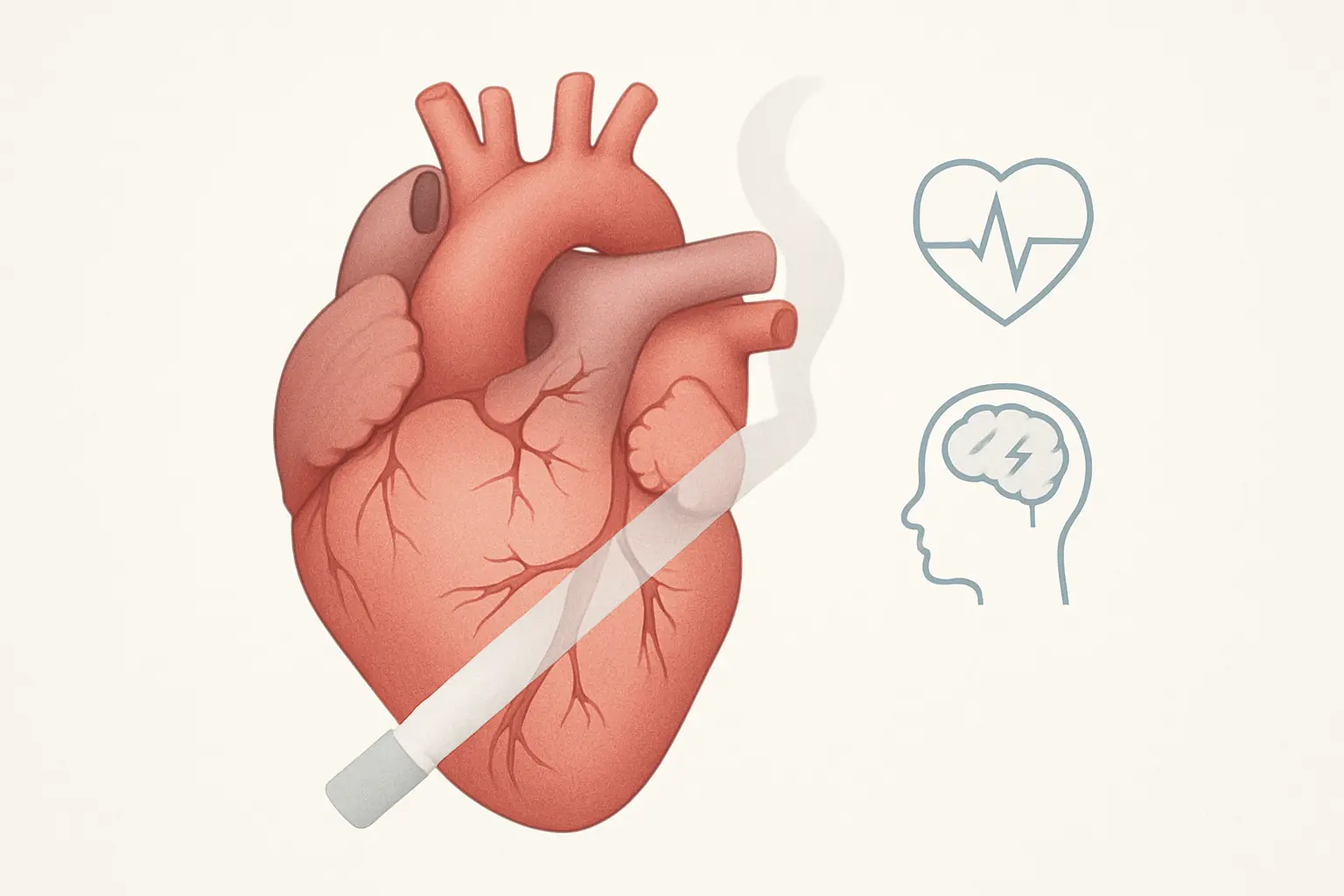
Men who smoked 1 cigarette a day had a pooled relative risk of 1.48 for coronary heart disease, compared with 2.04 for men smoking 20 a day. For women, the numbers were 1.57 versus 2.84. In percentage terms, that means one cigarette daily carries roughly 46% of the excess heart disease risk of a full pack for men, and about 31% for women — not the 5% you’d expect from the cigarette count alone.
Stroke risk followed the same pattern: men smoking 1 a day carried about 41% of the excess stroke risk of 20-a-day smokers, and women about 34%. The study’s blunt conclusion was that no safe level of smoking exists for cardiovascular disease.
| Condition | Men, 1/day | Men, 20/day | Women, 1/day | Women, 20/day |
|---|---|---|---|---|
| Coronary heart disease (relative risk) | 1.48 | 2.04 | 1.57 | 2.84 |
| Stroke (relative risk) | 1.25 | 1.64 | 1.31 | 2.16 |
Once you understand how much nicotine one cigarette actually delivers, the disproportionate cardiovascular hit makes more physiological sense — it isn’t the nicotine driving heart risk, it’s the combustion products hitting your arteries with every single cigarette, light or heavy.
Does one cigarette a day increase cancer risk too?
Yes, though the shape of the dose-response curve is different from heart disease. The CDC’s page on cigarettes and cancer states plainly that “people who smoke have a greater risk for lung cancer today than they did in 1964, even though they smoke fewer cigarettes.” The same page reports that cigarette smoking causes about one out of every three cancer deaths in the United States, and lists twelve body sites where smoking is an established cause of cancer.
Lung cancer risk does rise more steadily with cigarette count than heart disease risk does, but the key point for light smokers is the same: there’s no dose of daily smoking that current research treats as cancer-safe. If you want the full breakdown by cancer site, the complete smoking and cancer statistics cover relative risk across every major cancer type.
Mayo Clinic sums up the same finding in under a minute: when it comes to tobacco, there is no lesser evil.
Why isn’t smoking risk proportional to how much you smoke?
Two mechanisms explain the steep curve at low consumption. First, cardiovascular damage from smoking — platelet activation, endothelial dysfunction, arterial inflammation — turns on rapidly at very low exposure, then rises more gradually as consumption climbs. The first cigarette does outsized damage compared with the twentieth.
Second, compensatory smoking narrows the gap in what actually reaches your lungs. Researchers studying dose-response relationships have long observed that people who smoke fewer cigarettes tend to draw deeper, longer puffs per cigarette, partially offsetting the lower count. Someone smoking 1 cigarette a day is not inhaling a twentieth of the smoke a pack-a-day smoker inhales — they’re inhaling considerably more than that fraction.
This is also why how soon after waking you smoke your first cigarette predicts dependence better than your daily count does — a light smoker who lights up within minutes of waking is often more chemically dependent than the raw number suggests.
Is “just social smoking” any safer?
Social or occasional smoking — a few cigarettes at parties, with drinks, or once a week — carries lower absolute risk than daily smoking purely because total lifetime exposure is lower. But the same non-linear pattern holds: occasional smokers still show measurably elevated cardiovascular risk compared with people who have never smoked at all.
The practical problem with social smoking is less about the biology and more about trajectory. Nicotine dependence tends to escalate gradually, and “just on weekends” is one of the most common on-ramps to daily smoking, particularly under stress or during heavy drinking, which itself amplifies craving.
If you’re not sure whether your pattern is chemical dependence or a cued habit around drinking and socializing, the difference between a nicotine craving and a habit urge changes which tools actually help — worth untangling before you assume “social” means “safe.”
Is cutting down to 1 a day a useful step?
For some smokers, tapering from a pack a day down toward one cigarette can be a reasonable bridge, especially when it’s a deliberate step toward zero with a set end date rather than a permanent plateau. Reducing daily consumption is associated with lower lung cancer risk than not reducing at all, but the benefit isn’t linear and it never approaches the benefit of quitting completely.
Where cutting down goes wrong is when it becomes the destination instead of a step. If you’ve been “down to just one” for months or years without a further reduction plan, that plateau is worth revisiting — the cardiovascular data above shows you’re still carrying nearly half the excess risk of a full pack.
One thing that helps at this stage is knowing precisely when your remaining cigarette gets smoked. Logging that single craving each day — the trigger, the intensity, the hour — turns a vague “I only have one” into a pattern you can plan around. The free iQuit app supports scheduled-reduction quits and learns your risky hours, which is exactly the data a one-a-day smoker needs before setting a stop date.
What happens to your risk if you quit that last cigarette?
Risk starts falling within weeks of quitting even from a baseline of light smoking, though full normalization takes longer. Circulation and blood pressure begin improving in the first month; excess heart attack risk drops substantially within the first year; and by five to ten years smoke-free, cardiovascular risk approaches that of someone who never smoked. For the full week-by-week and year-by-year picture, this hour-by-hour recovery guide walks through what changes and when.
If your light smoking is tangled up with cardiovascular risk specifically, the data on how fast cardiovascular risk falls after quitting breaks down the exact timeline by risk factor. And if you’re weighing whether the scale of harm from smoking in general justifies quitting now rather than tapering further, the mortality data on how many people smoking kills each year puts your personal risk in context.
One caution worth flagging: quitting after light smoking is not risk-free of relapse either. Having just one cigarette after you’ve quit is a different question from the one this article answers, but it’s worth reading if your quit history includes going back to “just one” before.
A realistic plan for quitting your last cigarette a day
One-a-day smokers rarely need a long taper — there is nothing left to taper. What they usually need is a plan for the single ritual that cigarette is attached to, because at this level the habit loop is doing more work than the nicotine.
A workable two-week approach looks like this:
- Days 1–3: map it. Don’t change anything. Just write down the time, place, mood and company for your one cigarette each day. Most light smokers find it is welded to one specific cue — the drive home, the first coffee, the after-dinner step outside.
- Days 4–7: break the pairing. Keep the cigarette but move it. Smoke it standing somewhere neutral, at a different hour, without the coffee or the phone. This is the step that makes the last cigarette feel optional rather than automatic.
- Day 8: set the stop date and tell one person. A named date beats “soon” by a wide margin in every behavioral-support trial of quit planning.
- Days 8–14: rehearse the replacement. Decide in advance what happens in that exact slot instead — a five-minute walk, a glass of water on the step, a 4-7-8 breathing round. Rehearsing the substitute before quit day is what stops the slot from sitting empty.
Do light smokers need nicotine replacement? Often not at one cigarette a day, but it is not wrong to use it — and if your one cigarette is the first thing you reach for in the morning, that is a dependence signal worth treating with 2 mg gum or a low-dose patch rather than willpower alone. Ask a pharmacist; NRT is sold without prescription in the US, UK and most of Europe.
Light-smoking myths versus the evidence
| What people say | What the evidence shows |
|---|---|
| “One a day is 5% of the risk of a pack.” | For coronary heart disease it is closer to 46% (men) and 31% (women) of the excess risk of 20 a day (BMJ 2018). |
| “I’m not addicted, I only have one.” | Time to first cigarette after waking predicts dependence better than daily count; a morning-only smoker can be highly dependent. |
| “Cutting down is basically as good as quitting.” | Reduction lowers some risks but never approaches quitting; only cessation removes the excess cardiovascular risk. |
| “Rolling my own or smoking lighter cigarettes reduces the harm.” | Compensatory deeper puffing offsets much of the nominal reduction; no cigarette type is treated as safe. |
| “I’ll count as a non-smoker for insurance.” | Any current cigarette use is normally classified as smoker status; the smoke-free clock assumes zero cigarettes. |
Frequently Asked Questions
Is smoking 1 cigarette a day bad for your heart?
Yes. A 2018 meta-analysis of 141 cohort studies found men smoking 1 cigarette a day carry about 46% of the excess coronary heart disease risk of smoking 20 a day, and women carry about 31% — far more than the 1/20th you’d expect from the count alone (BMJ, Hackshaw et al 2018).
Does 1 cigarette a day raise cancer risk too?
Yes. The CDC states that people who smoke have a greater risk for lung cancer today than they did in 1964 even though they smoke fewer cigarettes, and that smoking causes about one in three US cancer deaths. There is no dose of daily smoking research treats as risk-free (CDC, Cigarettes and Cancer).
Why is the risk not proportional to how many cigarettes I smoke?
Cardiovascular damage from smoking — platelet activation, arterial inflammation, endothelial dysfunction — turns on sharply at very low exposure and then rises more gradually, so the first cigarette does disproportionate harm compared with the twentieth (BMJ 2018 meta-analysis).
Is social smoking a few cigarettes a week actually safer?
It carries lower absolute risk than daily smoking simply from less total exposure, but the same non-linear pattern applies — occasional smokers still show measurably higher cardiovascular risk than people who have never smoked, with no threshold research treats as zero-risk.
Is cutting down to 1 cigarette a day a useful step toward quitting?
It can be a reasonable bridge for some smokers, but cutting down should be treated as a step on the way to zero, not a stopping point — the evidence is consistent that only quitting fully removes the excess cardiovascular and cancer risk, not reduction alone.
Does quitting reverse the risk from years of smoking 1 a day?
Yes, risk falls measurably after quitting even from light smoking, though the timeline runs in months to years rather than days. Cardiovascular risk begins improving within weeks and continues declining for up to a decade or more, according to CDC and NHS recovery timelines.
Does using nicotine replacement instead of 1 cigarette a day carry the same risk?
No. NRT delivers nicotine without the combustion products — tar, carbon monoxide, and thousands of other chemicals — that drive the cardiovascular and cancer risk of even light cigarette smoking, which is why NHS and FDA guidance treats NRT as far lower-risk than any level of smoking.
Does 1 cigarette a day count as being a smoker for insurance or medical purposes?
Generally yes. Most life insurers, employers, and clinical questionnaires classify any current cigarette use, including less-than-daily use, as smoker status — the 12-month smoke-free threshold used for non-smoker reclassification assumes zero cigarettes, not a reduced number.
Do I need to tell my doctor I only smoke one a day?
Yes. Light daily smoking still changes decisions about contraception, surgery, anesthesia and cardiovascular screening, and it makes you eligible for cessation support. Under-reporting is common among one-a-day smokers, and it costs them help they would otherwise be offered.
See your real risk fall, one smoke-free day at a time
iQuit’s disease-risk insights show your personal risk for 11 conditions dropping as you rack up smoke-free days — plus craving forecasts, SOS breathing tools, and craving logging built for exactly the kind of light, daily smoking this article covers. Free on Google Play (4.3★) and the App Store.