Leukoplakia is a white patch, or several patches, in the mouth that cannot be rubbed or scraped away. For smokers it is one of the more important mouth findings to take seriously, because it can be a pre-cancer change and tobacco is thought to increase your chances of developing it. The good news in the sources is practical: the NHS says patches may get smaller or go away if you stop smoking, stop drinking alcohol or cut down, and do not chew tobacco, paan or betel nuts. This guide explains what leukoplakia looks like, what the cancer-risk research does and does not say, and what to do next.
What leukoplakia is
The NHS describes leukoplakia as a white patch or patches in the mouth. According to the NHS, leukoplakia patches are white, are not usually painful, are an irregular shape, may be slightly raised, may have red areas within the patch, and cannot be rubbed or scraped away. That last point matters: the NHS notes that patches that can be removed could be oral thrush instead.
The NHS says patches often appear on or below the tongue, but you can also get them on the inside of your cheeks, on the gums, or on the floor or roof of the mouth.
Because leukoplakia is usually painless, many people only find it by accident, at a dental check-up or while looking in the mirror. That is why a regular dental visit is worth keeping if you smoke.
Tobacco as the main cause
The NHS says the exact cause of leukoplakia is not known, but that smoking and chewing tobacco are thought to increase your chances of getting it. The same page lists alcohol as another factor to cut down.
The American Cancer Society adds context on why the mouth is so exposed. It says many of the chemicals in tobacco can damage DNA directly, that the more you smoke the greater your risk of oral cavity and oropharyngeal cancers, and that smoke from cigarettes, pipes and cigars increases risk. It also says smoking and drinking alcohol together multiplies the risk, and that in people who drink and smoke heavily the risk is about 30 times higher than in people who do not smoke or drink.
If you want the bigger picture of which cancers smoking is linked to, see our guide to what cancers does smoking cause risk data. For the everyday effects on teeth and gums, read teeth and gums after quitting smoking.
How it looks and when to worry
A white patch alone is not enough to say what it is. The NHS says a dentist or GP will look at the patch and can rule out other causes such as a fungal infection (oral thrush) or cheek biting. A biopsy may be needed to know for sure.
The NHS tells you to see a dentist or GP if:
- you have a white patch in your mouth that does not go away;
- you have a white patch on your tongue and a weakened immune system, for example if you have HIV or have had an organ transplant;
- you have pain or discomfort in your mouth that is not going away.
Do not wait to see whether it passes if it has been there for weeks. A patch that does not go away is exactly the situation the NHS describes.
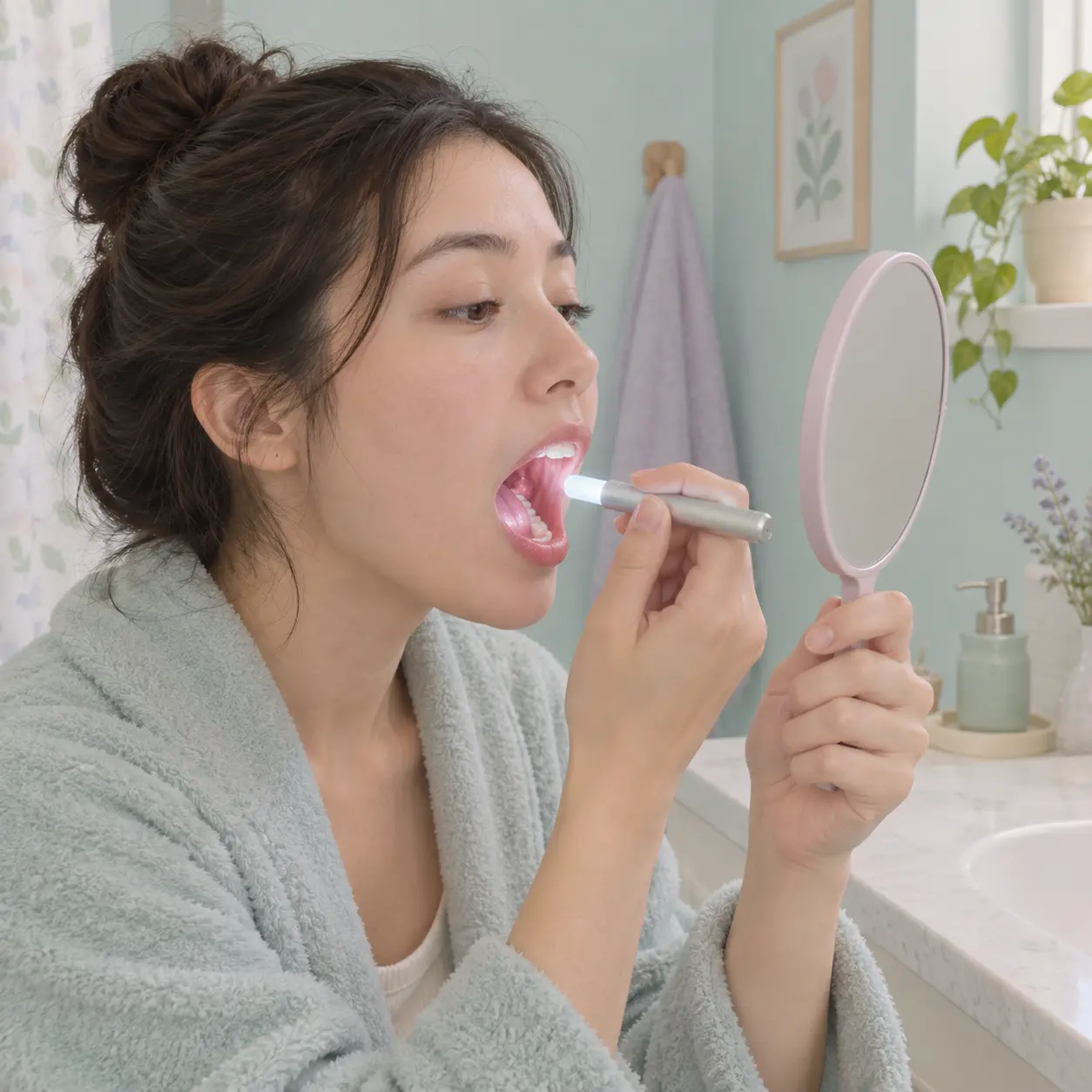
This short Cleveland Clinic video walks through a simple self-check of the mouth, which can help you notice a patch early.
Hairy leukoplakia is different
The NHS explains that there are several types of leukoplakia. Hairy leukoplakia is caused by the Epstein-Barr virus and mostly affects people with a weakened immune system. It causes fuzzy white patches, often on the sides of the tongue, and, unlike other types, it does not carry a risk of mouth cancer. Most smokers with a persistent white patch will not have this type, which is one reason a clinician needs to examine it.
Cancer risk: what the transformation figures show
This is the question that worries people most, so here is an honest answer. The American Cancer Society says areas of leukoplakia or erythroplakia, which are pre-cancer growths, sometimes turn into cancer. A Cochrane review describes oral leukoplakia as a relatively common lesion that, in a small proportion of people, precedes the development of oral cancer.
How small a proportion? The studies disagree widely, and I will not give you one number because it would be misleading. Two systematic reviews illustrate the spread:
| Review | Studies included | Range reported across studies |
|---|---|---|
| Journal of Oral Pathology & Medicine, 2016 | 24 observational studies | 0.13% to 34.0% |
| Oral Diseases, 2021 | 24 studies, 16,604 patients | 1.1% to 40.8% |
The range is wide because studies define leukoplakia differently, follow patients for different lengths of time, and include different kinds of lesions. The 2016 review itself says drawing meaningful evidence-based conclusions is difficult from retrospective studies of this nature.
What the reviews do agree on is which features carry more risk. The 2016 review lists advanced age, female sex, leukoplakia exceeding 200 mm2, non-homogeneous type (for example erythroleukoplakia, a patch with red areas) and higher grades of dysplasia. The 2021 review found female gender, non-homogeneous clinical type and epithelial dysplasia significantly related to transformation. A 2025 meta-analysis of 55 studies concluded that the probability is especially increased in large non-homogeneous lesions in smokers, located on the lateral border of the tongue, with epithelial dysplasia.
Reviews also describe a rarer, more aggressive form called proliferative verrucous leukoplakia, with much higher transformation figures than ordinary leukoplakia. If a specialist uses that term, ask what it means for follow-up.
Does it go away after quitting?
The NHS says the patch may get smaller or go away if you stop smoking, stop drinking alcohol or reduce the amount you drink, and do not chew tobacco, paan or betel nuts. It uses the word “may,” and I have not found a source giving a percentage of patches that regress after quitting, so I will not quote one.
The American Cancer Society adds an important caution. Even when leukoplakia areas are completely removed, studies have found that people with certain types still have a higher chance of developing cancer in another area of the mouth. It explains this may be because the whole lining of the mouth has likely been exposed to the same cancer-causing agents, such as tobacco. That is why people who have had areas removed are encouraged to keep getting regular check-ups.
For a broader view of what to expect when you stop, see our what happens when you quit smoking complete health recovery guide. The practical message is that stopping tobacco is the part you control, and check-ups are the part your clinician controls. Doing both is better than either alone. Our quit smoking success rates statistics page explains what helps people succeed, and bleeding gums after quitting smoking covers a common early mouth symptom that is separate from leukoplakia.
Diagnosis and biopsy
According to the NHS, if leukoplakia is suspected you may be referred to a specialist for a biopsy, where a small piece of the patch is removed and checked for abnormal cells. Treatment is not always needed, but you will have regular check-ups to make sure the patch is not getting bigger.
The NHS says surgery is sometimes used to remove patches if there is a chance they could become cancerous. It may be done after numbing the area with local anesthetic, sometimes with a general anesthetic, and the patch can be removed using a laser or a surgical scalpel. The mouth should heal quickly afterward.
The reviews above also point to dysplasia, which is abnormal growth seen under the microscope, as one of the stronger signals of risk. That is something only a biopsy can show, which is why a visual look at a patch, however experienced, is not the end of the process.
Smokeless tobacco and betel quid
Leukoplakia is not only a cigarette problem. The NHS lists chewing tobacco, paan and betel nuts among the things to avoid. The American Cancer Society says oral tobacco products such as snuff, dip, spit, chew and dissolvable tobacco are linked with cancers of the cheek, gums and inner surface of the lips, and that using oral tobacco for a long time is linked to a very high risk.
If dip or chew is part of your routine, switching to cigarettes is not an answer, and neither is cutting back to a “smaller” dip. Our guide to how to quit chewing tobacco dip covers practical steps.
What to do this week
- Look in the mirror with good light and note any white or red patch, its location and size.
- If it has lasted more than a couple of weeks, book a dentist or GP visit and say you smoke or chew tobacco.
- Ask whether a biopsy is needed and how often you should be re-checked.
- Set a quit date for all tobacco and nicotine products you use, including dip.
- Cut down on alcohol, since the NHS lists it alongside tobacco.
The free iQuit app can help with the quitting side if you smoke. You can log cravings with their triggers and intensity, use SOS breathing and grounding tools, and watch your smoke-free streak and recovery milestones build, with streak shields and slip recovery if you stumble. It supports your quit attempt and does not diagnose or treat leukoplakia, so please still see a dentist or doctor about any patch.
Frequently Asked Questions
What is leukoplakia in smokers?
A white patch or patches in the mouth that cannot be rubbed or scraped away. The NHS says smoking and chewing tobacco are thought to increase the chance of getting it, and that any white patch that does not go away should be checked by a dentist or GP (NHS).
Is leukoplakia cancer?
No, but it can be pre-cancer. The American Cancer Society says leukoplakia areas sometimes turn into cancer, and the NHS says there is a small chance of progression over time. That is why a clinician should examine any patch that persists (American Cancer Society; NHS).
How likely is leukoplakia to become cancer?
Studies vary widely. A 2016 systematic review reported ranges from 0.13% to 34.0% across studies, and a 2021 review reported 1.1% to 40.8%. Risk is higher for large, non-uniform patches with dysplasia, so only a clinician can judge yours (PubMed, 2016 and 2021).
Can leukoplakia go away after quitting smoking?
It may. The NHS says a patch may get smaller or go away if you stop smoking, cut out or reduce alcohol, and avoid chewing tobacco, paan and betel nuts. It still needs checking and follow-up by a clinician (NHS).
How do I tell leukoplakia from oral thrush?
The NHS says leukoplakia patches cannot be rubbed or scraped away, whereas patches that can be removed could be oral thrush. Do not rely on this alone; a dentist or GP can tell the difference and decide on a biopsy (NHS).
Does leukoplakia hurt?
Usually not. The NHS says patches are not usually painful, which is why they can go unnoticed. Pain or discomfort in the mouth that is not going away is a separate reason to see a dentist or GP (NHS).
Does chewing tobacco cause leukoplakia?
The NHS says smoking and chewing tobacco are thought to increase your chance of leukoplakia, and the American Cancer Society links oral tobacco products with cancers of the cheek, gums and inner lips. Quitting all forms of tobacco is advised (NHS; American Cancer Society).
What happens if leukoplakia is removed?
The NHS says patches can be removed by laser or scalpel, often with local anesthetic, and the mouth should heal quickly. The American Cancer Society warns removal does not always prevent cancer elsewhere in the mouth, so regular check-ups continue (NHS; American Cancer Society).
Protect Your Mouth, Quit Tobacco Today
Whether it is cigarettes or chewing tobacco, stopping is the step you control. iQuit helps you log cravings, ride them out with SOS tools and track your smoke-free progress alongside your dental and medical care.