If you have a quit date coming up and a box of patches in your bag, you may be asking whether nicotine preloading is worth it: wearing the patch for a few weeks first, while you still smoke. The short answer from the best trial we have is a cautious yes, with a modest effect and a real catch. This guide walks through what the research found, what it did not find, and how to try it safely if you decide to.
Preloading is not the way the patch box tells you to use the product, so it is worth talking it through with a pharmacist or your stop smoking service first. Everything below sticks to what the trial reports and what the official labels say. If you are still choosing a quit date, our guide on how to set a quit date that sticks comes first.
What nicotine preloading means
Researchers define preloading as using nicotine replacement therapy prior to a quit date while smoking normally
, according to the summary of the UK trial published in Health Technology Assessment. The idea is simple. If nicotine from a patch dulls the drive to smoke, then each cigarette becomes less rewarding, and the cravings you face on quit day may be weaker. Those early cravings are, in the researchers’ words, the main cause of early relapse
.
That is different from the usual advice. The directions on a standard US over-the-counter patch label, which you can read on DailyMed, say to begin using the patch on your quit day
. Preloading starts earlier, so you would be using the product outside its printed directions. That does not make it dangerous or forbidden, but it is a reason to involve a professional rather than improvising.
Preloading is not cutting down
You are not trying to smoke less during the preloading weeks. The trial asked people to smoke normally while wearing the patch. If you want to reduce first, that is a separate approach, and our plan for quitting nicotine in any form compares the options side by side.
What the big UK trial found
The most useful evidence comes from the NIHR-funded Preloading randomized trial in NHS stop smoking clinics. According to the published abstract, 1792 people were eligible and were enrolled
, with 899 randomized to the intervention group and 893 to the control group. The intervention was wearing a 21 mg/24 hour nicotine patch for 4 weeks prior to quit date
, plus minimal behavioral support to explain why and to help people stick with it. The comparison group got equivalent support but no early patch.
The main result was six-month abstinence confirmed by a biochemical test. Here is what it showed.
| Measure | Result |
|---|---|
| Abstinent, preloading group | 157 people (17.5%) |
| Abstinent, control group | 129 people (14.4%) |
| Difference | 3.02 percentage points (95% CI -0.37 to 6.41) |
| Odds ratio | 1.25 (95% CI 0.97 to 1.62; p = 0.081) |
| Odds ratio after adjusting for post-quit varenicline use | 1.34 (95% CI 1.03 to 1.73; p = 0.028) |
Read that carefully. The unadjusted difference did not reach statistical significance, because the confidence interval crosses zero. Only after the authors adjusted for varenicline use after the quit date did the result clear that bar. So this is a modest, uncertain gain, not a miracle.
The catch: varenicline and side effects
The authors explain the gap. Their conclusion reads that preloading can increase the proportion of people who stop successfully, but its benefit is undermined because it reduces the use of varenicline after preloading
. In other words, people who had already spent four weeks on a patch were less likely to take varenicline afterward, and varenicline is itself an effective medicine. If that effect could be overcome, the authors write, preloading appears to improve health and reduce health-service costs in the long term
.
On safety, the abstract reports that the odds ratio for serious adverse events was 1.12 (95% CI 0.42 to 3.03), which is statistically uncertain and consistent with no difference. It also notes that moderate-severity nausea occurred in an additional 4% of the preloading group
compared with controls. Nausea is a known sign of too much nicotine, so it is something to watch for while you smoke and wear a patch at the same time.
The trial also suggests a mechanism. The authors report evidence that reduced urges to smoke and reduced smoke inhalation mediated the effect of preloading on abstinence
. They add a limitation: the trial was open-label, which could partially account for the mediation results
.
What the wider evidence says
One trial never settles a question. The Cochrane review of NRT doses, durations and timing, summarized on PubMed, pooled nine preloading studies. It reports moderate-certainty evidence, limited by risk of bias, of a favourable effect of preloading on abstinence
, with a risk ratio of 1.25 (95% CI 1.08 to 1.44) across 9 studies and 4,395 participants.
The same abstract adds a warning that matters for honesty. When the reviewers restricted their analysis to studies at low or unclear risk of bias, the results for every comparison stayed the same apart from the preloading comparison
. That is the review’s way of saying the preloading finding is less solid than, for example, the finding on combination NRT, where the abstract reports high-certainty evidence (risk ratio 1.27, 95% CI 1.17 to 1.37). Our combination NRT versus single NRT guide covers that better-supported strategy.
So the fair summary is this: the pooled evidence leans toward a small benefit, but it is moderate-certainty at best, and the biggest single trial was borderline.
Who might consider preloading, and who should ask first
The trial enrolled people seeking help to stop smoking
in NHS clinics, so the results apply best to someone already committed to a quit attempt with some support. Preloading makes the most sense for you if you are certain about your quit date, you already plan to use a patch, and you want a head start on cravings.
It makes less sense if you are still unsure about quitting, because wearing a patch for four weeks costs money and effort. And you should speak to a pharmacist or doctor before starting if any of the standard patch warnings apply. The US label says to ask a doctor before use if you have heart disease, recent heart attack, or irregular heartbeat
, high blood pressure not controlled with medication, an allergy to adhesive tape or skin problems, stomach ulcer or diabetes, or a history of seizures. It also says that if you are pregnant or breast-feeding
, you should only use the medicine on the advice of your health care provider, and to ask a doctor before use if you are under 18.
Those warnings are the same whether or not you preload. The difference is that you would be exposed to the patch, and to nicotine from cigarettes, at the same time.
How to preload with a patch, step by step
This is not medical advice, and the dose has to come from a professional or the product you buy. What follows is the shape of what the trial tested, laid out as steps.
- Pick your quit date first. Preloading only makes sense with a fixed target. Choose a date about four weeks away.
- Talk to a pharmacist. Tell them you want to start the patch before you stop smoking. Ask which strength suits you. The trial used a 21 mg/24 hour patch, but the US label puts people who smoke 10 or fewer cigarettes a day on a lower step, so do not assume 21 mg is right for you.
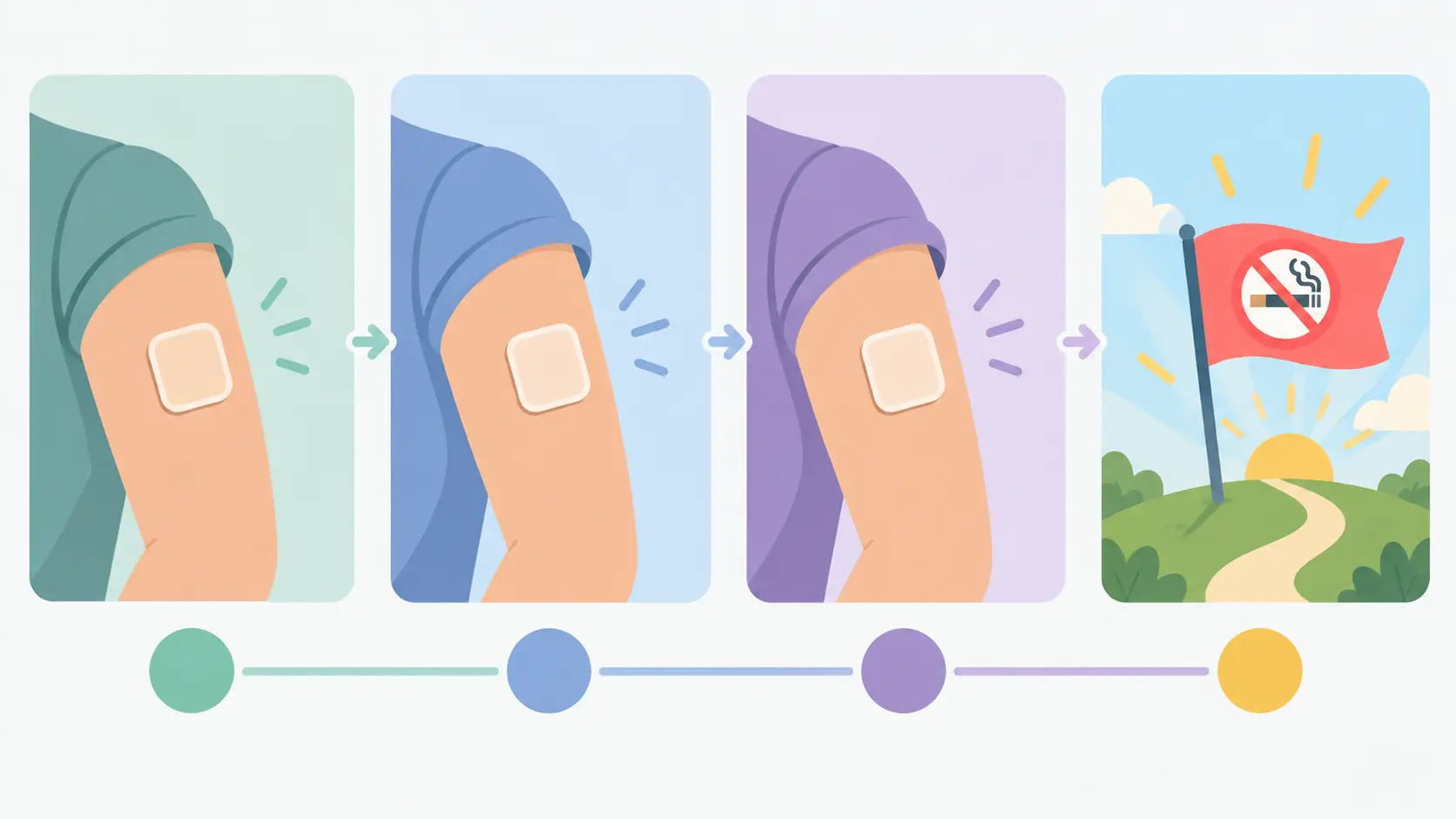
- Start the patch about four weeks before quit day. Wear it daily, as the instructions say, rotating the skin site each day.
- Keep smoking as you normally do for now. The aim is for the patch to take the edge off, not for you to change your habits yet.
- Notice what changes. The trial’s proposed mechanism was fewer urges and less inhalation. Jot down how each cigarette feels.
- Watch for too much nicotine. The US label tells you to stop use and ask a doctor if you get
symptoms of nicotine overdose, such as nausea, vomiting, dizziness, weakness and rapid heartbeat
. - Carry on into quit day. On your quit date you stop smoking and keep wearing the patch. Do not stop the patch on quit day.
For the routine of applying a patch, including where to place it and how to rotate sites, see our step-by-step guide to using nicotine patches.

Is it safe to smoke while wearing the patch?
This is the question everyone asks, because the box is built around stopping first. The honest answer is that the trial asked its participants to smoke normally while wearing the patch, and the abstract reports no clear excess of serious adverse events. It does report extra moderate nausea. The abstract does not say that smoking on the patch is risk-free, and it was a supervised trial in clinics, not a self-directed experiment.
If you want a longer look at that question, including what we know about nicotine overload, read our article on whether you can smoke while using nicotine patches. The takeaway is that the risk is mainly feeling unwell from too much nicotine, so go easy, watch for nausea, and ask for help if you get symptoms.
Preloading with varenicline instead
Varenicline is a prescription medicine, so any plan involving it belongs with your prescriber. Standard use already starts the medicine before the quit date. One small, single-center trial in Israel of 242 smokers compared six weeks of varenicline before quit day with the standard one week. It reported 24-week continuous abstinence of 23.1% vs. 4.1%
in favor of the longer course, with more nausea in the longer group at week 4 (39.6% versus 11.5%). The authors stress that confirmatory evidence is needed from larger clinical trials
, and the study is reported on PubMed. Treat it as a hint, not a plan.
Moving to your quit date and staying on track
The preloading weeks only matter if quit day goes well. A few things help. Keep wearing the patch, because the aim was to start the quit attempt with cravings already dampened. Use a fast-acting product too if cravings break through, since the NHS advises that the best approach is to combine a fast-acting source of nicotine, like a mouth spray with a slow-acting source of nicotine like a patch
. For how to use a spray correctly, see our guide to using a nicotine mouth spray.
Plan the length too. The NHS guide to stop-smoking products says the general advice is to use NRTs and other products for at least 12 weeks, or even longer if needed
. And keep the bigger picture in mind: the odds of staying quit are shaped by support and planning, which our overview of quit smoking success rates puts in context.
Where iQuit fits
iQuit is a quit-smoking app, free on Google Play and the App Store. During the preloading weeks, its craving log lets you record each craving with its trigger and intensity, so you can see whether things change by quit day. Its craving forecasts show your risky hours, and its Premium custom quit-plan generation can help you lay out the weeks around your date. It does not replace a patch or a pharmacist’s advice.
Frequently Asked Questions
What is nicotine preloading?
Nicotine preloading means using nicotine replacement therapy, usually a patch, before your quit date while you are still smoking as normal. The goal is to weaken the urge to smoke so cravings on quit day are lower. The UK trial used a 21 mg/24 hour patch for 4 weeks beforehand. (Health Technology Assessment trial summary)
Does nicotine preloading work?
Modestly. In the UK trial of 1,792 people, 17.5% of the preloading group and 14.4% of controls were abstinent at 6 months, which was not statistically significant (p = 0.081). A Cochrane review pooling 9 studies found a risk ratio of 1.25, with moderate-certainty evidence. (Health Technology Assessment; Cochrane)
How long should you wear a patch before your quit date?
The UK trial tested 4 weeks of a 21 mg/24 hour patch before quit day. The patch box itself says to begin on your quit day, so ask a pharmacist before starting early and confirm the strength that suits the number of cigarettes you smoke. (Health Technology Assessment; DailyMed patch label)
Can I smoke while wearing a nicotine patch?
In the preloading trial participants smoked normally while wearing the patch, and serious adverse events were not clearly different. Moderate nausea was 4% higher in the preloading group. Stop use and ask a doctor if you get nausea, vomiting, dizziness, weakness or a rapid heartbeat. (Health Technology Assessment; DailyMed patch label)
Is preloading better with varenicline or nicotine patches?
They are different approaches. The patch trial found its benefit was undermined because preloaders used less varenicline afterward. A small single-center trial of 242 smokers reported 23.1% versus 4.1% abstinence with 6 weeks of varenicline before quit day, but needs larger trials to confirm. Ask your prescriber. (Health Technology Assessment; PubMed)
Who should not preload with a nicotine patch?
Ask a doctor first if you have heart disease, a recent heart attack, an irregular heartbeat, uncontrolled high blood pressure, adhesive allergy, stomach ulcer, diabetes or seizures. The label also says pregnant or breast-feeding women should only use it on a provider’s advice, and under-18s should ask a doctor. (DailyMed patch label)
Should I stop the patch on my quit date?
No. Quit day is when you stop smoking while continuing the patch. The NHS general advice is to use NRTs and other products for at least 12 weeks, or even longer if needed, so preloading adds weeks before quit day rather than replacing treatment after it. (NHS)
Plan the Weeks Before Your Quit Date
Quit day goes better with a plan around it. iQuit gives you a craving log for triggers and intensity, craving forecasts that show your risky hours, SOS tools such as breathing exercises and craving surfing, and streak shields that help you recover from a slip. Premium adds custom quit-plan generation for the weeks around your date. It is free on Google Play and the App Store and does not replace NRT or your pharmacist.