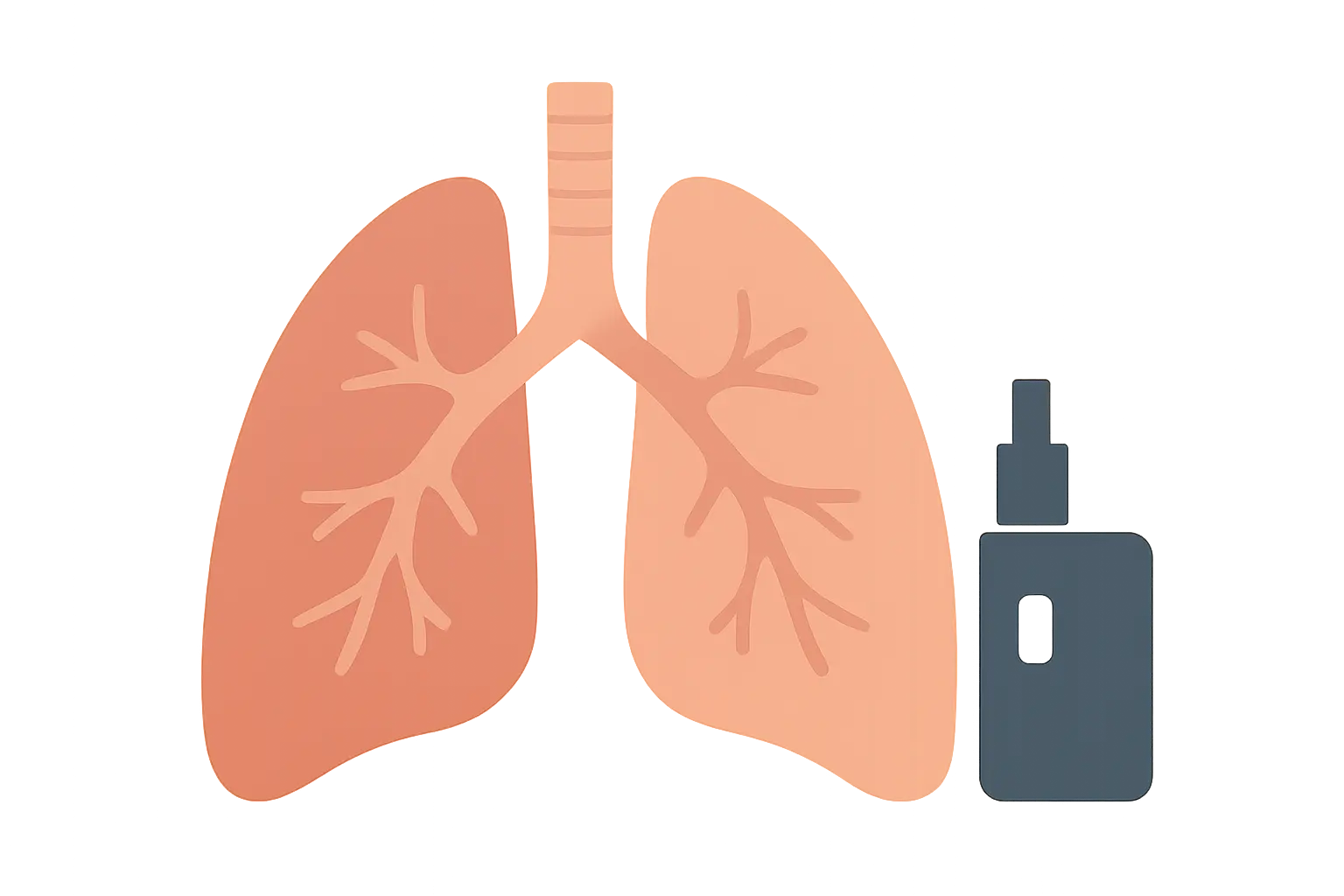
Popcorn lung is the nickname for obliterative bronchiolitis, a rare and incurable scarring disease of the lung’s smallest airways, first identified in factory workers exposed to the flavoring chemical diacetyl. The question of whether vaping causes it is one of the most-searched fears about e-cigarettes, and the honest answer sits between two extremes: diacetyl has been measured in some e-liquids, regulators in the UK and EU have banned it from vapes, and there are isolated case reports of severe bronchiolitis in vapers — but no large confirmed outbreak of classic occupational popcorn lung tied to vaping exists.
What Popcorn Lung Actually Is
Popcorn lung is the common name for obliterative bronchiolitis (also called bronchiolitis obliterans), a disease in which the lung’s smallest airways — the bronchioles — become scarred and narrowed. According to the U.S. National Institute for Occupational Safety and Health (NIOSH), “obliterative bronchiolitis causes scarring and constriction in the lung’s airways blocking air movement,” and critically, “obliterative bronchiolitis cannot be cured” (NIOSH, Flavorings and Lung Disease).
It is not a form of cancer and it is not the same thing as asthma or COPD, though it shares the symptom of breathlessness. Where asthma narrows airways through reversible inflammation that responds to inhalers, obliterative bronchiolitis physically scars the bronchiole walls, so the narrowing does not open back up with medication. Once the airway scarring sets in, it is permanent — which is why occupational health agencies treat prevention, not treatment, as the priority, and why any inhaled chemical with a documented link to it deserves scrutiny rather than reassurance.

Where the Name Came From: the Microwave-Popcorn Factory Workers
The name is not a marketing metaphor. In August 2000, a local health department asked NIOSH to investigate a cluster of obliterative bronchiolitis cases in former workers at a microwave-popcorn plant (NIOSH, Flavorings and Lung Disease). The investigation traced the disease to inhaled diacetyl, the artificial butter-flavor chemical used to scent the popcorn as it cooked. Workers who mixed and heated the flavoring — not people who simply ate popcorn at home — were the ones affected.
A 2026 clinical review in the Journal of Thoracic Disease summarizes the finding plainly: “the association between diacetyl inhalation and the development of bronchiolitis obliterans syndrome was first described in a group of microwave popcorn factory workers towards the start of the 21st century, with subsequent coining of the term ‘popcorn lung’” (Mellor et al., 2026). Exposed workers were more than twice as likely to report cough, breathlessness or wheeze compared with unexposed colleagues, alongside a measurable decline in lung function tests.
Is Diacetyl in Vapes? What’s Changed Since 2015
The vaping connection starts with a 2015 laboratory study. Harvard researchers tested 51 flavored e-cigarette products and found “diacetyl was detected above the laboratory limit of detection in 39 of the 51 flavors tested, ranging from below the limit of quantification to 239 μg per e-cigarette” (Allen et al., Environmental Health Perspectives, 2016). A related compound, 2,3-pentanedione, which carries similar concerns, turned up in 23 of the 51 flavors.
What has changed since then is regulation, not the underlying chemistry of every device on shelves today. The 2026 Journal of Thoracic Disease review notes that “the UK and European Union have both banned the inclusion of diacetyl and 2,3-pentanedione in e-liquids… though many countries including the US have not imposed such legislation” (Mellor et al., 2026). In practice, that means a vape bought in London or Berlin is legally required to be diacetyl-free, while one bought in most U.S. states carries no such guarantee — flavor testing has never been comprehensive, and neither the FDA nor manufacturers routinely publish diacetyl results for individual products.
Has Anyone Actually Gotten Popcorn Lung From Vaping?
This is the honesty trap worth naming directly: there is no confirmed large-scale outbreak of classic, factory-style popcorn lung caused by vaping — but that is different from saying it has never happened. The same 2026 review describes it this way: “early case reports of e-cigarette-related illnesses included presentations of bronchiolitis obliterans… however, whether these presentations represent distinct clinical entities or simply broader manifestations of [a separate injury] remains unclear” (Mellor et al., 2026). One of the case reports behind that sentence, published in the Canadian Medical Association Journal in 2019, described a previously healthy teenager who developed life-threatening bronchiolitis after vaping.
So the accurate picture is: isolated, severe case reports exist; a confirmed epidemic of classic occupational-style popcorn lung from vaping does not. Reviewers are honest that they cannot yet say whether these rare cases are the same disease process seen in popcorn-factory workers or a different acute injury that looks similar on a scan.
What Vaping Is Documented to Do to the Lungs
Popcorn lung is one entry on a longer list. The 2026 review catalogs several confirmed patterns of vaping-related lung injury beyond popcorn lung, including pneumothorax (a collapsed lung), hypersensitivity pneumonitis, lipoid pneumonia, eosinophilic pneumonia, organizing pneumonia and diffuse alveolar hemorrhage. The authors’ own summary is unambiguous: “there is a spectrum of lung disease associated with vaping, extending beyond [any single injury] alone… it is imperative that these devices are no longer viewed as ‘safe’” (Mellor et al., 2026). Chronic cough, breathlessness and wheeze are described as common among vapers, though the long-term trajectory of lung function is still being studied.
The best-documented and largest of these harms by far is EVALI, covered next, because it is the one with hard national numbers behind it. It’s also worth stressing that popcorn lung and EVALI are just two entries in a much broader comparison of how vaping’s overall harm profile stacks up against smoking — vaping avoids many of the roughly 7,000 combustion chemicals in cigarette smoke, but “fewer known risks” is not the same claim as “no risk,” and lung injury is one of the areas where the evidence is still actively being written.
How This Differs From EVALI
EVALI — e-cigarette or vaping product use-associated lung injury — is a distinct, well-tracked outbreak, not another name for popcorn lung. The U.S. Centers for Disease Control and Prevention’s archived case-tracking page states that “a total of 2,807 hospitalized EVALI cases or deaths have been reported to CDC from all 50 states” and that “sixty-eight deaths have been confirmed in 29 states and the District of Columbia,” as of February 18, 2020 (CDC EVALI outbreak page). The cause was narrowed down quickly: “vitamin E acetate is strongly linked to the EVALI outbreak,” found in product samples tested by the FDA and state laboratories, and national data showed THC-containing vaping products — often from informal or illegal sources — were linked to most cases.
| Feature | Classic occupational popcorn lung | EVALI | Vaping-linked bronchiolitis case reports |
|---|---|---|---|
| First documented | 2000, microwave-popcorn factory workers | Summer 2019, U.S. national outbreak | Scattered case reports, 2019 onward |
| Suspected/confirmed cause | Inhaled diacetyl | Vitamin E acetate in illicit THC vapes | Unclear; possibly diacetyl or other e-liquid components |
| Scale | Occupational cluster | 2,807 hospitalized cases/deaths, 68 confirmed deaths (as of Feb 2020) | Handful of individual case reports |
| Curable? | No — permanent airway scarring | Most patients recover with steroid treatment | Varies by case |
What Quitting Vaping Changes
None of this evidence argues for switching flavors or “safer” devices — it argues for stopping. Every pathway discussed above, from diacetyl exposure to EVALI to unexplained case reports of bronchiolitis, requires ongoing inhalation of e-liquid aerosol to continue. Quitting removes the exposure entirely, and common vaping-related respiratory symptoms such as cough and wheeze are reported to improve for many people once they stop, even though researchers are still mapping the long-term recovery curve for chronic lung changes.
Free tools such as understanding what tobacco harm reduction really means can help separate genuine risk-reduction strategies from marketing claims, and reviewing what’s actually in cigarette smoke is a useful reality check for anyone who switched from smoking to vaping assuming it was a finish line rather than a different set of risks.

If nicotine cravings are what’s keeping the device in your hand, understanding the vape withdrawal timeline and having a plan for beating vape cravings with proven techniques makes the first two weeks far more manageable than trying to white-knuckle it. And if a teenager in your life vapes, the specific guidance on helping a teenager quit vaping addresses the conversation differently than an adult quit plan.
Frequently Asked Questions
Can vaping definitely cause popcorn lung?
Not with certainty. Diacetyl, the chemical behind classic occupational popcorn lung, has been measured in some e-cigarette flavors, and isolated case reports describe severe bronchiolitis in vapers. But no confirmed large-scale outbreak of classic popcorn lung from vaping has been documented, and researchers are still unsure whether the rare case reports represent the same disease (NIOSH; Mellor et al., 2026).
Is popcorn lung the same as EVALI?
No. EVALI is a separate, well-documented outbreak linked mainly to vitamin E acetate in illicit THC vaping products, with 2,807 hospitalized cases or deaths and 68 confirmed deaths reported to the CDC as of February 2020. Popcorn lung (obliterative bronchiolitis) is a different, older diagnosis tied to inhaled diacetyl (CDC EVALI archive).
Do all vapes contain diacetyl?
No, but it has been found in many. A 2016 laboratory study detected diacetyl above the testing limit in 39 of 51 flavored e-cigarette products sampled. The UK and EU have since banned diacetyl in e-liquids; the US has not imposed a similar ban (Allen et al., 2016; Mellor et al., 2026).
Can eating microwave popcorn give you popcorn lung?
The documented cases involved factory workers who inhaled concentrated diacetyl vapor while manufacturing and mixing the flavoring, not people eating the finished product at home. NIOSH’s investigation was specifically into an occupational exposure among production-line employees.
Is popcorn lung curable?
No. NIOSH states plainly that “obliterative bronchiolitis cannot be cured” — the airway scarring is permanent once it develops, which is why prevention and early cessation of exposure are the only real levers available.
What are the warning signs of vaping-related lung injury?
Persistent cough, shortness of breath, wheeze, chest pain or fever in someone who vapes warrants prompt medical attention. These are common symptoms across the whole spectrum of documented vaping lung injuries, from EVALI to the rarer bronchiolitis case reports, and none of them should be assumed to pass on their own.
Does quitting vaping reverse lung damage?
Many vapers report improvement in cough and breathlessness after quitting, and stopping removes ongoing exposure to diacetyl and other e-liquid chemicals entirely. Researchers note that the long-term trajectory of chronic lung changes from vaping is still being studied, so quitting is framed as risk reduction going forward rather than a guaranteed reversal.
Track Your Vape-Free Progress
Quitting Vaping Removes Every Risk on This Page Going Forward
iQuit tracks vaping the same way it tracks cigarettes — cravings, triggers, days vape-free and money saved — with SOS tools for the moments the urge feels strongest. Free on Google Play and the App Store.
Download iQuit Free on Google Play
Download on the App Store