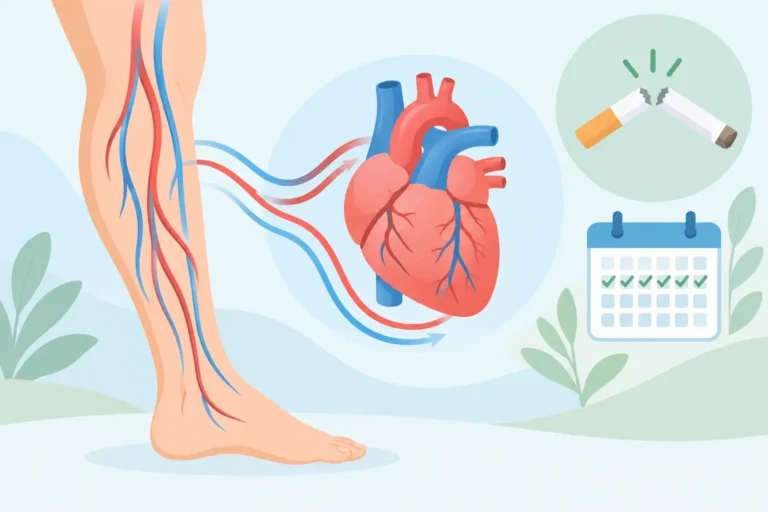
If you want to know how to quit smoking with high blood pressure, start with this reassurance: smoking is one of the things the NHS lists as raising your chances of high blood pressure, so quitting works in your favor. The worry most people have is about the tools. Nicotine can raise blood pressure, some quit medicines carry blood pressure warnings, and nobody wants to trade one problem for another. This guide gives you a five-step plan built around what the official labels and health services actually say, so you can have a better conversation with your doctor or pharmacist. It does not give dosing advice, and it is not a substitute for your clinician.
How to Quit Smoking With High Blood Pressure: The Short Plan
Five steps, in order: plan with your doctor, choose your quit aid with the labels in mind, keep checking your blood pressure, handle withdrawal with a plan, and support the rest of your health. The NHS describes high blood pressure as something that “can lead to serious problems like heart attacks or strokes” but that “lifestyle changes and blood pressure medicines can help you stay healthy.” Quitting smoking is part of those lifestyle changes. The NHS’s own list of things that increase your chances of high blood pressure includes “smoking,” and its “don’t” list says “do not smoke.” Source: NHS: high blood pressure.
For what changes in your readings after your last cigarette, see our guide to blood pressure after quitting smoking, and for the nicotine question, does nicotine raise blood pressure covers what the studies show.
Why Quitting Matters More When You Have Hypertension
The NHS explains that if your blood pressure is too high, “it puts extra strain on your blood vessels, heart and other organs, such as your brain, kidneys and eyes,” and that if it is not treated it can increase your risk of conditions including heart disease, heart attacks, strokes, heart failure and kidney disease. It adds that “lowering your blood pressure even a small amount can help reduce your risk of these problems.” It also notes that high blood pressure “does not usually cause any symptoms,” so you cannot rely on feeling fine.
Put those two facts together and the case is plain: you are already carrying one strain on your heart and blood vessels, and smoking is a known contributor to the problem. If your doctor also finds heart disease, the guide on quitting smoking after a heart attack covers that situation.
In this short video from Geisinger, a US health system, a doctor explains what quitting does for your heart.
Step 1: Plan With Your Doctor or Pharmacist
Before you choose anything, tell your care team two things: that you want to quit, and that you have high blood pressure. The FDA says your health care provider “may need to take into consideration your age, whether you’re pregnant or breastfeeding, and medical history, such as heart disease, diabetes, depression, asthma, blood pressure, and more.” Bring your current blood pressure medicines and your latest readings.
Smokefree.gov says quit medicines “can double your chances of quitting for good,” which is why this conversation is worth having rather than going without help. Ask three questions: which options are safest for my readings, how often should I check my blood pressure, and do any of my other medicines need review when I stop smoking? That last question matters because smoke can change how some drugs are cleared. Our page on medication doses that change when you quit explains why your prescriber should know your quit date. Sources: the FDA consumer update on FDA-approved cessation products and Smokefree.gov’s page on quit medications.
Step 2: Choose Your Quit Aid With the Labels in Mind
| Quit aid | What the label says | Your move |
|---|---|---|
| Nicotine patch (NicoDerm CQ label) | Ask a doctor before use if you have high blood pressure not controlled with medication; nicotine can increase your blood pressure | Ask your doctor or pharmacist first |
| Bupropion SR (prescription) | Can increase blood pressure; assess blood pressure before starting and monitor periodically | Needs a prescriber and regular readings |
| Bupropion plus nicotine replacement | A trial found more treatment-emergent hypertension with the combination; monitoring is recommended | Only under a prescriber’s supervision |
| Varenicline (Chantix) | People with underlying cardiovascular disease may be at increased risk of events; balance against the benefits of quitting | Discuss your history with the prescriber |
The table summarizes the labels; it is not a ranking. The nicotine patch label says to “ask a doctor before use if you have” “high blood pressure not controlled with medication,” and that “nicotine can increase your blood pressure.” The same label asks you to stop use and ask a doctor if an irregular heartbeat or palpitations occur. It does not say that nicotine replacement is off limits for everyone with hypertension, and this guide does not add a claim the label does not make. That is exactly the kind of judgment your clinician makes with your readings in front of them.
For bupropion, the DailyMed label for bupropion SR tablets (an antidepressant label that also describes a smoking-cessation trial) says treatment “can result in elevated blood pressure and hypertension” and tells prescribers to assess blood pressure before starting and monitor periodically. It reports that in a trial of bupropion SR, a nicotine patch and the two combined, 6.1% of people on the combination had treatment-emergent hypertension, compared with 2.5% on bupropion alone, 1.6% on the patch alone and 3.1% on placebo, and that most of those people had pre-existing hypertension. Its advice: “Monitoring of blood pressure is recommended in patients who receive the combination of bupropion and nicotine replacement.”
For varenicline, the Chantix label says patients with underlying cardiovascular disease “may be at increased risk of CV events; however, these concerns must be balanced with the health benefits of smoking cessation.” Both bupropion and varenicline are prescription-only, according to the FDA. To compare the over-the-counter forms side by side, see every NRT option compared. Labels: NicoDerm CQ label, bupropion SR label and Chantix label.

Step 3: Keep Checking Your Blood Pressure
The NHS explains how readings are used: you are usually considered to have high blood pressure if your reading is “140/90 or higher when checked by a healthcare professional” or “135/85 or higher when checked at home.” It also says that if a test shows you might have high blood pressure, you may be asked to “use a blood pressure monitor at home to check your blood pressure regularly over the next few days.”
Those are the thresholds for diagnosis. Your own target and schedule come from your clinician, not from this page. A simple routine is to write down your home readings, the date and what you were taking, starting a week or two before your quit date and continuing through the first weeks, and bring the notebook to your appointments. Then your doctor sees how your numbers move while you change your quit aids or your habits.
Step 4: Plan for Withdrawal and Cravings
Quitting is rarely a straight line, and rough days are when plans fall apart. Build your plan before your quit date: know your triggers, decide what you will do in the first ten minutes of a craving, and tell the people around you. The FDA lists the most common side effects of varenicline as nausea, constipation, gas, vomiting, and trouble sleeping or vivid, unusual or strange dreams, and the most commonly observed bupropion side effects as dry mouth and insomnia, so it helps to know which are normal and which to report. Tell your doctor about any that trouble you.
This is also where a phone can help. A craving log shows you which hours and triggers are hardest, and SOS support gives you something to do other than light up. See the box at the end for how iQuit fits in.
Step 5: Support Your Blood Pressure Around the Edges
The NHS lifestyle advice for high blood pressure gives you a short list to work on once the quit is under way: “have a healthy, balanced diet,” “exercise regularly – aim to do at least 150 minutes of exercise a week,” and “lose weight if you’re overweight.” On the “do not” side it lists too much salt, drinking more than 14 alcohol units a week on a regular basis, and too much caffeine, noting that “drinks high in caffeine include coffee, tea and cola.”
Do not try to fix everything in week one. Quitting is the big change. Add one lifestyle step at a time, such as a daily walk in place of the post-meal cigarette, and let your clinician know what you are changing so they can read your blood pressure numbers in context.

When to Get Urgent Help
The NHS says to call 999 if you get “sudden pain or discomfort in your chest that does not go away,” pain that spreads to your arm, neck, jaw, stomach or back, or chest pain with sweating, sickness, light-headedness or shortness of breath, because “you could be having a heart attack. Call 999 straight away as you need immediate treatment in hospital.” It adds: “Do not drive yourself to A&E.” If you take varenicline, the US Chantix label tells patients to “seek immediate medical attention if they experience signs and symptoms of myocardial infarction (MI) or stroke.” Outside the UK, use your local emergency number (911 in the United States).
Frequently Asked Questions
Can I use nicotine patches if I have high blood pressure?
Ask a doctor first. The NicoDerm CQ over-the-counter label says to ask a doctor before use if you have high blood pressure not controlled with medication, because nicotine can increase your blood pressure. A clinician can weigh your readings and history. (NicoDerm CQ label, DailyMed)
Does bupropion raise blood pressure?
It can. The bupropion SR label on DailyMed says treatment can result in elevated blood pressure and hypertension, and that blood pressure should be assessed before starting and monitored periodically. A trial found more hypertension with bupropion plus a nicotine patch. (DailyMed bupropion SR label)
Is Chantix safe with high blood pressure?
Only your prescriber can say. The Chantix label says patients with underlying cardiovascular disease may be at increased risk of cardiovascular events, but that these concerns must be balanced with the health benefits of smoking cessation. Tell the prescriber your full history. (DailyMed Chantix label)
When is blood pressure considered high?
The NHS says you are usually considered to have high blood pressure if a healthcare professional measures 140/90 or higher, or if a home reading is 135/85 or higher. Your own target is set by your clinician. (NHS)
Does smoking cause high blood pressure?
The NHS lists smoking among the things that increase your chances of having high blood pressure and advises people with high blood pressure not to smoke. For what happens to your readings after you stop, see our guide on blood pressure after quitting. (NHS)
Should I check my blood pressure at home when I quit?
Many people do, but ask your clinician. The NHS says people with suspected high blood pressure may be asked to use a home monitor to check regularly over several days. Your doctor can tell you how often to check while you change quit aids. (NHS)
What symptoms need an emergency call?
The NHS says to call 999 for sudden chest pain or discomfort that does not go away, pain spreading to the arm, neck, jaw, stomach or back, or chest pain with sweating, sickness, light-headedness or breathlessness. Do not drive yourself to A&E. Use your local emergency number outside the UK, such as 911 in the US. (NHS)
Daily Support for Your Quit Plan
A quit plan with high blood pressure works best with steady daily support. iQuit is free on Google Play and the App Store. Log cravings with their triggers and intensity, use SOS support when an urge hits, ride out a craving with the virtual cigarette, and keep an eye on days smoke-free, cigarettes avoided and money saved on your dashboard. It sits alongside your doctor’s advice and does not replace it.