

Smoker’s lips is the popular name for a set of changes people notice around the mouth after years of smoking: darker or uneven lip color, fine vertical lines and a dry, tired look. If you are searching for it, you are probably wondering whether the changes are permanent and what, if anything, fades once you stop. This guide sticks to what the published studies actually measured, and it is upfront that nobody can give you a reliable fading timetable.
What smoker’s lips actually means
“Smoker’s lips” is not a medical diagnosis. It is shorthand for three things that people often lump together:
- Pigmentation: lips that look darker, brownish or patchy.
- Lines: fine vertical creases above and below the lips, often called smoker’s lines.
- Dryness: lips that feel rough or chapped more often.
Each has its own evidence and its own outlook, so it helps to take them one at a time. It also helps to remember that sun, age, genetics and hydration all affect the lips, so a change is not proof of anything on its own.
Dark lips and smoker’s melanosis
When smoking darkens the mouth, the term doctors use is smoker’s melanosis: extra melanin pigment in the lining of the mouth. A 2025 review of oral pigmented lesions in the American Journal of Clinical Dermatology lists smoker’s melanosis as a reactive process, alongside post-inflammatory pigmentation, and notes that while most oral pigmented lesions are benign, they require a careful clinical evaluation and, when indicated, a biopsy (Wolk 2025, PubMed).
For the lips specifically, a Japanese case-control study assessed photos of 213 male workers. Among those with lip pigmentation, 73% were current smokers, compared with 33% of those without it. The odds ratio of current smoking for lip pigmentation was 5.6, and for gum pigmentation 17.0. Pigmentation scores rose with daily consumption and with years of smoking (Haresaku 2007, PubMed).
| Finding | Lip pigmentation | Gum pigmentation |
|---|---|---|
| Current smokers among those WITH pigmentation | 73% | 87% |
| Current smokers among those WITHOUT pigmentation | 33% | 27% |
| Odds ratio of current smoking | 5.6 | 17.0 |
The authors called the association between smoking and pigmentation of the lip and gums striking, and stronger for the gums. Keep the limits in mind: it was one group of men employed at one institution, and it shows association, not that smoking is the only cause of dark lips.
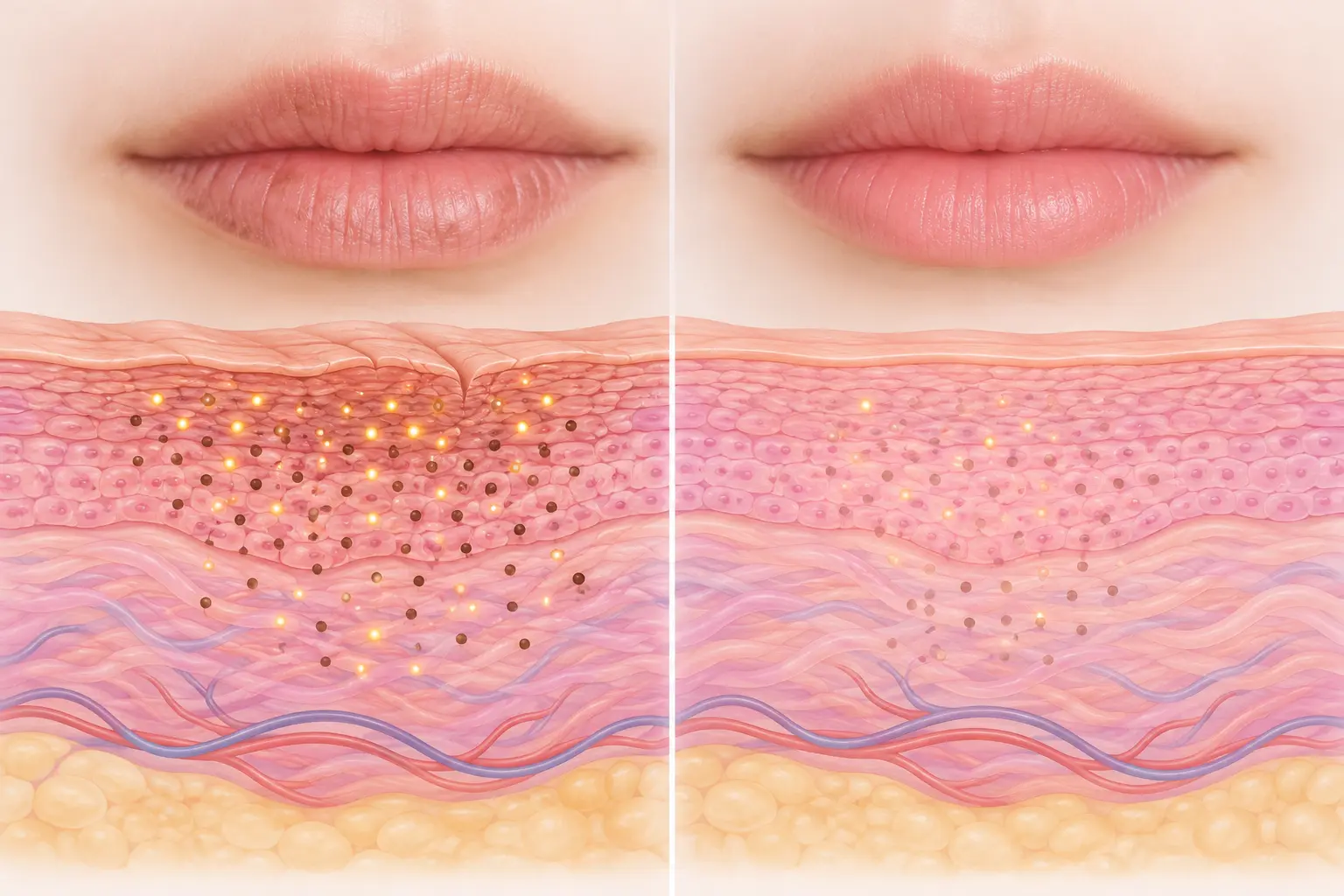
Why lines form around the mouth
Lines are the part with the broadest research, though most of it looks at the face in general rather than the lips alone. A 1991 cross-sectional study of 132 adults in the Annals of Internal Medicine found that premature wrinkling, measured on photos of the temple region, increased with pack-years of smoking after controlling for age, sex and sun exposure. Heavy smokers (more than 50 pack-years) were 4.7 times more likely to be wrinkled than non-smokers, and the authors concluded that smoking is an independent risk factor for premature wrinkling (Kadunce 1991, PubMed).
The same paper found that sun exposure was an independent risk factor too, and that sun and smoking together produced a multiplicative effect on wrinkling. A 2021 systematic review of skin aging risk factors also listed smoking among seven notable ones, with age, gender, ethnicity, air pollution, nutrition and sun exposure (Wong and Chew 2021, PubMed).
A vivid case is the twin study. A pair of identical twins with matched sun exposure differed in smoking: the twin with roughly 52.5 pack-years showed more severe skin aging than the nonsmoking twin (Doshi 2007, PubMed). It is a single pair, so it illustrates the pattern rather than proving it.
We did not find a study measuring lines around the lips specifically, so we will not claim that the mouth area ages faster than other areas. Repeated pursing of the lips and the skin effects of smoke are often blamed, but that is explanation, not something these studies tested. Our guide to smoking and skin aging and face recovery after quitting covers the wider picture.
What fades after quitting, and how long
This is where honesty matters most, because many pages promise timelines that no study backs up.
| Change | What studies show | Timeline |
|---|---|---|
| Dark pigmentation | Case report: smoker’s melanosis disappeared in two patients after considerable reduction in smoking | No reliable timeline found |
| Fine lines | Smoking is a risk factor for premature wrinkling; we found no study measuring how lines change after quitting | Unknown |
| Dryness | No quitting study found | Unknown |
The 1993 report in the Journal of Oral Pathology and Medicine compared oral melanin pigmentation in a large number of former smokers with non-smokers, and described two patients whose smoker’s melanosis in the cheek lining disappeared after a considerable reduction in smoking. The authors note that besides genetic factors, tobacco smoking is known to be the main cause of oral melanin pigmentation (Hedin 1993, PubMed).
That is encouraging, but it is two patients, and the site was the inside of the cheek rather than the lips. So the honest answer is that pigmentation can fade after reducing or stopping smoking, how long it takes varies, and some people have naturally darker lips or gums for reasons unrelated to tobacco. Do not use your lip color as a daily scorecard.
A practical way to track change without obsessing is to take one photo in the same daylight at the start of your quit and then once a month. Compare the photos rather than the mirror, because lighting, hydration and tiredness change how lips look from day to day. If nothing seems to shift, that does not mean quitting failed: the studies above cannot say how long pigment or lines take, and the benefits you cannot see are not tied to your lip color.
Other visible changes tend to be easier to track. Stains on teeth and fingers, for example, are covered in our guides on how long after quitting teeth whiten, removing nicotine stains from fingers and nails and teeth and gums after quitting.
Lip care basics
None of the studies above tested a lip product, so we do not recommend any brand or treatment. General habits that cost little and make sense whatever the cause:
- Protect from the sun. The Kadunce study found sun exposure independently increased wrinkling and compounded the effect of smoking, so shading your face and lips is reasonable.
- Stay hydrated. Drinking enough water is a low-risk habit for dry lips, and a pharmacist or dentist can tell you what suits your skin if dryness persists.
- Avoid picking or biting. Irritation can leave a lip sore and slow healing.
- Ask a professional before treatments. If you are considering a cosmetic procedure for pigmentation or lines, a dermatologist or dentist can tell you what is appropriate and whether a lesion should be checked first.

When a lip change needs a doctor
Most color change on the lips is harmless, but new or changing marks deserve a look. The NHS lists mouth cancer symptoms that can affect any part of the mouth, including the lips:
- a mouth ulcer that lasts more than 3 weeks
- a red or white patch inside your mouth
- a lump inside your mouth or on your lip
- pain in your mouth that is not going away
- difficulty swallowing or speaking, or a hoarse voice that does not go away
The NHS stresses that these symptoms are very common and can be caused by other conditions, so having one does not definitely mean cancer, but it is important to get checked by a GP or dentist because early detection may make treatment easier. The 2025 pigmented lesion review makes a similar point: most oral pigmented lesions are benign, but a careful examination is needed, and a biopsy when indicated. A single dark spot that is new, changing, bleeding or uneven in color is worth showing a clinician rather than assuming it is smoker’s melanosis. White patches in the mouth have their own explainer in our guide to leukoplakia and white patches in smokers.
If you are unsure what you are looking at, take your dated photos to the appointment. A picture with a date on it helps a clinician judge whether a spot has changed, which is often more useful than a description from memory.
Why quitting is still worth it for the bigger picture
Appearance can be a real motivator, and there is nothing shallow about wanting to like what you see. But the changes on your lips are the visible tip of a much larger set of effects, and the benefits of quitting start long before anything shows in a mirror. Our one-month benefits guide and the complete health recovery guide cover what changes first.
The free iQuit app can help you see that progress when the mirror is slow to show it. Its health-recovery timeline lines up your smoke-free days with recovery milestones, the dashboard counts cigarettes avoided and money saved, and the craving and mood journal lets you log triggers so you can spot patterns. iQuit supports quitting; it does not treat skin or oral conditions.
Frequently Asked Questions
What are smoker’s lips?
It is a popular phrase, not a diagnosis, for darker or uneven lip color, fine lines around the mouth and dryness in smokers. Studies support an association between smoking and lip pigmentation and premature wrinkling, but sun, age and genetics also play a role (Haresaku 2007; Kadunce 1991).
Does smoking make your lips dark?
It is linked to it. In a study of 213 men, 73% of those with lip pigmentation were current smokers versus 33% of those without it, an odds ratio of 5.6. It is an association from one group, not proof that smoking is the only cause (Haresaku 2007).
Do dark lips go back to normal after quitting?
Sometimes. A 1993 report described smoker’s melanosis disappearing in two patients after they greatly reduced smoking. That is a tiny sample and a different site, and no reliable timeline exists, so results vary and some darkness may not be tobacco related (Hedin 1993).
Does smoking cause lines around the mouth?
Smoking is a risk factor for premature facial wrinkling, with heavy smokers over 50 pack-years 4.7 times more likely to be wrinkled in a 1991 study. That study measured the temple area, so lines specifically around the lips were not tested (Kadunce 1991).
How long does it take for smoker’s lines to fade?
We found no study measuring how wrinkles change after quitting, so there is no reliable timeline. Because sun exposure also drives wrinkling, sun protection is a sensible habit alongside quitting (Kadunce 1991; Wong and Chew 2021).
When should I see a doctor about a lip spot?
The NHS says to see a GP or dentist for a mouth ulcer lasting more than 3 weeks, a lump on your lip or in your mouth, or a red or white patch. These are often caused by other conditions, but early checking matters (NHS).
Is a dark spot on my lip always smoker’s melanosis?
No. A 2025 review says most oral pigmented lesions are benign but that they need careful clinical evaluation and, when indicated, a biopsy, because some are serious. A new, changing or uneven spot should be examined by a clinician (Wolk 2025).
See Your Progress, Not Just Your Reflection
iQuit is free and shows your smoke-free days, cigarettes avoided and money saved, with a health-recovery timeline and a craving and mood journal to keep you going while the visible changes catch up.


