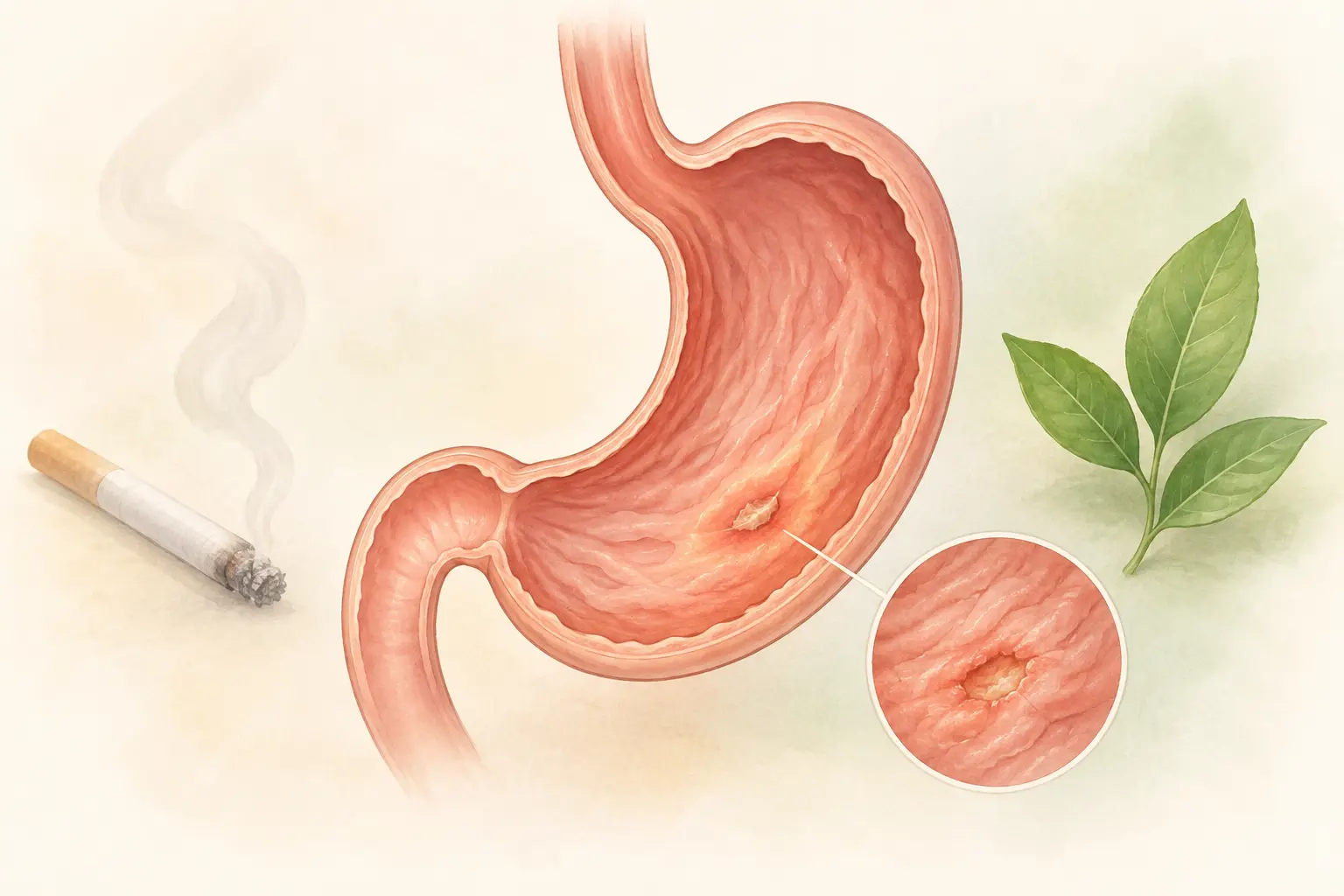
If you have a stomach ulcer, or you have been told you are at risk of one, it is fair to ask where smoking fits in. The short answer on smoking and stomach ulcers is that smoking is not the main cause, but it makes ulcers more common, makes treatment less likely to work and raises the chance that an ulcer comes back. The main causes are a bacterial infection and certain painkillers, and fixing those comes first. This guide explains each piece, what the studies measured, and what stopping smoking is shown to change.
What causes ulcers: H. pylori, painkillers and smoking
The NHS describes stomach ulcers (also called peptic or gastric ulcers) as sores in the stomach. It says they can be serious, but most people recover with treatment. The same page covers sores in the intestine, known as duodenal ulcers.
It names the main causes as infection with Helicobacter pylori (H. pylori) bacteria and regular use of anti-inflammatory painkillers (NSAIDs) such as ibuprofen. It then adds that stomach ulcers are also more common in people who smoke, and that the risk increases as you get older. The US National Institute of Diabetes and Digestive and Kidney Diseases likewise says the most common causes of peptic ulcers are H. pylori infection and NSAIDs.
| Factor | Role |
|---|---|
| H. pylori infection | One of the two main causes |
| Regular NSAID painkillers | One of the two main causes |
| Smoking | Ulcers are more common in smokers (NHS) |
| Older age | Risk increases with age (NHS) |
That framing matters. Smoking is not described as a standalone cause in these sources, so a smoker with no H. pylori infection and no NSAID use is much less likely to develop an ulcer than one with those factors. What smoking does appear to do, as the studies below show, is get in the way of healing and make relapse more likely. A 2018 review of lifestyle and peptic ulcer disease reached a similar view, listing avoiding smoking, limiting alcohol, balanced diet, stress management and sleep as essential in the prevention and healing of ulcers (Yegen 2018, PubMed).
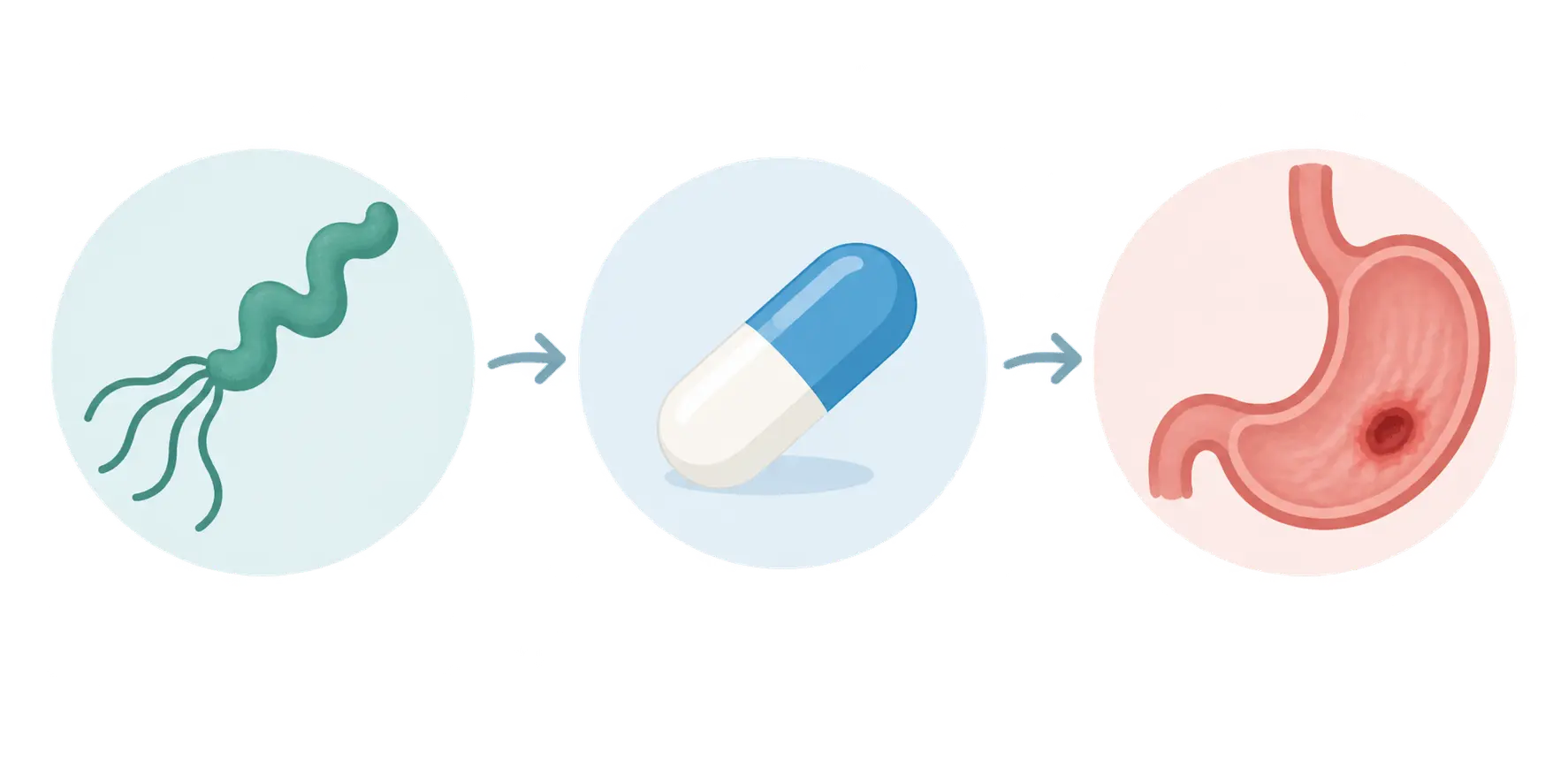
Mayo Clinic has a short video on H. pylori, the bacterium behind many ulcers, and why doctors treat it.
How smoking slows healing
Older clinical trials give the clearest picture of healing. A 1982 double-blind study in Digestive Diseases and Sciences tested ranitidine against a placebo in 50 patients with endoscopically proven duodenal ulcers. After 4 weeks, healing was 80% on the drug versus 16% on placebo. Among all patients, 70% of non-smokers healed compared with 30% of smokers, and the authors concluded that smoking adversely affected healing (Korman 1982, PubMed).
Take that with a large grain of salt. It was a small study of 50 people, it was done more than 40 years ago, it covered duodenal ulcers rather than stomach ulcers, and it tested a single older drug. It is supportive, not definitive. We did not find a modern trial that measures healing time in smokers and quitters directly, so we will not give you a number of days or weeks.
Smoking and H. pylori treatment
This is the best-quantified link. A 2022 systematic review and meta-analysis in the journal Helicobacter pooled 39 studies on smoking and H. pylori eradication. It found that smoking increases the failure rate of eradication treatment, with an odds ratio of 1.70. Failure was more likely with a higher smoking dose (odds ratio 2.59 for more than 5 cigarettes a day) and when people kept smoking during treatment (odds ratio 2.49) (Yu 2022, PubMed).
| Comparison | Odds ratio of treatment failure |
|---|---|
| Smokers vs non-smokers, overall | 1.70 |
| More than 5 cigarettes a day | 2.59 |
| Continued smoking during treatment | 2.49 |
| Regimens using vonoprazan | 0.94 (no significant effect) |
Two points stand out. First, the studies with a large share of ulcer patients showed a higher failure rate in smokers (odds ratio 2.14), which is the group this article is about. Second, when the acid blocker vonoprazan was used, smoking made no difference to eradication. That is an honest complication: the finding depends on which drugs are used, so ask your doctor what applies to your regimen. The sensible reading is that if you smoke during H. pylori treatment, the antibiotics may be less likely to clear the infection, and a persistent infection is exactly what keeps ulcers returning.
Recurrence after treatment
Even after an ulcer heals, the question is whether it stays healed. The RUDER study group followed patients with a healed duodenal ulcer who took ranitidine maintenance treatment for one or two years. The two-year relapse rate was 23.4% in smokers, 26.3% in ex-smokers and 18.0% in non-smokers, and the difference between smokers or ex-smokers and non-smokers was statistically significant (Breuer-Katschinski 1995, PubMed).
The same report found the effect of stopping. There were significantly fewer relapses among smokers who stopped smoking during maintenance treatment (14.2%) than among smokers who continued (25.2%). The authors concluded that continued and past smoking significantly increase the relapse rate.
Reading the relapse numbers fairly
The ex-smoker figure (26.3%) is higher than the smoker figure, which looks odd. The published summary does not explain why, and groups of ex-smokers often include people who quit after becoming ill, which is one common explanation but not something this report tests. The cleaner comparison is the second one, smokers who quit during maintenance treatment versus smokers who did not. That one points clearly in favor of stopping.
This was a study of ranitidine maintenance, a style of care that differs from today’s focus on clearing H. pylori. It supports the direction of the advice but is not a forecast of your own relapse risk.

NSAIDs, alcohol and other triggers
Because smoking is only one of several factors, the NHS lists what to do and avoid after you have seen a GP. It advises eating smaller meals, eating your evening meal 3 to 4 hours before bed, keeping to a healthy weight and managing stress. It says not to take anti-inflammatory painkillers such as ibuprofen without speaking to a doctor first, and not to smoke or drink too much alcohol. It also mentions that foods that trigger your own symptoms, such as fatty or spicy foods, coffee and chocolate, are worth avoiding if they bother you.
Note that the NIDDK says researchers have not found that diet and nutrition play an important role in causing, preventing or treating peptic ulcers, and that doctors do not recommend a special diet. The two sources differ a little here, so a practical approach is to avoid what clearly worsens your symptoms without cutting out whole food groups.
If you drink as well as smoke, the two often reinforce each other as triggers. Our guides on quitting smoking and acid reflux and why smoking affects your bowels cover related digestive effects, and the pancreas has its own story in smoking and pancreatitis.
What quitting does
Pulling the evidence together, here is what is reasonably supported:
- Treatment is more likely to work. Smoking raises H. pylori eradication failure, and continuing to smoke during treatment carried the highest odds of failure in the meta-analysis.
- Relapse is less likely. Smokers who stopped had fewer relapses (14.2%) than those who continued (25.2%) in the RUDER study.
- The NHS recommends it. Stopping smoking is listed among the lifestyle changes a doctor may recommend, and among the things not to do if you want to reduce the risk of an ulcer returning.
What is not shown: how many days sooner an ulcer heals once you quit, or that quitting alone will heal an ulcer without treating the cause. Medicine for the underlying cause remains the foundation. For the broader picture of what changes after your last cigarette, see what happens to your body when you stop smoking, the health recovery timeline data and our complete health recovery guide. If digestive symptoms flare in the first days, our nicotine withdrawal symptoms guide separates normal withdrawal from signs that need a doctor.
The free iQuit app can help with the practical side, especially after meals, a classic craving moment. Log each craving with its trigger and intensity to see whether meals are your pattern, and use the SOS tools, such as breathing exercises or the virtual cigarette, to ride out the urge. Its health-recovery timeline and savings dashboard make your progress visible. iQuit supports quitting; it does not treat ulcers or any other condition.
When to see a doctor
The NHS says to see a GP if you have indigestion that does not go away with treatment or your tummy pain keeps coming back. It says to ask for an urgent GP appointment or get help from NHS 111 if your pain is getting worse or does not go away and you have any of these: lost appetite, feeling full after a very small amount of food, weight loss without trying, a lump in the tummy, painful or difficult swallowing, repeated vomiting or constant tiredness.
Call 999 or go to A&E if you are vomiting bright red blood or your vomit looks like ground coffee, your poo has blood in it or is black, sticky and very smelly, you have severe tummy pain, it hurts to touch your tummy, or you have chest pain that started suddenly. The NHS notes that untreated ulcers can lead to bleeding, anemia from blood loss, a hole in the stomach wall, and an increased risk of stomach cancer from an untreated H. pylori infection, so do not sit on persistent symptoms.
The NHS also says treatment usually lasts from 1 week to 2 months depending on the cause, that you may need tests afterward to make sure it has worked, and that you should speak to a GP if symptoms come back.
Frequently Asked Questions
Does smoking cause stomach ulcers?
Not on its own, according to the NHS. It names H. pylori infection and regular NSAID painkillers as the main causes, and says stomach ulcers are also more common in people who smoke. Smoking is a risk factor, not the primary cause (NHS).
Does smoking slow ulcer healing?
Evidence suggests so but is dated. A 1982 trial of 50 duodenal ulcer patients found 70% of non-smokers healed in 4 weeks versus 30% of smokers. It was small and old, so no modern healing timeline can be given (Korman 1982).
Does smoking make H. pylori treatment less effective?
Usually yes. A 2022 meta-analysis of 39 studies found smoking increased eradication failure (odds ratio 1.70). With vonoprazan-based regimens smoking made no difference, so ask your doctor about your own treatment (Yu 2022).
Will quitting smoking stop my ulcer coming back?
It lowers the odds but cannot guarantee it. In the RUDER study, smokers who stopped had a 14.2% relapse rate versus 25.2% for those who kept smoking over two years. Treating the cause, such as H. pylori, still matters most (Breuer-Katschinski 1995).
How long does stomach ulcer treatment last?
The NHS says treatment usually lasts from 1 week to 2 months, depending on the cause, and that you may need tests afterward to confirm it has worked. If symptoms return after treatment, speak to a GP (NHS).
Should I avoid painkillers if I have an ulcer?
The NHS says not to take anti-inflammatory painkillers such as ibuprofen without speaking to a doctor first, because regular NSAID use is one of the two main causes of stomach ulcers. Ask a GP or pharmacist for alternatives (NHS).
When is stomach pain an emergency?
The NHS says to call 999 or go to A&E if you vomit bright red blood or material like ground coffee, have black sticky poo or blood in it, have severe tummy pain, or have sudden chest pain (NHS).
Quit Smoking and Give Your Stomach a Chance
iQuit is free and helps with the moments that tempt you most, including after meals: craving logging with triggers, SOS tools and a health-recovery timeline. It supports your quit alongside your medical treatment.