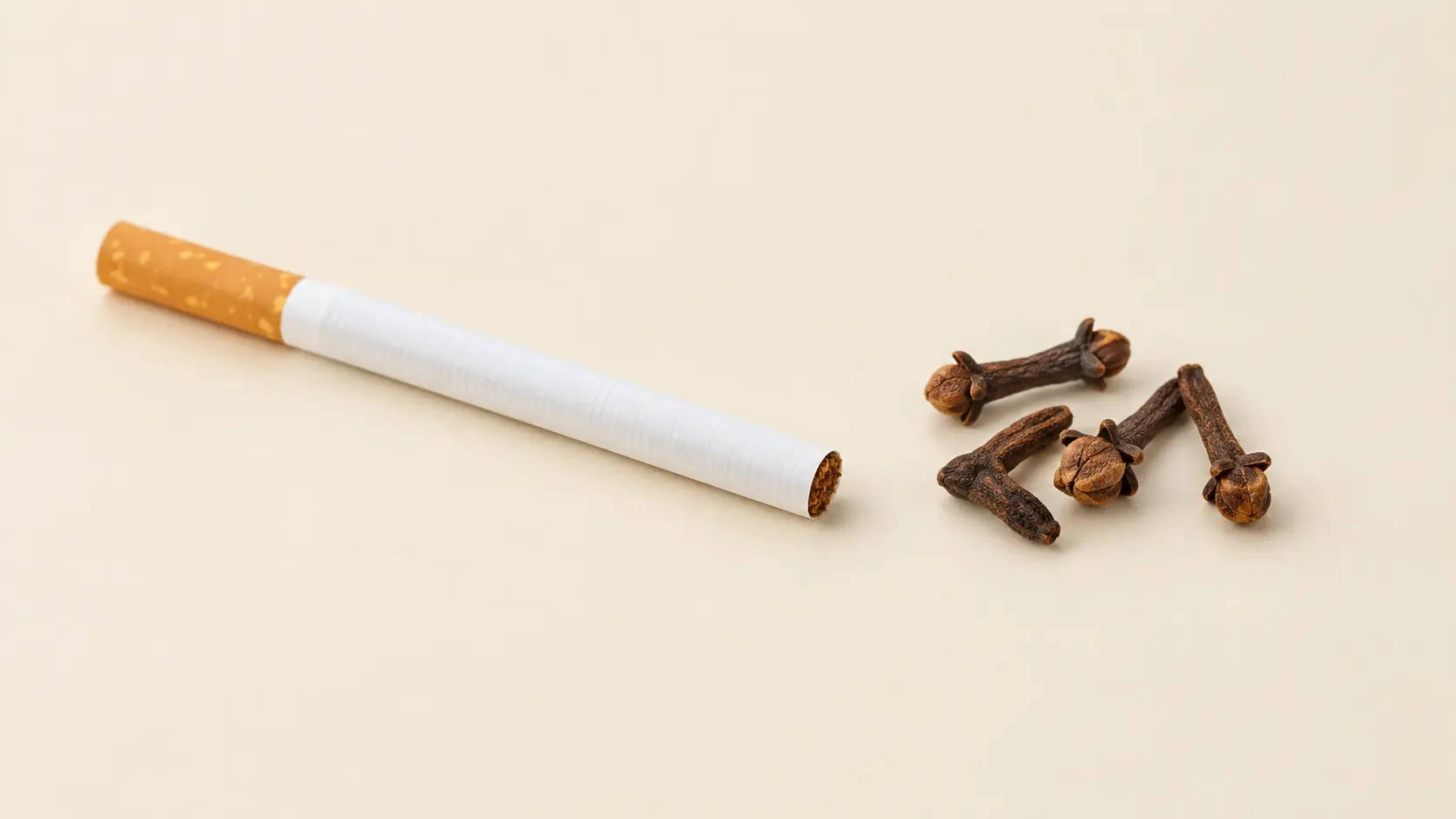
Are clove cigarettes worse than regular cigarettes? Based on the best available evidence, they are not a safer choice, and the research points the other way. A clove cigarette (a kretek) is still shredded tobacco, burned and inhaled, with clove and other flavorings mixed in. The smoke still carries nicotine and thousands of chemicals. This guide explains what is in a kretek, what the studies say about harm, how US law treats clove, and what to do if you have been weighing a swap instead of quitting.
Are Clove Cigarettes Worse Than Regular Cigarettes? The Short Answer
Nobody has run the kind of head-to-head study that would give a clean number, so the honest answer is a range. The best available summary is a systematic review of kretek health research, which looked at 32 studies, all from Indonesia. Its authors say most of them were “of poor quality” and ended with this conclusion: “Although existing studies are of poor quality, kretek are likely to be at least as harmful as regular cigarettes” (Health Risks of Kretek Cigarettes: A Systematic Review, 2021).
In plain terms, there is no reliable evidence that adding clove makes a cigarette milder, and there are reasons to think it may add risks of its own. The review linked kretek smoking to oral cancer, cardiovascular disease, myocardial infarction, asthma and oral diseases. Because the studies were small and mostly cross-sectional, those links show association, not exact size of risk.
If you are asking because you want a lower-risk smoke, the more useful fact is on the FDA’s nicotine page: cigarettes “deliver more than 7,000 chemicals along with nicotine that makes it hard to quit” (FDA). Clove does not remove that chemistry. For a broader picture, see our guide to what is in cigarette smoke.
What Clove Cigarettes (Kretek) Contain
A kretek is a tobacco cigarette that also contains ground clove and a flavoring mixture sometimes called the “saus.” Researchers who tested nine brands bought in Brazil explain that the term kretek comes from the crackling sound the product makes when it burns, and that the saus is “a mixture of essential oils and plant extracts whose ingredients are mostly kept in secret” (Toxicology Research, 2022).
That study found 20 different compounds across the samples, and each brand had a different combination. One sample contained menthol even though the pack did not say it was a menthol product. The authors also reported traces of two unusual substances in some samples, but flagged that those were not confirmed with certified reference materials, which shows how little is known about what goes into some of these products.
Nicotine is still there
A common assumption is that clove cigarettes are a different thing from tobacco. They are not. In the Brazilian analysis, “nicotine concentrations were generally higher than eugenol, and lower than nicotine concentration in a conventional cigarette.” Nicotine was present in all of them, and a lower concentration does not tell you how much a person actually absorbs from smoking one. How deeply you inhale and how many you smoke matter just as much.
Eugenol: the clove compound
Eugenol is a clove-flavored compound. A 2024 analysis in Tobacco Control measured 22 kretek brand variants and nine non-clove cigarette brand variants bought in Indonesia; one kretek pack held three variants, giving 24 kretek samples. It reported that “eugenol was present at significant levels in all 24 kreteks (2.8-33.8 mg/stick), but was essentially absent in all of the cigarettes” (Tobacco Control, 2024). Eugenol is the single clearest chemical difference between the two products.
Eugenol and Your Lungs
Here the evidence is thin, and it is worth saying so plainly. There is no large modern study that measures lung function in kretek smokers against regular smokers while controlling for how much each person smokes. What exists is older case reporting and small studies.
A 1989 paper in The Western Journal of Medicine opens with this warning: “The smoking of clove cigarettes has been associated with 13 cases of serious illness in the United States, including hemorrhagic pulmonary edema, pneumonia, bronchitis, and hemoptysis.” The authors described a patient who developed pneumonia and a lung abscess after smoking a clove cigarette, and suggested the lung disease “may have been caused by aspiration pneumonia as a consequence of pharyngolaryngeal anesthesia from clove cigarette smoke” (Western Journal of Medicine, 1989).
That is a hypothesis from one case report, not proof of a general effect. But it points to a specific worry: a numbing agent in smoke could dull the throat’s protective reflexes. If smoke feels gentler, that does not mean it does less damage.
The same 1989 paper also noted that clove cigarettes appeal to adolescents experimenting with smoking and may influence later smoking habits. That concern is behind much of the later regulation, covered below.
Clove vs Regular: What the Numbers Do and Do Not Show
People often ask for a table of tar, nicotine and carbon monoxide per cigarette. No government or peer-reviewed source has published a comparable figure that measures both products the same way, so the table below sticks to what the published research actually says.
| Feature | Clove cigarette (kretek) | Regular cigarette |
|---|---|---|
| Contains tobacco | Yes, mixed with clove | Yes |
| Eugenol | 2.8-33.8 mg/stick in 24 kretek samples | Essentially absent |
| Nicotine | Present; lower concentration than a conventional cigarette in one 9-brand analysis | Present; delivered to the brain fast |
| Health evidence | 32 studies, mostly poor quality; “likely to be at least as harmful” | Extensive evidence of cancer, heart and lung disease |
| Tar and carbon monoxide | No comparable published data | No comparable published data |
The key point from the table: the one area where clove cigarettes could look “better” is a lower nicotine concentration in one set of samples. But a lower concentration per stick does not make a product safer. Smokers can compensate by smoking more or inhaling more deeply, and the smoke still comes from burned plant material.
The same logic applies to other products that were marketed as gentler. Our articles on whether light cigarettes are safer and on herbal cigarettes reach the same conclusion: changing the label or the flavor does not change the fact that you are inhaling smoke.
The US Flavor Rule and the Clove Cigar Loophole
If you live in the United States, you may have heard that clove cigarettes were banned. The FDA describes the rule this way: the Family Smoking Prevention and Tobacco Control Act “establishes a tobacco standard special rule for cigarettes that is effective on September 22, 2009.” It prohibits a cigarette or any of its parts from containing “an artificial or natural flavor (other than tobacco or menthol) or an herb or spice, including strawberry, grape, orange, clove, cinnamon, pineapple, vanilla, coconut, licorice, cocoa, chocolate, cherry, or coffee, that is a characterizing flavor of the tobacco product or tobacco smoke” (FDA guidance, edition 2).
Note the wording: the rule covers cigarettes, and only where the flavor is a “characterizing flavor.” Menthol and tobacco flavors are excluded. It is a rule about flavor in cigarettes, not a statement that clove is toxic.
What happened after the rule
A study of the 200 most popular internet cigarette vendors tracked what they sold in 2009, 2010 and 2011. It found that noncompliance was high: cigarettes with banned flavors or misleading descriptors were still offered, and “89% of vendors continued to sell the products, including 95.8% of international vendors.” It also found that vendors began selling potential alternative products. In 2010, the odds of selling clove cigars were 5.50 (95% CI 2.36 to 12.80) times the 2009 odds. The authors concluded that “many vendors appear to be circumventing the intent of the flavors ban by selling unbanned flavored cigars” (Nicotine & Tobacco Research, 2015).
That is the loophole in a sentence: a flavored product can sit outside the cigarette rule by being sold as a cigar. The data cover online vendors up to 2011 and say nothing about what is sold in stores today, and rules change, so check the FDA’s current pages for the legal position on a specific product. For the age and legal side of tobacco more broadly, see legal smoking age by country.
Kretek in Indonesia
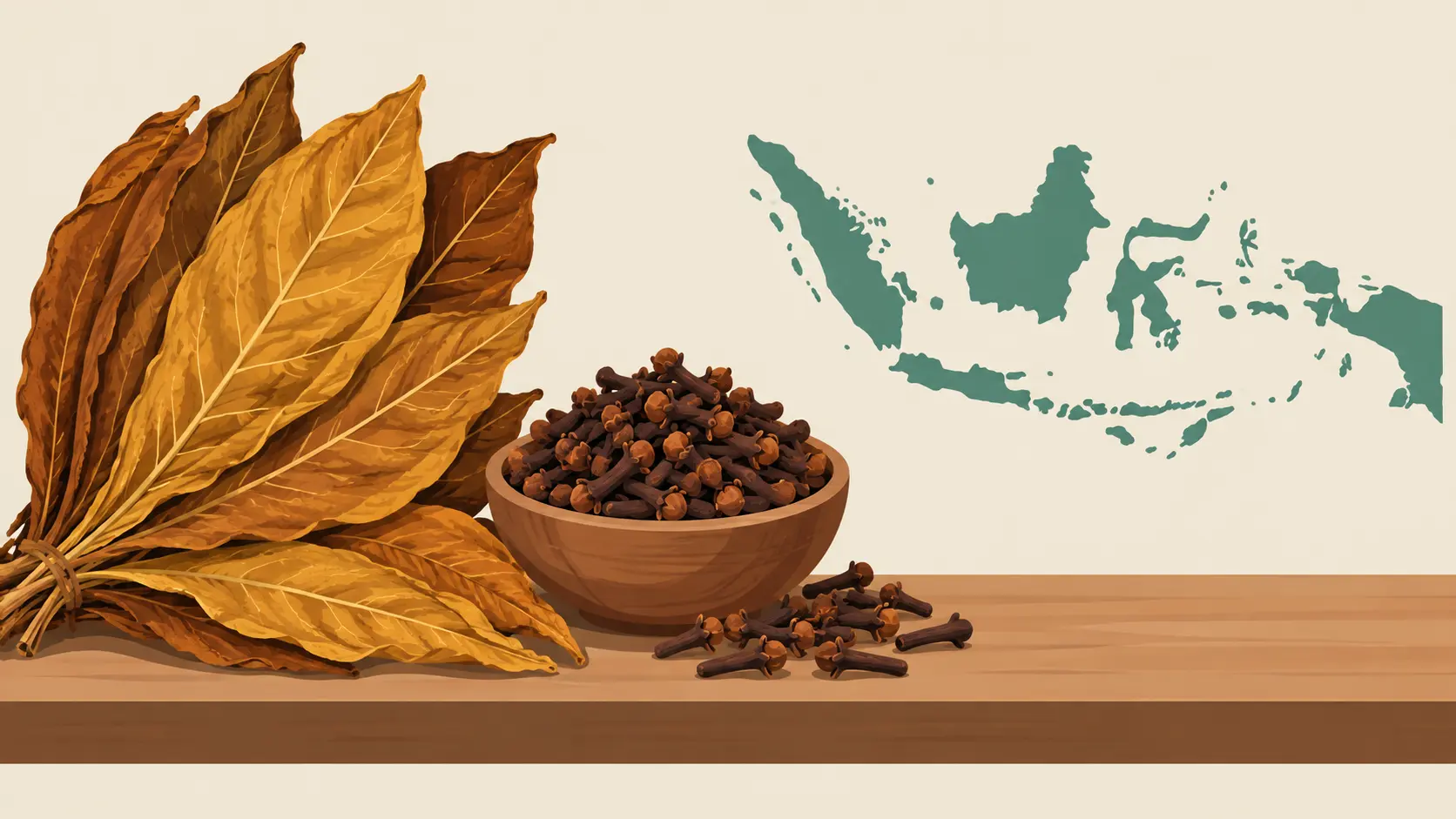
Kretek is where the product comes from, and the Indonesian setting explains why most kretek research originates there. The Tobacco Control paper notes that flavored tobacco products are not restricted in Indonesia, a country with “about 68 million adults who smoke,” and that most of them “use clove-mixed tobacco cigarettes (‘kreteks’).” The same study points out that the WHO has identified flavoring as promoting tobacco use.
This matters for how to read the research. The 32 studies in the systematic review were all conducted in Indonesia, where many people smoke kretek. That makes it hard to cleanly separate kretek smokers from other smokers in some of the data, and much less is known about people who smoke the occasional clove cigarette in another country.
None of this is a judgment about the culture around kretek. It is a note about evidence: the best studies available were done where the product is common, were mostly small and cross-sectional, and still found associations with harm.
Better Options Than Switching

If you are reading this because you are trying to smoke less harmfully, the evidence favors getting off combustion entirely. The FDA ranks its approved nicotine replacement therapies, such as gums and lozenges, as the least harmful nicotine products, and says that used properly, NRTs “can double the chances of successfully quitting cigarettes.” The same FDA nicotine page says it is the chemicals in tobacco smoke, not nicotine itself, that cause the serious health effects, including COPD and cancer.
Quitting is hard on a single attempt. The National Institute on Drug Abuse reports that “only about 6 percent of smokers are able to quit in a given year,” and that most people need multiple attempts. Nicotine from smoke “peaks within 10 seconds of inhalation” (NIDA research report), so the habit is reinforced quickly, whatever the flavor.
A practical way forward
- Pick a method. Compare your options in our guide to the best NRT options, and talk with a pharmacist or doctor about what suits you.
- Plan for triggers. If clove cigarettes are tied to a social setting, a meal or a drink, name that trigger and plan a substitute action for it.
- Expect a few tries. Past attempts are practice, not failure. Our article on quit smoking success rates puts the odds in context.
- Start with the full plan. Our complete evidence-based guide to quitting smoking covers medication, behavior and support in one place.
If you want something that tracks the work for you, iQuit lets you quit your way, with cold turkey or gradual reduction, log each craving with its trigger and intensity, and watch days smoke-free and money saved add up on the dashboard. It does not treat any condition and is not a substitute for medical advice. For the swap question, our piece on natural and additive-free cigarettes covers a related myth.
Frequently Asked Questions
Are clove cigarettes worse than regular cigarettes?
A 2021 systematic review of 32 Indonesian studies concluded that kretek are “likely to be at least as harmful as regular cigarettes,” while noting that most studies were of poor quality. No evidence shows they are safer. Treat them as tobacco cigarettes with added flavoring (PubMed, 2021 systematic review).
Are clove cigarettes tobacco?
Yes. A kretek is a tobacco cigarette blended with clove and a flavoring mixture. A 2022 analysis of nine clove cigarette brands measured nicotine in the samples, so they are not a nicotine-free or herbal product. Clove is added to tobacco, not used instead of it (Toxicology Research, 2022).
What is eugenol and is it harmful?
Eugenol is a clove-flavored compound. A 2024 Tobacco Control analysis found it in all 24 kreteks tested at 2.8-33.8 mg/stick, and essentially absent in regular cigarettes. A 1989 case report suggested clove smoke may numb the throat, but that remains a hypothesis from one case (Tobacco Control, 2024; Western Journal of Medicine, 1989).
Are clove cigarettes legal in the US?
The FDA special rule effective September 22, 2009 prohibits cigarettes from containing an herb or spice, including clove, that is a “characterizing flavor.” A 2009 to 2011 vendor study found many sellers moved to clove cigars, which fall outside the cigarette rule. Check current FDA pages for today’s position (FDA guidance, edition 2; PMC vendor study).
Do clove cigarettes have less nicotine?
In one analysis of nine brands, nicotine concentrations were “lower than nicotine concentration in a conventional cigarette.” That is a small sample, and lower concentration does not prove lower exposure, because how much you smoke and inhale also matters. They still contain nicotine (Toxicology Research, 2022).
Can clove cigarettes help me quit smoking?
There is no evidence that they help. The FDA says approved nicotine replacement therapies such as patches, gum and lozenges, used properly, “can double the chances of successfully quitting cigarettes.” Switching to another smoked product keeps you inhaling smoke and the same dependence (FDA nicotine page).
How do I stop smoking clove cigarettes?
Treat it like quitting any cigarette: pick a method, plan for triggers and expect more than one attempt. NIDA reports only about 6 percent of smokers quit in a given year, and most need several tries. Ask a pharmacist or doctor about nicotine replacement or prescription options (NIDA; FDA).
Quit Instead of Swapping
Swapping Cigarettes Is Not Quitting. A Plan Is.
iQuit supports quitting your way, with cold turkey or gradual reduction, craving logging with triggers and intensity, SOS tools for the hard moments, an AI coach, and a real-time dashboard of days smoke-free, cigarettes avoided and money saved. Free on Google Play and the App Store.
Download iQuit Free on Google Play
Download on the App Store