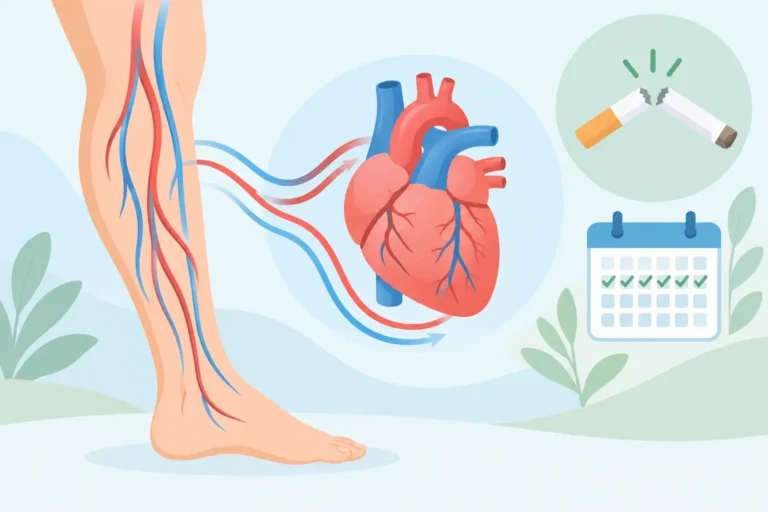
If you are asking can you smoke while on blood thinners, the first thing to know is that nothing physically stops you, and the second is that smoking works against the reason you were prescribed them. Blood thinners, also called anticoagulants, are given to prevent or treat clots, and the NHS lists smoking among the things that make a clot in a leg vein more likely. There is also a medicine-specific wrinkle for warfarin that your anticoagulation clinic needs to know about. This guide explains both, stays within what the official sources say, and tells you who to call before you change anything.
Can you smoke while on blood thinners? The short answer
The NHS: warfarin page explains that warfarin is an anticoagulant, a type of medicine that some people call blood thinners. It treats and prevents clots in the veins and lungs, and it can reduce clot risk in people with an irregular heartbeat (atrial fibrillation), a mechanical heart valve, a clotting disorder or a past transient ischemic attack (TIA). The NHS: deep vein thrombosis page, in its list of who is more likely to get a DVT, includes people who smoke, and its advice for lowering the chance of DVT includes “do not smoke.”
So the plain answer is that you are taking a medicine to lower your clot risk while doing something the NHS names as a clot risk factor. That is not a reason for guilt. It is a reason to treat quitting as part of your treatment plan and to talk to the people who manage your anticoagulant.
This guide is general information from official sources. It is not medical advice, and your prescriber’s instructions come first. If anything below conflicts with what your clinic has told you, follow your clinic.
Warfarin and smoking: what the label says about INR
Warfarin is the blood thinner with the most direct link to smoking, because its dose is tuned using a blood test. The NHS warfarin page says you will need regular blood tests to measure how quickly your blood clots, called an international normalized ratio (INR) test, to check you are getting the right dose, and that your dose may change based on the results.
The US prescribing information has a short passage that matters here. In the drug-interaction section of the COUMADIN (warfarin) prescribing information on DailyMed, the label says: “Inducers of CYP2C9, 1A2, and/or 3A4 have the potential to decrease the effect (decrease INR) of warfarin by decreasing the exposure of warfarin.” Its Table 2 of examples then lists “cigarette smoking” among the CYP1A2 inducers, alongside several medicines. The label adds: “The CYP450 inhibition and induction potential should be considered when starting, stopping, or changing dose of concomitant mediations.”
What does that mean for a smoker? In plain terms, smoking is one of the things that can affect how much warfarin your body is exposed to. The label does not give a quitting rule, it gives no numbers, and it does not say how big the effect is. It would be a guess to claim a specific INR change when you stop, so we will not. What we can say, as a reasonable reading rather than a quotation, is that a major change like stopping smoking is exactly the kind of thing to mention to your anticoagulation clinic so they can decide how often to check your INR. Our article on quitting smoking and medication dose changes covers this general idea for other medicines too.
The British Heart Foundation has a short animation on how warfarin works inside your body, which helps explain why dose checks matter.

Newer blood thinners: apixaban, rivaroxaban and others
Some people take a direct oral anticoagulant, or DOAC, instead of warfarin. Apixaban is one. The NHS apixaban page describes it as an anticoagulant that helps prevent blood clots, and says some people call these medicines blood thinners.
The ELIQUIS (apixaban) label on DailyMed describes apixaban as metabolized “mainly via CYP3A4 with minor contributions from CYP1A2, 2C8, 2C9, 2C19, and 2J2.” The apixaban and rivaroxaban (Xarelto) labels on DailyMed do not list smoking or nicotine as an interaction. That is not proof that smoking never matters for these drugs, only that those two labels do not list it. The risk that matters most for these patients is the one from the first section: smoking and clots.
For warfarin, the NHS says to tell your doctor if you take any other medicines, herbal remedies, vitamins or supplements, and to speak to your doctor before starting any new medicines while you are taking it. Whichever anticoagulant you take, your prescriber or pharmacist should know about everything else you use. Treat nicotine replacement as part of that conversation, which is the next section.
Why clot patients are told to quit
People who have had a clot, or who have atrial fibrillation, often hear a clear instruction to stop smoking. The NHS names smoking among the risk factors for DVT. The NHS warfarin and apixaban pages do not discuss smoking for the other conditions anticoagulants are used for, so this guide leaves those out.
| Source | What it says about smoking |
|---|---|
| NHS: deep vein thrombosis | Smoking is on the list of what makes a DVT more likely; the prevention advice says do not smoke |
| US warfarin label (COUMADIN) | Table 2 lists cigarette smoking as a CYP1A2 inducer that may affect warfarin exposure |
| US apixaban label (ELIQUIS) | No mention of smoking or nicotine |
| NHS warfarin and apixaban pages | No mention of smoking; they stress regular INR tests (warfarin) and telling your doctor about other medicines |
If your clot or heart rhythm problem is linked to other medicines or conditions, your prescriber will explain the picture for you. We cover the clot question in our guide on whether smoking causes blood clots, and a different drug class in can you smoke while taking antibiotics. Other drug-and-smoking questions we have answered include smoking on the birth control pill.
Is nicotine replacement OK on blood thinners?
The official sources cited here do not give a specific rule about nicotine replacement therapy for people on blood thinners, so this guide does not give one. The NHS Better Health guide to stop-smoking products says only that before using an NRT you should speak to a healthcare professional, who can help you choose the right product or combination. If you are on an anticoagulant, make sure that professional knows. Your prescriber or pharmacist is the right person to ask about nicotine patches, gum or other products alongside your tablets.
That conversation is also the right place to raise varenicline or other prescription options, since choosing a method is a clinical decision for someone who knows your history. Our comparison of the best NRT options can help you prepare questions. If a stroke is part of your story, our guide to quitting smoking after a stroke adds context.
Tell your anticoagulation clinic when you quit
This is the one practical step that applies whichever blood thinner you take. Tell the clinic or prescriber:
- The date you stopped. A clear date lets them place any change in your results.
- How much you smoked before, in rough terms, and whether you cut down gradually or stopped suddenly.
- Any nicotine replacement or prescription quit medicine you plan to use.
- Anything new you have started, such as herbal remedies or supplements.
Ask them whether they want extra checks around the time you stop, and when. Keep going to your scheduled tests. Do not adjust your own dose, skip doses, or stop your tablets because you read something online. The people reading your INR or managing your prescription decide that.
Know the warning signs too. The NHS warfarin page lists blood in your pee or poo, unexplained bruising or nosebleeds, coughing up or vomiting blood, and a sudden bad headache with confusion, slurred speech or difficulty moving your arms or legs as signs of serious bleeding, and says to call NHS 111 if you have symptoms of bleeding. The NHS DVT page says to call 999 or go to A&E if you have DVT symptoms such as pain and swelling and you feel short of breath or have chest pain. Do not wait for your next appointment.

Making the quit work
The aim here is a quit that lasts, supported by the same professionals who look after your clot risk. For the bigger picture of what changes in your body after your last cigarette, read what happens to your body when you stop smoking.
iQuit can help with the day-to-day part. Its dashboard shows your smoke-free days, so you can tell your clinic exactly how long you have been off cigarettes. You can log each craving with its trigger and intensity, use the SOS craving tools when an urge hits, and track money saved. You can quit gradually or cold turkey, whichever you agree with your clinician. iQuit does not give medical or medication advice, so take that to your prescriber.
Quit with support while you protect your health
Quitting is part of lowering your clot risk, and your clinic should hear about it. iQuit helps with craving logging, SOS craving tools and a dashboard of smoke-free days and money saved. It is free on Google Play and the App Store.
Download iQuit Free on Google Play
Download on the App Store
Frequently Asked Questions
Can you smoke while on blood thinners?
You can, but you should not. The NHS lists smoking as a risk factor for deep vein thrombosis, the kind of clot these medicines treat and prevent. Talk to your prescriber about quitting and do not change your medicine yourself (NHS: deep vein thrombosis).
Does smoking affect warfarin?
The US warfarin label lists cigarette smoking in its table of CYP1A2 inducers and says inducers can decrease the effect (decrease INR) of warfarin. It gives no figures and no quitting rule, so ask your anticoagulation clinic how to handle INR checks (COUMADIN label).
Will my INR change if I quit smoking?
The label gives no number and no quitting instruction, so we cannot say how much. Because smoking is listed as an inducer, stopping is a change worth reporting. Tell your clinic the date you quit so they can decide when to test your INR (COUMADIN label).
Does smoking affect apixaban or rivaroxaban?
The ELIQUIS and XARELTO labels on DailyMed list no smoking or nicotine interaction. That does not prove it never matters, so tell your prescriber you smoke or plan to quit. Smoking still raises clot risk (DailyMed labels; NHS).
Can I use nicotine patches or gum on blood thinners?
Official sources do not give a specific rule. The NHS advises speaking to a healthcare professional before using nicotine replacement so they can help choose the right product. Make sure that person knows you take an anticoagulant (NHS Better Health).
Why do doctors tell clot patients to stop smoking?
The NHS names smoking as something that makes a deep vein thrombosis more likely and says do not smoke to lower your chance of one. Quitting supports the treatment you are already taking. Your prescriber can explain how it applies to your condition (NHS: deep vein thrombosis).
Who should I tell when I quit smoking?
Tell your anticoagulation clinic, prescriber or pharmacist the date you stopped and any nicotine replacement you plan to use. The NHS says to speak to your doctor before starting any new medicines while taking warfarin, and to keep up regular INR tests (NHS: warfarin).