Almost every quit-smoking timeline says the same thing: your cilia regrow in a few months. It is a satisfying line, and it may even be roughly true. But if you ask do cilia grow back after quitting smoking and go looking for the proof, the evidence turns out to be thinner, and more interesting, than the timelines suggest.
This guide separates what has been measured in people from what is simply repeated, so you know how much weight to put on the number and what to pay attention to instead.
What Cilia Do and What Smoke Does to Them
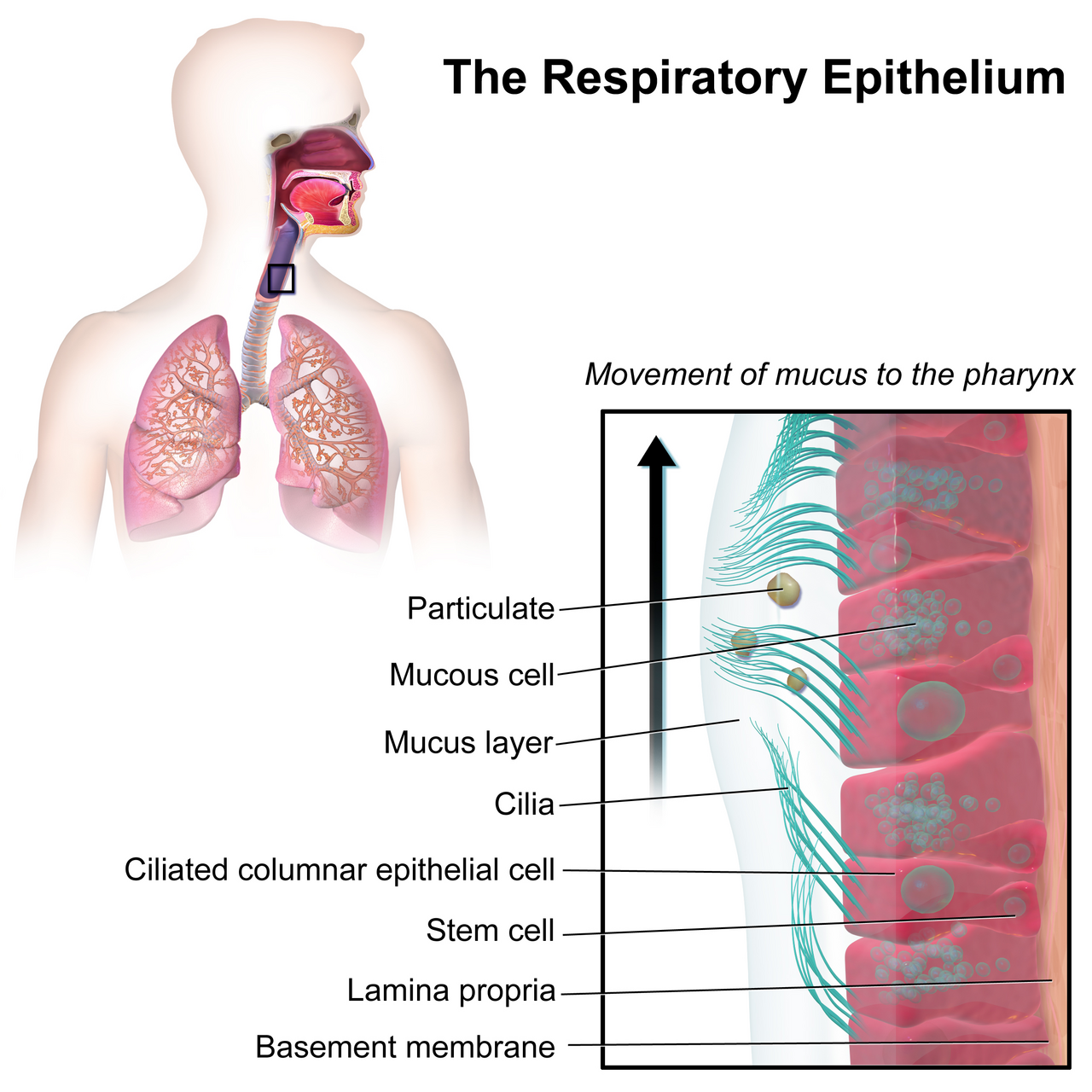
Cilia are microscopic hair-like structures on the cells lining your airways. Together with a thin layer of mucus they form a conveyor belt: mucus traps dust and germs, and the cilia beat to push it up and out of the lungs. Doctors call this mucociliary clearance.

Smoke hits this system in more than one way. Researchers had already linked smoking to cilia damage and slower beating, and a study in PLoS One (Leopold et al., 2009) added a further finding: in 28 airway biopsies, cilia from healthy smokers were 15% shorter than those from nonsmokers. The authors’ models predict that shorter cilia move mucus less effectively, because they need to reach far enough through the fluid layer to push the mucus above it.
That study compared smokers with nonsmokers at one point in time. It could not show what happens to those cilia after someone stops, which is where the real question begins.
Do Cilia Grow Back After Quitting Smoking?
The closest human evidence comes from a study that followed people through a quit program, published in Clinics (Utiyama et al., 2016). Researchers tested nasal mucus clearance using a saccharin transit test, in which a tiny amount of saccharin is placed in the nose and the time until the person tastes it is recorded.
| Measure | Result |
|---|---|
| Participants | 33 people with a median 34 pack-year history: 20 quitters and 13 continuing smokers |
| At baseline | All had impaired nasal clearance |
| Quitters at 1 month | 63% showed significant improvement |
| Quitters at 12 months | 85% showed significant improvement |
| Mucus properties | Changes only appeared at 12 months |
That is genuinely encouraging, especially given how long these participants had smoked. But read it carefully. It is a small study, it measured the nose rather than the lungs, and it measured clearance rather than cilia themselves. Improved clearance is consistent with cilia recovering, but it does not prove they regrew, and improved function could come from existing cilia working better.
So the honest answer is: probably, at least in part, with the timing still uncertain. Cilia regrowth in the deep airways is hard to study in living people, because it requires taking samples from inside the lungs.
Where the 1 to 9 Month Figure Falls Short
If you have read anything about quitting, you have seen some version of “cilia regrow within 1 to 9 months.” Look at what authoritative timelines currently say, and you find something slightly different.
- WHO says that at 1 to 9 months, coughing and shortness of breath decrease.
- CDC says coughing and shortness of breath decrease at 1 to 12 months.
- The NHS says breathing problems improve at 3 to 9 months, with lung function up by as much as 10%.
None of these timelines mentions cilia. They describe symptoms that people can report, and the cilia explanation has been layered on top. It is a reasonable explanation, and it may be part of the story, but symptoms and cilia are not the same thing. Be wary of any page that gives you a precise regrowth date.
The Bigger Picture: Your Airway Lining Can Renew
A more striking finding comes from a different angle. A 2020 study in Nature (Yoshida et al.) sequenced 632 cell colonies derived from individual airway cells in 16 people. Smoking typically added 1,000 to 10,000 mutations per cell. Yet some cells in people with a smoking history had mutation levels like those expected in someone who had never smoked, and these cells were four times more common in ex-smokers than in current smokers.
The researchers concluded that quitting promotes replenishment of the airway lining from cells that avoided the worst of the damage. That study was about DNA, not cilia, so it cannot tell you when your cilia recover. It does show that the airway lining can change after quitting, which makes partial cilia recovery biologically plausible. For the wider picture, see whether lungs can heal after years of smoking and how lung function recovers after quitting.

What You Can Actually Notice
You cannot feel your cilia, and no home test can measure them. What you can notice are indirect signals, and each of them has more than one possible cause.
| What you notice | How to read it |
|---|---|
| More cough or phlegm early on | Common, and consistent with mucus moving, since the NHS says the lungs are clearing out mucus by 48 hours. Not proof of cilia regrowth. |
| Less cough and easier breathing over months | The change WHO and CDC describe. A good sign, whatever the exact mechanism. |
| Cough lasting more than 3 weeks | The NHS advises seeing a GP. Don’t assume it is healing. |
| Coughing up blood, chest pain or trouble breathing | The NHS advises urgent help. Not a recovery symptom. |
If phlegm is your main concern, our guide to coughing up phlegm after quitting goes into detail, and smoker’s cough warning signs covers when a cough needs checking.
What to Do With This Information
You do not need a precise cilia date to make a good decision. Here is what the evidence supports in practice.
- Treat improvement as gradual and uneven. Even in the small study above, not everyone improved at 12 months. People differ, and a slow change is not a failure.
- Protect the airway you are recovering. Every cigarette re-exposes the airway lining to the same smoke that caused the problem in the first place. Staying smoke-free is the single thing you control.
- Skip the lung detox products. We found no good evidence that supplements or cleanses speed cilia recovery. Our guide on what actually helps your lungs after quitting covers the options that hold up.
- Get lasting symptoms checked. If you smoked for many years, ask your doctor whether spirometry is appropriate, rather than assuming a lingering cough is cilia at work.
Frequently Asked Questions
Do cilia grow back after you quit smoking?
Probably, at least in part, but direct human evidence is limited. A 2016 study in Clinics found nasal mucus clearance improved in most quitters, which suggests the clearing system recovers. It measured clearance in the nose rather than cilia in the lungs, and it was small.
How long does it take cilia to recover after quitting?
We found no reliable study that has established a timeline for cilia in the lungs. In a small 2016 study, 63% of quitters had improved nasal clearance at 1 month and 85% at 12 months. The widely repeated 1 to 9 month figure does not appear on current WHO, CDC or NHS timelines, which describe cough and breathing instead.
Why do I cough more if my cilia are healing?
Better mucus movement is one plausible reason, and the NHS says the lungs are clearing out mucus by 48 hours after quitting. But increased cough has other causes too. See a doctor if a cough lasts more than 3 weeks, and urgently if you cough up blood.
Can you feel your cilia recovering?
No. You cannot feel cilia, and there is no home test for them. What you can notice are indirect signs, such as less coughing or easier breathing, which WHO and CDC describe as improving over roughly 1 to 12 months after quitting.
Do cilia recover after decades of smoking?
The evidence does not give a clear answer. In the 2016 Clinics study, participants had a median of 34 pack years and most still improved nasal clearance after quitting. Other research found long-term damage to airway cells can persist, so recovery is likely to vary between people.
Give Your Airways the Time They Need
Your lungs can’t be rushed, but you can make the smoke-free days add up. iQuit shows your days smoke-free, cigarettes avoided and money saved on a real-time dashboard, and includes a health-recovery timeline and SOS craving support for the harder moments. It’s free on Google Play and the App Store.
Download iQuit Free on Google Play Download on the App Store
Featured illustration: BruceBlaus / Wikimedia Commons, CC BY 3.0.