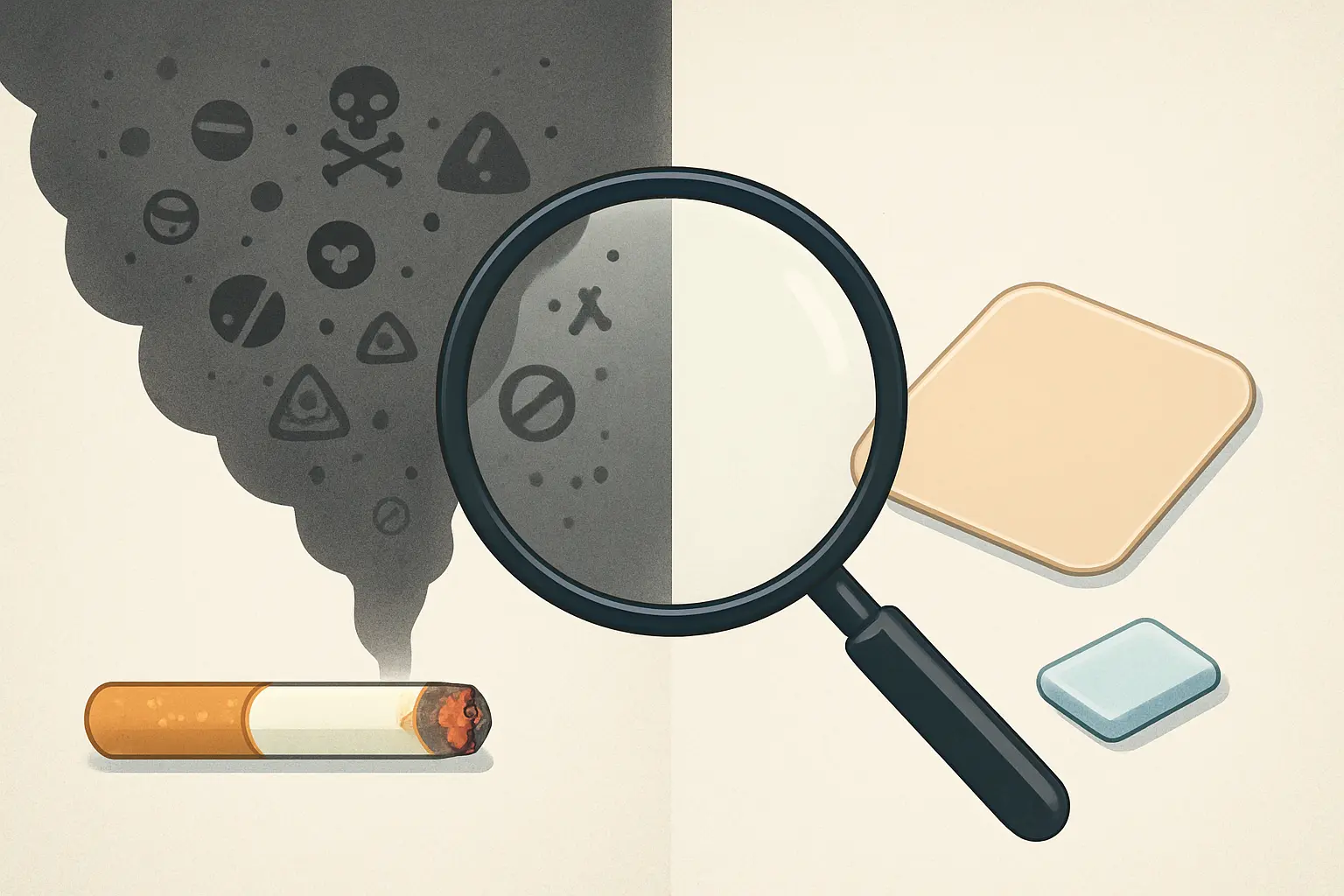
Many people who smoke avoid nicotine patches or gum because they believe nicotine is what gives smokers cancer. So, does nicotine cause cancer? According to the International Agency for Research on Cancer (IARC), the FDA and Cancer Research UK, nicotine is not considered a cause of cancer. The cancer risk from smoking comes mainly from the thousands of other chemicals in tobacco smoke. Nicotine is still not harmless, though, and the science has some honest gaps.
This guide separates nicotine from tobacco smoke, explains what health agencies and the research actually say, covers nicotine’s real risks, and shows what that means if you are thinking about nicotine replacement therapy (NRT), vapes or pouches.
Short answer: does nicotine cause cancer?
No major health agency classifies nicotine as a cause of cancer. The clearest statements come from three sources:
- Cancer Research UK: nicotine itself does not cause cancer. Because it is so addictive, it keeps people smoking and taking in cancer-causing chemicals.
- FDA: the toxic mix of chemicals in tobacco, not nicotine, causes the serious health effects of tobacco use, including cancer.
- US Surgeon General (2014): the evidence is inadequate to infer the presence or absence of a causal link between nicotine and cancer.
Those statements are not contradictory. The first two describe where cancer risk from tobacco comes from. The third is a careful scientific verdict: there is no good human evidence that nicotine causes cancer, but it has not been proven to have zero effect either.
For practical decisions, that matters less than it might sound. Compared with smoking, getting nicotine from a patch or gum removes the smoke that carries the carcinogens.
What actually causes cancer in cigarette smoke
When tobacco burns, it produces a huge chemical mixture. The US National Cancer Institute (NCI) says tobacco smoke contains more than 7,000 chemicals, at least 250 of which are known to be harmful and at least 69 of which can cause cancer. Cancer Research UK explains that these chemicals damage DNA in our cells and make it harder for cells to repair that damage, and the damage builds up over time.
| Substance | Where it comes from | Cancer classification |
|---|---|---|
| Nicotine | Tobacco plant; also in NRT, vapes and pouches | Not generally considered a carcinogen (IARC) |
| NNK and NNN (tobacco-specific nitrosamines) | Formed from tobacco alkaloids, mainly during curing, fermentation and ageing of tobacco | Carcinogenic to humans, Group 1 (IARC) |
| Polycyclic aromatic hydrocarbons, such as benzo(a)pyrene | Burning tobacco | Listed by Cancer Research UK among cancer-causing chemicals in smoke |
| Benzene, formaldehyde, arsenic, 1,3-butadiene | Tobacco smoke | Listed by Cancer Research UK among cancer-causing chemicals in smoke |
The names can be confusing. IARC explains that NNK and NNN form from tobacco alkaloids, including nicotine, mainly while tobacco is cured, fermented and aged, which is why they are called “tobacco-specific.” They are different chemicals from nicotine, and their levels depend on the tobacco type and how it is processed.
Smoking is linked to many cancers beyond the lungs. Our guide to the cancers caused by smoking covers each one with risk data.

What IARC and health agencies say about nicotine
IARC is the World Health Organization agency that classifies cancer hazards. In its 2012 monograph on tobacco and other personal habits, IARC classified tobacco smoking, smokeless tobacco, NNK and NNN as carcinogenic to humans. In the same volume it states that nicotine is not generally considered to be a carcinogen. Nicotine itself does not appear in IARC’s cumulative index of evaluated agents.
| Organization | Position |
|---|---|
| IARC (WHO) | Nicotine is not generally considered a carcinogen, but may enhance the effects of carcinogens |
| US Surgeon General (2014) | Evidence inadequate to infer whether nicotine causes cancer |
| FDA | Chemicals in tobacco, not nicotine, cause cancer and other serious effects |
| Cancer Research UK | Nicotine itself does not cause cancer |
| NCI | Nicotine is the drug primarily responsible for tobacco addiction |
The FDA’s nicotine explainer also describes a continuum of risk. Burning products such as cigarettes are the most harmful, FDA-approved NRTs are the least harmful, and products such as e-cigarettes and smokeless tobacco fall in between.
Cancer Research UK discusses the evidence on nicotine-containing e-cigarettes as a stop smoking tool in this video:
What lab and animal studies suggest
If the agencies agree, why the lingering doubt? Because laboratory research gives mixed signals, and the 2014 Surgeon General’s report chapter on nicotine reviewed them in detail:
- Cells: nicotine binds receptors found throughout the body, including in lung tumors. In lab dishes it can switch on pathways linked to cell growth, survival and new blood vessel formation.
- Animals given nicotine alone: several studies did not find that nicotine by itself causes tumors, including by inhalation. One mouse study reported muscle and uterine sarcomas.
- Tumor promotion: some studies found nicotine increased tumors caused by other carcinogens, or helped implanted tumors grow. Others found no effect.
- Doses like NRT: a 2011 set of mouse experiments dosed nicotine to match levels in people using NRT and found it did not promote lung tumors caused by NNK.
The Surgeon General concluded that there is some biological basis for proposing that nicotine may promote cancer, but that the experimental studies have limits in replicating human exposure and human evidence is lacking. IARC similarly notes that nicotine may enhance the effects of carcinogens even though it is not itself carcinogenic.
Researchers are especially interested in whether nicotine affects people who already have cancer. If you are being treated for cancer, ask your oncology team about nicotine products rather than relying on general guidance.
Nicotine’s real risks
Not causing cancer does not make nicotine safe for everyone. The 2014 Surgeon General’s report found sufficient evidence for several harms:
| Effect | Surgeon General 2014 verdict |
|---|---|
| Addiction | Nicotine is the main driver of tobacco addiction (NCI, FDA) |
| Acute poisoning at high doses | Sufficient evidence |
| Harm in pregnancy, such as preterm delivery and stillbirth | Sufficient evidence |
| Lasting effects on fetal brain development | Sufficient evidence |
| Effects on adolescent brain development | Suggestive evidence |
| Heart rate and heart workload | Raises heart rate and contractility, contributing to some extent to smokers’ cardiovascular risk |
| Cancer | Inadequate evidence either way |
Addiction is the biggest everyday risk. If you have never used nicotine, do not start. If you want to understand how quickly dependence builds, read how long it takes to get addicted to nicotine. And if you are comparing products, see how nicotine delivery stacks up in how many cigarettes equal one vape.
Is NRT safe to use for months?
For people who smoke, the evidence strongly favors using NRT. The NHS describes NRT as safe and proven to work, says it can double your chances of quitting, and recommends using it for about 12 weeks or for as long as you need to stop yourself from smoking again. The FDA calls approved NRTs safe and effective.
The best long-term human data come from the Lung Health Study, which followed more than 3,000 participants for 7.5 years after a five-year trial. Smoking predicted lung cancer, but NRT use did not. The authors noted the follow-up was relatively short, and the Surgeon General called it the only study with information on long-term NRT users.
- Pregnancy: the NHS says licensed NRT is safe to use in pregnancy if you need help to quit, ideally after speaking to a healthcare professional.
- Long-term use: staying on NRT to avoid relapse is far safer than going back to cigarettes. Our guide on long-term nicotine gum safety covers dependence and tapering.
- Vapes and pouches: the NHS says vapes are likely to be far less harmful than cigarettes, and the FDA says they are not risk-free. Read our comparison of vaping vs smoking and our guide to nicotine pouch safety.
The wider idea of switching to less harmful nicotine sources is called tobacco harm reduction. It works best as a route to stopping smoking completely.
If you use NRT, iQuit can help you use it with confidence: log each craving with its trigger and intensity to see whether your dose is covering you, and track your days smoke-free while you step down.

How many people believe nicotine causes cancer
The misconception is common, even among health professionals, and how researchers ask the question changes the answer:
- US adults aged 18 to 45: in a 2022 randomized survey experiment of 2,526 people, published in Nicotine & Tobacco Research in 2026, 36% overall said nicotine does not cause cancer. Depending on the wording, that ranged from 10% to 81%. With a blunt “nicotine is a cause of cancer” item, only 23% gave the correct answer.
- Healthcare workers: a 2026 survey of 598 providers and trainees at one US academic medical center found 25.9% wrongly believed nicotine causes most tobacco-related cancer.
- People who smoke: a 2024 study of adults who smoke and believe nicotine causes cancer found many described nicotine as directly causing disease, which shaped how they felt about switching products.
The misperception has consequences. If you think the patch carries the same cancer risk as a cigarette, you are less likely to use the tool that could help you quit. A 2025 randomized trial found that repeated corrective messages reduced false beliefs about nicotine and NRT.
Nicotine and Cancer FAQ
Does nicotine cause cancer?
Nicotine is not classed as a carcinogen. IARC says it is not generally considered one, Cancer Research UK says nicotine itself does not cause cancer, and the US Surgeon General found the evidence inadequate to show a causal link. Cancer from smoking comes mainly from other chemicals in smoke (IARC 2012, Surgeon General 2014).
What in cigarettes causes cancer if not nicotine?
Tobacco smoke contains more than 7,000 chemicals, and at least 69 can cause cancer, according to the NCI. They include tobacco-specific nitrosamines such as NNK and NNN, which IARC classifies as carcinogenic to humans, plus benzene, formaldehyde and polycyclic aromatic hydrocarbons (NCI, IARC, Cancer Research UK).
Can nicotine patches or gum give you cancer?
There is no good evidence that they do. In the Lung Health Study, smoking predicted lung cancer over 7.5 years of follow-up but NRT use did not. The FDA calls approved NRT safe and effective, and the NHS says it can double your chances of quitting (Nicotine and Tobacco Research 2009, FDA, NHS).
Does vaping cause cancer if nicotine doesn’t?
Vapes do not burn tobacco and produce no tar or carbon monoxide, and the NHS says they are likely far less harmful than smoking. The FDA says e-cigarette aerosol still contains some harmful chemicals and they are not risk-free, and long-term data are still limited (NHS, FDA).
Is nicotine safe then?
Not entirely. Nicotine is highly addictive, toxic at high doses, harmful to maternal and fetal health in pregnancy, and may affect the developing adolescent brain. It also raises heart rate. For adults who smoke, getting nicotine from NRT instead of cigarettes is much safer (Surgeon General 2014, FDA).
Can I use NRT while pregnant?
The NHS says licensed NRT products are safe to use in pregnancy if you need support to quit smoking. It recommends speaking to a healthcare professional first to choose the right product and avoiding liquorice-flavored nicotine products while pregnant (NHS Better Health).
Does nicotine make existing cancer grow?
Some laboratory and animal studies suggest nicotine can help implanted tumors grow, while others found no effect at NRT-like doses. Human evidence is lacking. If you have cancer, ask your oncology team before using nicotine products, and do not keep smoking instead (Surgeon General 2014).
How long can I safely use nicotine replacement?
The NHS recommends using NRT for about 12 weeks, or for as long as you need it to avoid smoking again. Using it longer is far safer than returning to cigarettes. Speak to a pharmacist or stop smoking adviser about tapering when you feel ready (NHS Better Health).
Use NRT with a plan
iQuit logs every craving with its trigger and intensity, shows your days smoke-free and money saved, and gives you SOS support and an AI coach while you use NRT to quit. Free on Google Play and the App Store.
Download iQuit Free on Google Play
Download on the App Store