If you are wondering how to dispose of vapes, the short version is that they do not belong in your household trash or recycling bin. A vape contains nicotine and a lithium battery, which makes it hazardous waste, and the right drop-off point depends on where you live. This guide covers the United States, the United Kingdom and Canada, how to prepare a device before you hand it in, and why quit day is the best time to clear out every last pod and charger. It relies on the EPA, the FDA and the UK government, and it notes where rules are set locally rather than nationally.
How to Dispose of Vapes: The Short Answer
The rule is the same in all three countries this guide covers: keep vapes out of the ordinary bin. The EPA states “Do NOT put e-cigarettes in your household trash or recycling” and “DO take e-cigarettes to your household hazardous waste collection site.” The FDA repeats the same two points on its e-cigarette page. What changes from country to country is the drop-off point.
| Country | What the official source says | What to do |
|---|---|---|
| United States | EPA: take e-cigarettes to your household hazardous waste collection site; not in household trash or recycling | Search for local household hazardous waste collection or call your solid waste agency |
| United Kingdom | Defra: return used vapes to your vape supplier or take them to your nearest recycling point; retailers must provide collection points | Ask the shop where you bought it, or find a recycling point |
| Canada | Rules set by provinces and municipalities; Call2Recycle Canada reports launching Québec’s first vape recycling initiative in 2025 | Ask your municipality or provincial recycling program |
Sources: the EPA guide for individuals, the FDA page on e-cigarettes, vapes and other ENDS, and the UK government’s Defra environment blog. If you are in the UK and want the legal background on single-use devices, see our explainer on the UK disposable vape ban.
Why Vapes Count as Hazardous Waste
The EPA says: “E-cigarettes contain nicotine and lithium batteries, making them hazardous waste.” It explains the two risks separately. “Nicotine is toxic and poses a risk to both workers and the environment,” and “lithium batteries can catch fire, especially when damaged.” In household trash or recycling bins, it says, those batteries “often get damaged by trash compactors and can cause fires during transportation and at waste and recycling facilities.”
The UK government gives a sense of the scale of the problem. In its blog on the single-use vape ban, Defra reports that “in 2023 there were over 1,200 battery fires in bin lorries and waste sites across the UK,” a 70% increase on the year before, and notes that almost five million single-use vapes were either littered or thrown away in general waste every week, according to a Material Focus estimate. The FDA, for its part, lists “overheating, fires, and explosions” among the safety problems reported to it about vaping products.
This short video from a county hazardous waste program shows what happens to a disposable vape after you throw it away.
Prepare the Device Before You Drop It Off
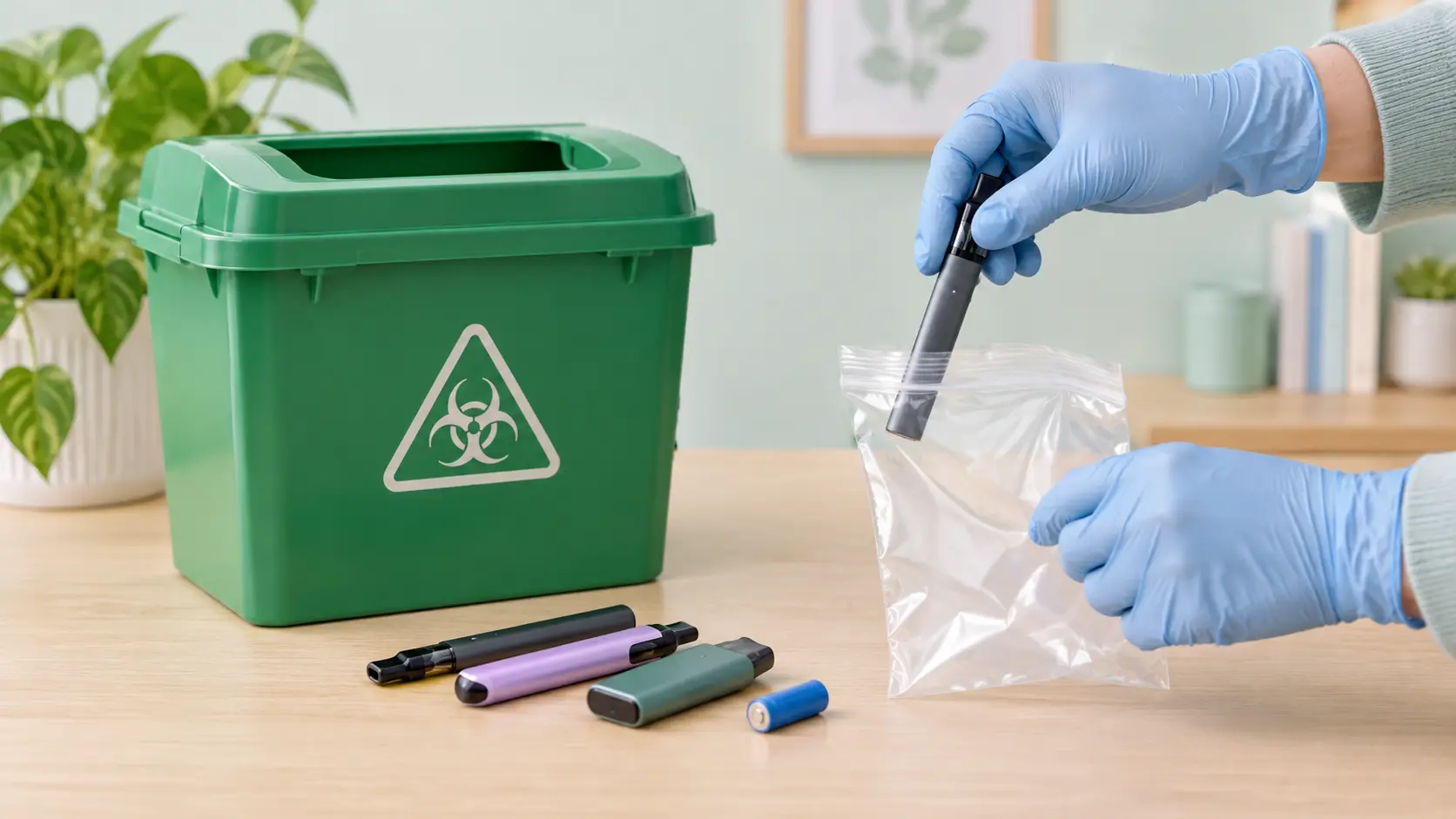
The EPA’s lithium-ion battery page, which lists e-cigarettes among the products that contain these batteries, gives a simple routine: “Place each battery or device containing a battery in a separate plastic bag. Place non-conductive tape (e.g., electrical tape) over the battery’s terminals.” It also warns that “even used batteries can have enough energy to injure or start fires.”
- Gather everything. Check pockets, glove boxes, drawers and bags for stray devices, spare batteries and chargers.
- Bag each device separately. One device per plastic bag, as the EPA describes.
- Tape exposed battery terminals with electrical tape where you can see them.
- If a battery is damaged, the EPA says to contact the battery or device manufacturer for specific handling information.
- Take it to the right place, not the curbside bin.
Official guidance does not describe a safe way to empty leftover e-liquid at home, so this guide does not suggest one. Ask your local hazardous waste program how it wants liquid containers handled. Source: EPA: used lithium-ion batteries.

Disposing of Vapes in the United States
The EPA’s advice is to use household hazardous waste (HHW) collection. It says “many towns and counties have collection programs for household hazardous waste” and tells you to search online for collections near you or to contact your local solid waste agency. It adds that “typically, household hazardous waste collections are free for residents,” and that dropping off at an HHW site is the best way to make sure the waste does not cause a fire, expose first responders and other workers to toxic chemicals, or release toxic chemicals into the environment.
Notice what the EPA does not say. It does not point to a national take-back scheme, so the answer is local. If your area has no HHW program, call your solid waste agency and ask what they accept. The same EPA page warns that liquid nicotine “can be easily absorbed by the skin, potentially causing nicotine poisoning with symptoms that include difficulty breathing, fainting, or seizures.” The last section of this guide covers what to do if that happens.
Disposing of Vapes in the UK
Defra’s advice is direct: “If you’ve got a collection of used up vapes in a drawer at home, don’t bin them. Return them to your vape supplier for recycling or take them to your nearest recycling point.” It also says “retailers have a legal duty to provide collection points for waste vapes to their customers,” so a shop that sells vapes should take yours back.
Defra explains that the ban on selling or supplying single-use vapes began on 1 June 2025 across England, Wales, Scotland and Northern Ireland, and that reusable vapes can still be sold. That means the devices in your drawer may be disposables bought before the ban, or reusable ones, and the same advice applies to both: they are not general waste. For the quit side of the story, read how to quit disposable vapes step by step.
Disposing of Vapes in Canada
Canada is the hardest of the three to summarize. There is no single federal page on vape disposal, and waste rules in Canada are mostly set by provinces and municipalities. One concrete example: Call2Recycle Canada, a battery recycling organization, says that in 2025 it launched “Québec’s first vape recycling initiative.” That does not tell you what is available in your own province.
The practical route is the same as elsewhere. Ask your municipality or provincial recycling program where electronic waste and batteries go, and tell them it is a vape. In the meantime, the safe-handling steps above (separate bag, taped terminals) are general lithium battery guidance from the EPA, and do not depend on the country.
Quit Day: Clear Out Every Device
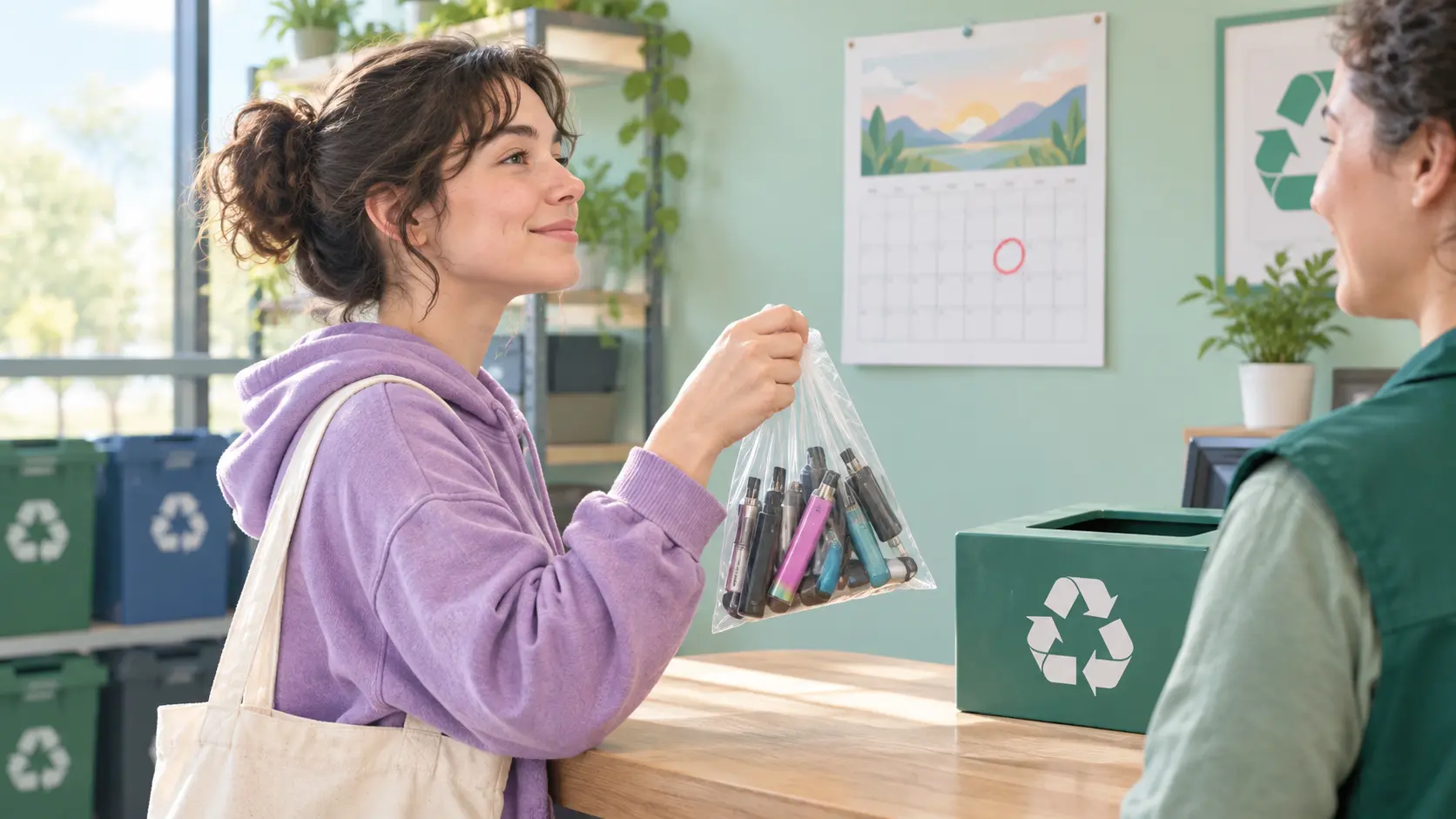
Disposal is not just an environmental chore. If you are quitting, a drawer of half-full pods is a stash. Defra’s own words about “a collection of used up vapes in a drawer at home” describe the situation many people are in, and getting rid of all of them on the same day makes the next craving a little harder to act on. Keeping one device back turns every rough hour into a decision. Our full plan in a step-by-step vape quit plan puts the disposal step on the day you stop.
Expect the first days to be uncomfortable. Defra says nicotine withdrawal “can cause anxiety, irritability, trouble concentrating and headaches.” If you want help riding out those moments, the best quit vaping apps compared lists your options, and our teen guide, how to tell if your teen is vaping, covers what to do when the devices you find are not yours.
For the wider picture on tobacco litter, see our page on cigarette butt pollution.
If Nicotine Liquid Gets on Skin or Is Swallowed
The EPA warns that liquid nicotine can be absorbed through the skin, with symptoms that include difficulty breathing, fainting or seizures. For medical advice, Poison Control says you can use its online tool or “call a poison center at 1-800-222-1222,” and that “both options are free, expert, and confidential.” Its page adds: “If the individual collapses, has a seizure, has trouble breathing or can’t be awakened: Call 911 now!” This number is for the United States; if you live elsewhere, use your local poison information service or emergency number. Source: Poison Control.
Frequently Asked Questions
Can I throw a vape in the trash?
No. The EPA says not to put e-cigarettes in household trash or recycling, because the lithium batteries can become damaged and cause fires and nicotine is toxic. Take them to a household hazardous waste collection site instead. (EPA)
Where do I take old vapes in the US?
The EPA says to take them to your household hazardous waste collection site. Many towns and counties run these programs, and you can search online or contact your local solid waste agency. The EPA says collections are typically free for residents. (EPA)
Where do I take old vapes in the UK?
Defra says to return used vapes to your vape supplier for recycling or take them to your nearest recycling point. It also says retailers have a legal duty to provide collection points for waste vapes to their customers. (Defra environment blog)
Can I recycle a vape in Canada?
It depends on where you live, because rules are set by provinces and municipalities rather than nationally. Call2Recycle Canada says it launched Québec’s first vape recycling initiative in 2025, so ask your municipality or provincial program what is available in your area. (Call2Recycle Canada)
How do I make a vape battery safe before disposal?
The EPA says to place each battery or device containing a battery in a separate plastic bag and put non-conductive tape, such as electrical tape, over the battery terminals. It warns that even used batteries can have enough energy to injure or start fires. (EPA)
Why do vapes cause fires in bins and trucks?
The EPA says lithium batteries can catch fire, especially when damaged, and that trash compactors often damage them. Defra reports over 1,200 battery fires in UK bin lorries and waste sites in 2023, a 70% rise on the year before. (EPA, Defra)
What if nicotine liquid touches my skin?
The EPA says liquid nicotine can be easily absorbed by the skin and may cause nicotine poisoning, with symptoms including difficulty breathing, fainting or seizures. In the US, Poison Control (1-800-222-1222) is free, expert and confidential, and it says to call 911 if the person collapses, has a seizure, has trouble breathing or cannot be awakened. (EPA, Poison Control)
After the Last Vape: Handle the Cravings
Handing in the last device is a strong first step, and the first days afterward are when cravings tend to bite. iQuit is free on Google Play and the App Store. Use the craving log to record triggers and intensity, SOS support when an urge hits, and the money dashboard to see what you are saving. Download it before you drop off the last pod.