
If you are wondering how to quit smoking if you only smoke a few a day, start with an uncomfortable fact: light smoking is often harder to stop than it looks. Your cigarettes are few, but each one is tied firmly to a place, a person or a feeling. This guide shows how to map those fixed cigarettes, when nicotine replacement makes sense at a low daily count, how to cut the anchor cigarettes first, and how to handle a slip without starting again from zero.
Why Quitting a Few a Day Is Harder Than It Sounds
Many light smokers expect quitting to be easy, because they already go hours or days without a cigarette. Then the same three cigarettes keep coming back. Research on how light smokers actually smoke explains why.
In one study, 212 people who smoked on some days but not every day recorded each cigarette and their surroundings in real time for three weeks. Their smoking was far more tightly linked to cues than that of daily smokers. That held for mood, location, activity, company, time of day and whether others were smoking (Shiffman et al., Psychology of Addictive Behaviors, 2015). A second study by the same team found that non-daily smokers had lower craving on days they did not smoke and no rise in withdrawal. Craving climbed only at the moment smoking resumed (Shiffman et al., Journal of Abnormal Psychology, 2015).
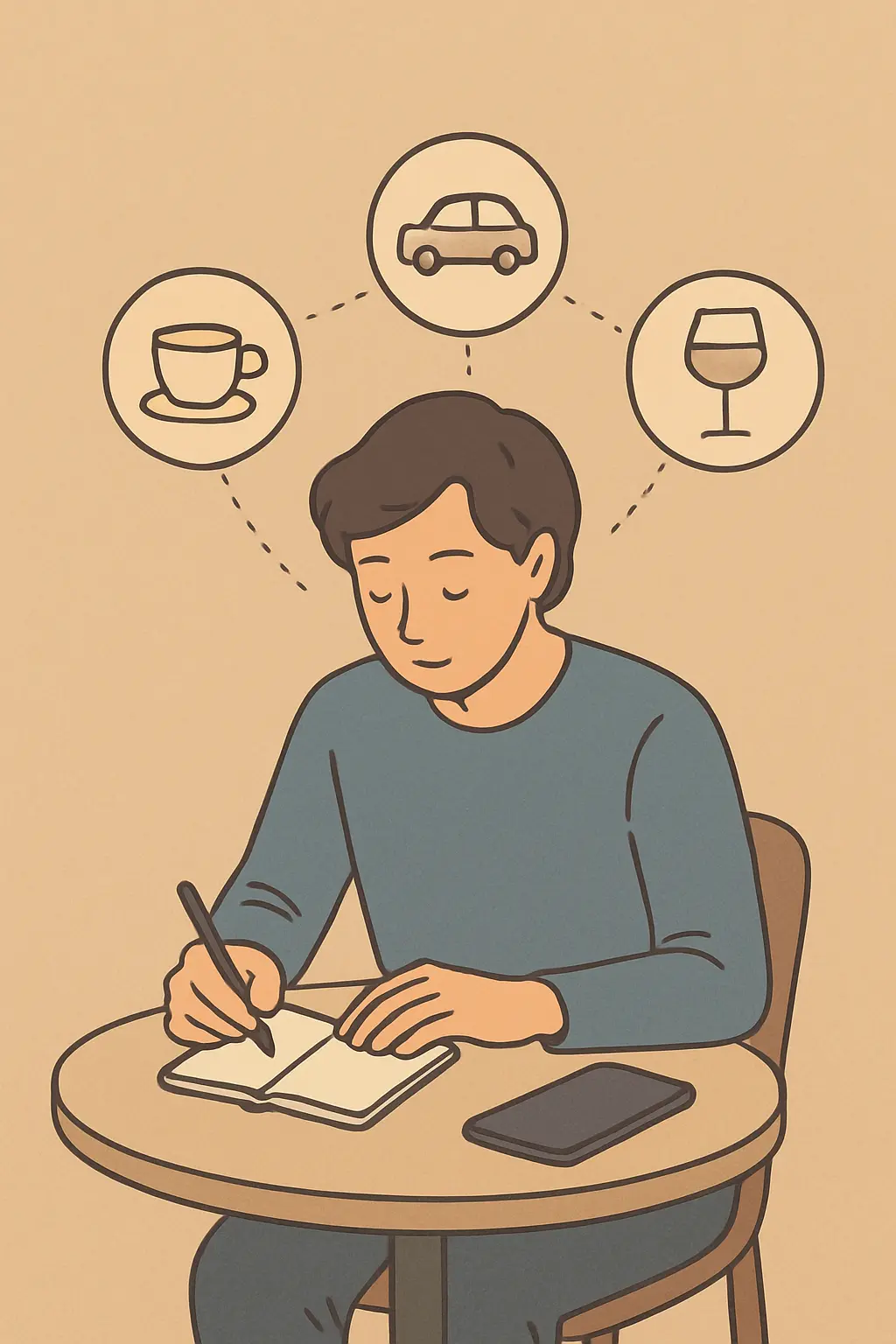
In plain terms, your cigarettes are not waiting for your body to run low on nicotine. They are waiting for the coffee, the drive, the drink or the argument. That is good news, because cues can be mapped, and a map can be planned around. Our guide to craving vs habit explains the difference in more detail.
The second reason is that a few a day feels harmless. It is not. In a large US study of older adults, people who had consistently smoked 1 to 10 cigarettes a day had a higher risk of death than people who had never smoked. The hazard ratio was 1.87, and it was 1.64 even for fewer than one a day (Inoue-Choi et al., JAMA Internal Medicine, 2017). A meta-analysis found that men smoking one cigarette a day carried 46% of the excess heart disease risk of men smoking 20 a day, and women 31% (Hackshaw et al., BMJ, 2018). We cover this in full in the risk of one a day.
Baylor Scott & White Health explains the risks of light smoking in this short video.
Are You a Light Smoker? The Definitions
There is no single agreed definition. A review in Circulation found that studies have called someone a light smoker for smoking fewer than 15 a day, fewer than 10 a day, or anywhere from 1 to 39 cigarettes a week (Schane, Ling and Glantz, Circulation, 2010). The same review notes that light and occasional smokers often do not think of themselves as smokers at all.
| Label | Typical pattern | What it means for quitting |
|---|---|---|
| Light smoker | Fewer than 10 a day in many studies | Cues matter, and some dependence is still possible |
| Low-rate or very light daily smoker | Fewer than 5 or 6 a day, every day | A few fixed daily anchors, such as the morning coffee |
| “Chipper” | No more than 5 on the days they smoke | Often rule-bound, such as only after work |
| Intermittent or non-daily smoker | Smokes on some days, not all | Strongly cue-driven; lapses cluster around events |
| Social smoker | Smokes mainly with others, may never smoke alone | Plans must cover parties, bars and friends |
If you smoke mostly with other people, our guide to social smoking triggers covers that pattern. To see how your count compares, check average cigarettes per day. A low count is not the same as low motivation, either. In England between 2021 and 2024, 21.0% of non-daily smokers were highly motivated to quit, compared with 14.8% of daily smokers (Jackson et al., Addiction, 2025).
Map Your Fixed Cigarettes
Before you change anything, spend seven days recording every cigarette. Write down the time, where you were, who you were with, what you were doing and how you felt. Also rate how much you wanted it from 1 to 10. Many light smokers find that their week comes down to a handful of repeating slots.
| Slot | Cue | Days it happened | Average want (1–10) | Type |
|---|---|---|---|---|
| 7:45am | First coffee on the back step | 7 of 7 | 8 | Anchor |
| 12:30pm | Lunch break with a smoking colleague | 5 of 7 | 5 | Social |
| 5:40pm | Driving home after work | 5 of 7 | 6 | Transition |
| 9:30pm | Glass of wine after the kids are in bed | 6 of 7 | 7 | Reward |
| Saturday night | Drinks with friends | 1 of 7 | 9 | Event |
This is an illustration, not real data, but the pattern is typical of what a log reveals. Some cigarettes are anchors that happen every day at the same moment. Others are transitions between parts of the day, rewards, or events that come less often but hit hardest.
You can do this on paper, but an app makes it quicker. iQuit’s craving log records each craving or cigarette with its trigger and intensity in a few taps. Over time, its craving forecasts learn which hours are risky for you and nudge you before they arrive. For a light smoker with fixed slots, that means a reminder at 5:35pm before the drive home, not after you have already lit up.
Do Light Smokers Need Nicotine Replacement?
Not always, but do not rule it out because your count is low. In 2010, the review in Circulation noted that public health guidelines gave no formal treatment advice for light and occasional smokers beyond telling them to stop. It also said it was unclear whether medicines have a role (Schane et al., 2010). What you can use is the product labels, which already set lower starting doses for lighter smokers.
| Product | Label rule | Starting point for a light smoker |
|---|---|---|
| Nicotine patch | More than 10 a day: start at 21 mg. 10 or fewer a day: start at 14 mg | 14 mg patch for 6 weeks, then 7 mg for 2 weeks |
| Nicotine gum | First cigarette within 30 minutes of waking: 4 mg. More than 30 minutes after waking: 2 mg | Usually 2 mg, unless your first cigarette comes soon after waking |
| Nicotine lozenge | Same 30-minute rule: 4 mg or 2 mg | Usually 2 mg, on the same rule |
The patch rule comes from the FDA-approved nicotine patch label on DailyMed. The gum and lozenge rules come from their own labels. The same patch label says to ask a doctor first if you have heart disease, a recent heart attack, an irregular heartbeat or high blood pressure not controlled with medication. It also says to ask a doctor or pharmacist if you take prescription medicine for depression or asthma, or use a non-nicotine stop smoking drug. If you are pregnant or under 18, talk to a health professional before using NRT.
Time to your first cigarette is a useful guide to dependence at any count. Our page on time to first cigarette explains why. If you smoke only on some days, the evidence is mixed. In a trial with non-daily smokers, 2 mg gum used when tempted did not significantly raise six-month quit rates. The quit rates were 7.2% with gum and 5.3% with placebo, and many people barely used the gum (Shiffman et al., Nicotine & Tobacco Research, 2020). But when people did chew active gum during a temptation, their odds of smoking in that moment fell by 55% (Shiffman et al., Addiction, 2020). The practical lesson is that if you use gum or a lozenge, keep it with you for your known risky moments and actually use it.
A pharmacist can help you choose. NHS Better Health notes that combining products, or pairing NRT with a nicotine-free medicine, gives the best chance of success.
Cut the Anchor Cigarettes First
With a map in hand, you can choose the order. Some people prefer to stop all at once, and that works well for many light smokers because there are only a few slots to cover. Others prefer to remove cigarettes one slot at a time over two or three weeks before a final quit date. Either way, take on the cigarettes in a deliberate order.
- Drop the lowest-want cigarette first. In the example above, that is the lunch cigarette. Take lunch somewhere else or with a non-smoking colleague for a week.
- Break the anchor routine next. Keep the coffee but change the setting. Drink it inside, at a different time, or with a short walk. The cue is the back step as much as the coffee.
- Swap the transition. For the drive home, try a different route, a podcast saved only for that trip, or something to keep your hands busy.
- Replace the reward. The evening cigarette is often about marking the end of the day. Give that moment a new ritual.
- Plan the events last and in detail. Decide in advance what you will say, where you will stand and when you will leave.
iQuit supports both approaches. You can choose cold turkey or gradual reduction, and the dashboard shows cigarettes avoided and money saved as you go. If you are not sure you are ready to start, take the readiness quiz first.
Only a few cigarettes, but always the same ones? iQuit’s craving log and forecasts are built for exactly that pattern. Log each cue for a week, and the app starts warning you before your risky hours. Free on Google Play and the App Store.
Quit Day for a Light Smoker
A light smoker’s quit day is less about surviving constant withdrawal and more about getting through three to six specific moments. Write each one down the night before with a plan next to it.
- Remove every cigarette, lighter and ashtray, including the emergency pack in the car or the jacket pocket.
- Tell the people who share your smoking slots, such as the lunch colleague or the Saturday friends, and ask them not to offer you one.
- If you use NRT, start it on your quit day as the label directs, and keep any gum or lozenges with you for your slot times.
- Have a five-minute plan for each slot. A breathing exercise, a short walk or a text to a friend gives you something to do until the urge eases.
- Log each craving, even ones you beat, so tomorrow’s plan is based on today’s evidence.
Do not be surprised if craving spikes at a cue on day 10 after days of feeling nothing. That fits the research on non-daily smokers: craving stayed low between smoking occasions and rose when smoking resumed, which the researchers linked to cues. Learning how quickly nicotine addiction forms also helps explain why a few cigarettes can still have a strong hold.

Handling Slips Without Restarting From Zero
For light smokers, slips often happen at events: a wedding, a night out or a stressful day. In the non-daily smoker gum study, 46.0% of the temptation episodes people recorded ended with smoking (Shiffman et al., 2020). Temptations are common, and some lapses are likely. What matters is what happens next.
- Do not let one cigarette become “I smoke again”. A lapse can easily feel like proof that you are just an occasional smoker after all. It is not.
- Log the slip with its cue. If it happened at a party with a particular friend, that is the slot your plan needs to strengthen.
- Keep your quit date and your progress. iQuit’s streak shields and slip recovery are designed so one cigarette does not wipe out weeks of smoke-free days.
- If slips repeat, add support. Talk to a pharmacist about NRT for your risky moments or contact a stop smoking service. In England, the National Smokefree Helpline is 0300 123 1044. In the US, 1-800-QUIT-NOW connects you to your state quitline.
Light Smoker FAQ
Is it easier to quit if you only smoke a few a day?
Not necessarily. Withdrawal may be milder, but light and non-daily smokers’ smoking is strongly tied to cues such as places, moods and company. Those links can make the same few cigarettes hard to drop, so a plan for each cue matters (Shiffman et al., Psychology of Addictive Behaviors, 2015).
How many cigarettes a day counts as a light smoker?
There is no single definition. Studies have used fewer than 10 a day, fewer than 15 a day, or 1 to 39 cigarettes a week. Very light smokers are sometimes defined as fewer than 5 or 6 a day (Schane, Ling and Glantz, Circulation, 2010).
Is smoking 3 cigarettes a day bad for you?
Yes. People who consistently smoked 1 to 10 cigarettes a day had a higher risk of death than never smokers in a large US cohort. Even one cigarette a day carries a substantial share of the heart disease risk of 20 a day (Inoue-Choi et al., 2017; Hackshaw et al., BMJ, 2018).
What strength nicotine patch should a light smoker use?
US patch labels say people who smoke 10 or fewer cigarettes a day should start with the 14 mg patch for 6 weeks, then 7 mg for 2 weeks. People smoking more than 10 start at 21 mg. Check with a pharmacist, especially if you have heart problems (FDA label on DailyMed).
Should a social smoker use nicotine gum?
It can help in the moment. In non-daily smokers, using 2 mg gum during a temptation cut the odds of smoking then by 55%. Overall, the gum did not significantly raise quit rates and many people rarely used it, so keep it for your known risky events and use it (Shiffman et al., 2020).
Why do I crave a cigarette at parties but not at home?
Because your smoking is cued. Research on non-daily smokers found craving stayed low on days without smoking and rose at the moment smoking resumed, which fits cues rather than a regular nicotine cycle. Parties combine several strong cues at once (Shiffman et al., Journal of Abnormal Psychology, 2015).
Can an app help a light smoker quit?
Yes, because the main job is spotting and planning for cues. iQuit logs cravings with triggers and intensity, forecasts your risky hours, supports cold turkey or gradual reduction, and uses streak shields so a slip does not erase your progress. Use it alongside a pharmacist or stop smoking service if slips repeat.
Find Your Fixed Cigarettes With iQuit
Log each craving with its cue, get warned before your risky hours, and keep your progress through a slip. It is built for the few cigarettes that are hardest to drop. Free on Google Play and the App Store.
Download iQuit Free on Google Play
Download on the App Store