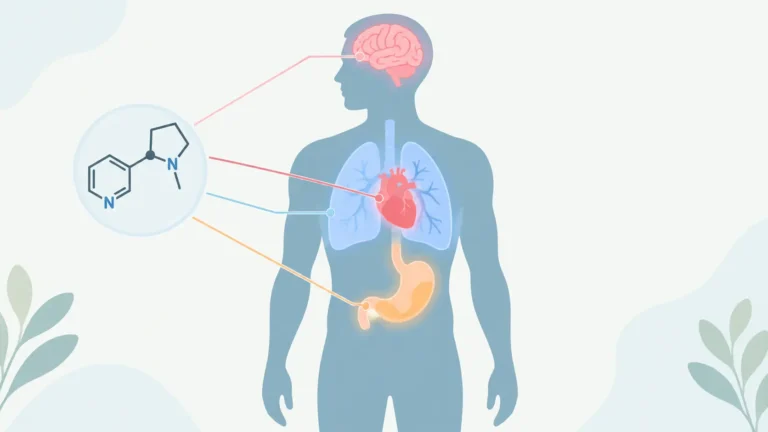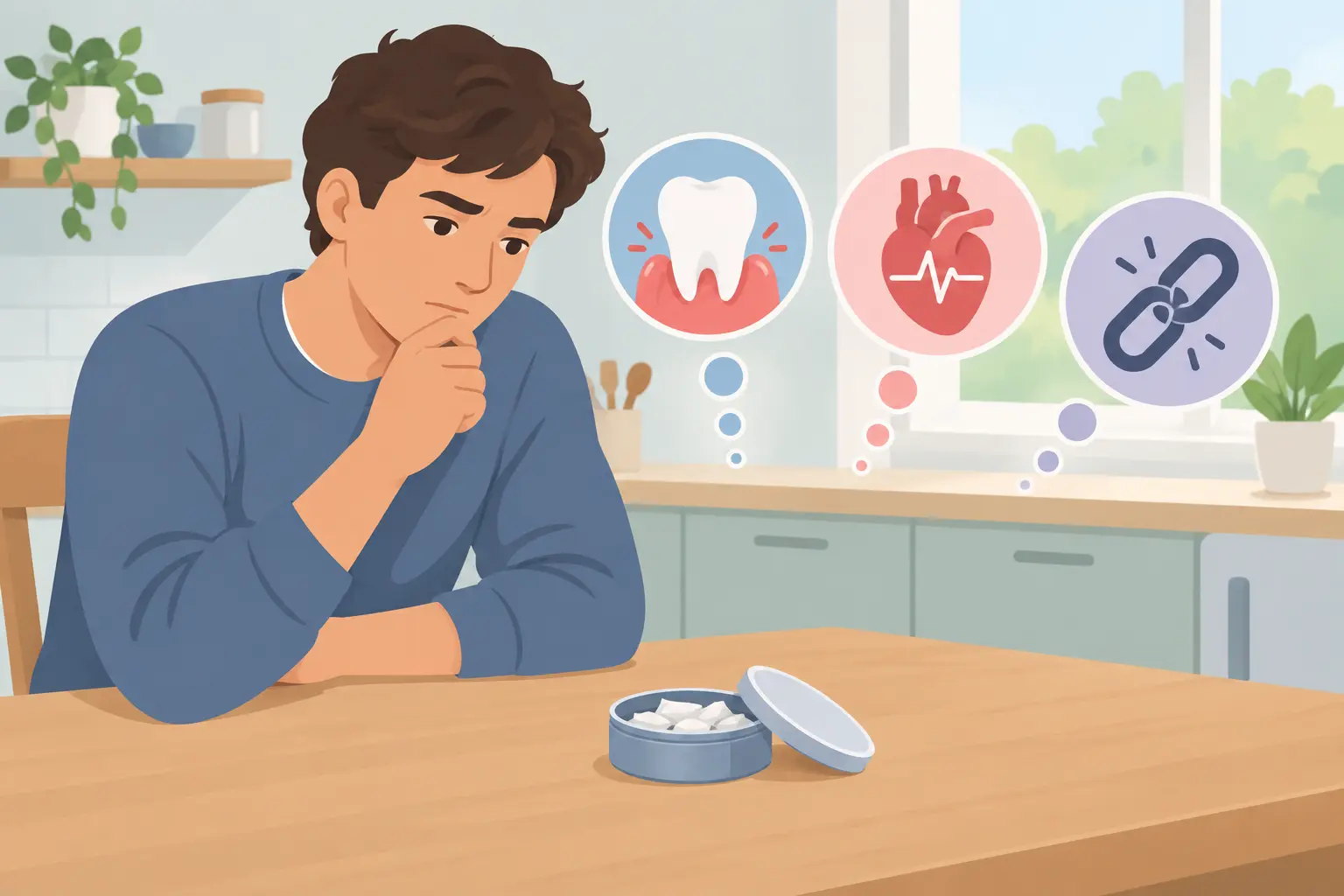
If you use pouches every day, the question is Zyn bad for you is a fair one, and the honest answer has two halves. Compared with smoking, a nicotine pouch with no tobacco leaf and no smoke exposes you to far fewer harmful chemicals, and the FDA says so. But “less harmful than cigarettes” is not the same as “harmless”: the nicotine still hooks you, your gums can take the damage, and long-term heart data barely exist yet.
Is Zyn bad for you? Less harmful than smoking, not harmless
Two statements can both be true at once. First, a pouch delivers nicotine without burning anything, so it avoids the tar and combustion products that do most of the damage in cigarettes. Second, nicotine pouches are new enough that nobody has decades of follow-up on the people who use them every day.
That is why the most careful sources sound like this: a lower-risk product for an adult who would otherwise keep smoking, and a poor idea for anyone who does not already use nicotine. If you are a former smoker who switched, the pouch may be a step forward. If you started on pouches without ever smoking, the sensible direction is out, not further in.
What is in a Zyn pouch
The FDA describes nicotine pouches as “small synthetic fiber pouches containing nicotine designed to be placed between a person’s gum and lip.” There is no tobacco leaf, nothing to light and no smoke. The 20 authorized Zyn products are ten flavors (Chill, Cinnamon, Citrus, Coffee, Cool Mint, Menthol, Peppermint, Smooth, Spearmint and Wintergreen), each in two nicotine strengths, 3 milligram and 6 milligram.
The nicotine passes through the lining of the mouth into your blood. If you want the full picture of how pouches compare as a way off cigarettes, our guide to nicotine pouches as a quit-smoking tool covers that separate question.
What the FDA authorization does and does not mean
In January 2025 the FDA authorized the marketing of these products through the premarket tobacco product application pathway. It was the first time the agency had authorized products commonly referred to as nicotine pouches. The agency judged that, because the products have “substantially lower amounts of harmful constituents than cigarettes and most smokeless tobacco products, such as moist snuff and snus,” they “pose lower risk of cancer and other serious health conditions than such products.”
The same announcement carries the sentence people tend to skip: the authorization “does not mean these tobacco products are safe, nor are they ‘FDA approved.’ There is no safe tobacco product.” The sale is legal to adults 21 and older, and the agency can suspend or withdraw an authorization if the public health case weakens, for example after a notable increase in youth initiation.
| It means | It does not mean |
|---|---|
| 20 specific Zyn products may be legally marketed to adults 21+ | The products are safe or “FDA approved” |
| Lower risk of cancer and other serious conditions than cigarettes and most smokeless tobacco | Lower risk than using no nicotine at all |
| Some adults who smoked completely switched in the study the maker supplied | The pouch is an approved way to quit smoking |
Gums and mouth: where the damage shows up first
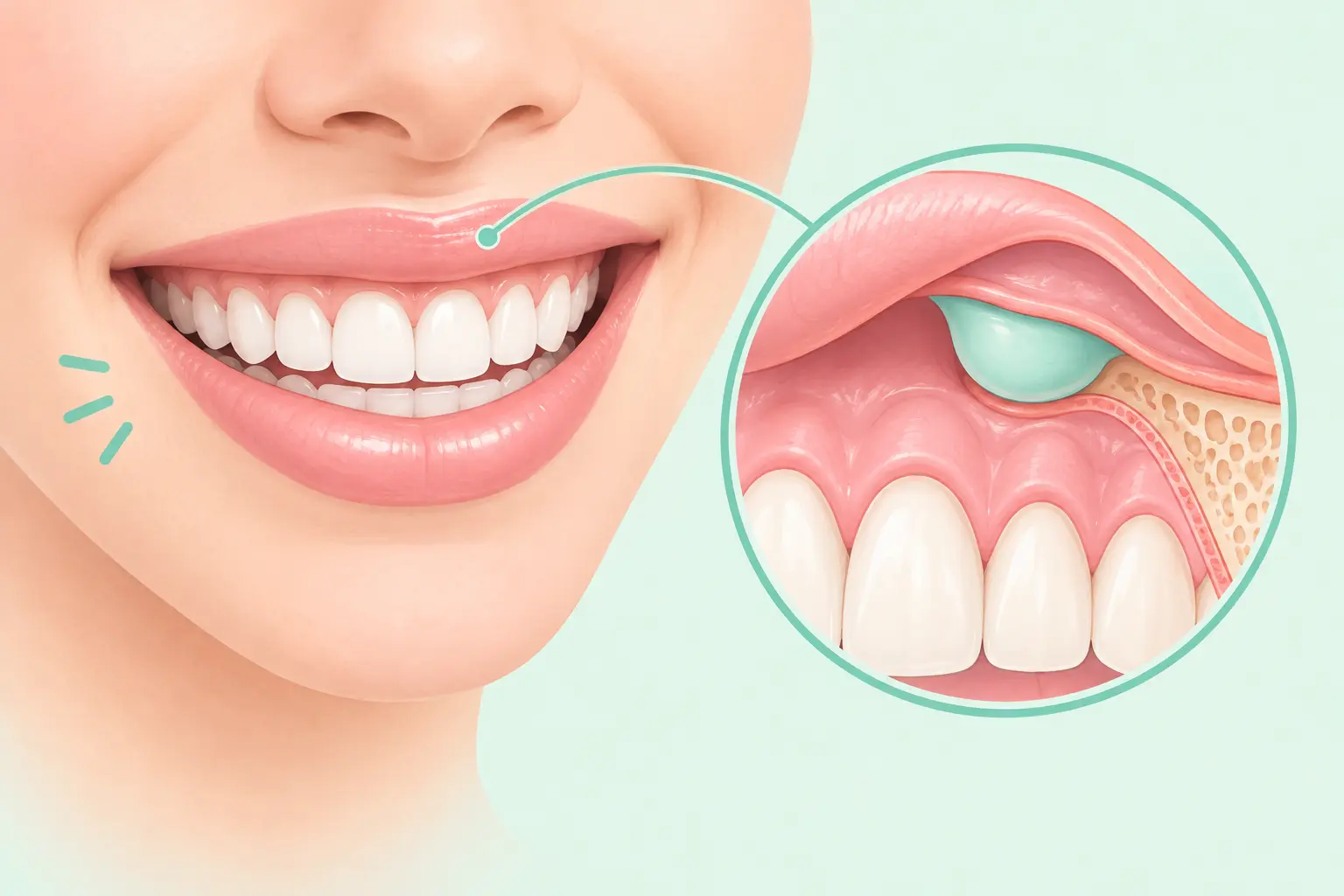
Because the pouch sits against the gum for a long stretch, the mouth is the place researchers are finding trouble. The evidence is still small and mostly observational, so read these as warning signs rather than settled numbers.
- Mouth lesions. In a 2026 cross-sectional study in Oral Diseases of adults aged 18 to 30, “oral lesions were identified in 79% of nicotine pouch users and 89% of oral tobacco-derived pouch users.” The authors concluded that nicotine pouches “appear to induce broader mucosal responses than tobacco-containing snus,” and saw no increased risk of cavities or periodontal disease for up to six years of use (PubMed record).
- Gum recession at the pouch site. A 2025 case report in BMC Oral Health described two otherwise healthy young men with localized gum recession, one also with a white patch called leukoplakia, matching where they habitually placed the pouch. The authors wrote that pouch use “may cause localized gingival recession and mucosal pathology.” Two cases cannot tell you how common this is.
- Periodontal status. A small 2026 study of 26 firefighters found that clinical gum measures were “numerically worse” in pouch users, and called itself hypothesis-generating.
The practical message is modest and useful: if you already use pouches, rotate the side of your mouth, and mention them to your dentist. Do not wait for a lesion to tell you.
Heart rate and blood pressure
This is the weakest part of the evidence, and it is better to say so than to guess. A 2025 review in Frontiers in Public Health states that nicotine pouches are “often perceived as safer alternatives to smoking, yet their cardiovascular risks remain largely unexamined,” pointing to “high nicotine content, efficient bloodstream delivery, and growing rates of dual or poly-use” as the concerns (PubMed record).
Nicotine itself acts on the cardiovascular system whatever form it arrives in. Our article on whether nicotine is bad for your heart separates what is known about nicotine alone from what is known about smoke. If you have heart disease, high blood pressure or palpitations, ask your doctor about pouches before you rely on them.
Addiction: why quitting pouches is harder than it looks
Dependence is the most certain harm. Nicotine is addictive in any form, and a product designed to be used discreetly, all day, in places where you could never smoke, can end up being used more often than people intend.
The authorized strengths are 3 mg and 6 mg, and a higher strength is not automatically “worse” for your body in a simple way, but it does feed a stronger habit. Signs that you are dependent look the same as for cigarettes: a pouch within minutes of waking, irritability when you cannot use one, and failed attempts to cut down. Our first week of quitting Zyn cold turkey guide walks through what that withdrawal feels like, and the running cost is easy to underestimate, as we show in how much Zyn costs per year.

Who should not use pouches at all
The FDA reviewed youth data before authorizing the products and reported that “the 2024 National Youth Tobacco Survey showed that 1.8% of U.S. middle and high school students reported currently using nicotine pouches.” That is low, but the agency states that “youth should not use tobacco products and adults who do not use tobacco products should not start.”
In practice, pouches are a bad fit for:
- anyone under 21 (they cannot legally be sold to you in the US);
- people who have never smoked or used nicotine and are just curious;
- anyone who is pregnant or planning a pregnancy, who should ask a clinician about nicotine in any form rather than rely on a “tobacco-free” label;
- anyone with a heart condition, unless a doctor has said otherwise.
Do pouches help you quit smoking?
This is the argument for pouches, and the evidence is thinner than the marketing. A 2025 Cochrane review of pouches for cessation found only “four small studies (n < 150 for each, total n = 284).” It concluded there is “limited evidence on the use of ONP for cessation or reduction of cigarette use” and that “limited, short-term data did not identify any serious health harms” when pouches were used to move away from smoking (PubMed record).
Read that carefully. It is not a finding that pouches are harmless, and it is not a finding that they work better than proven options. If you smoke and want to stop, it is worth comparing them with the standard nicotine replacement options that have much more evidence behind them.
If you want to stop: taper or cold turkey?
Both routes work for some people. The choice mostly comes down to how much you use and how you react to withdrawal.
- Cold turkey suits lighter users and people who want a clean break. Expect irritability, restlessness and strong cravings in the first days.
- Tapering suits heavy users: drop a pouch or two a day, or step down to the lower strength, and hold each step for several days. Write down the schedule so it does not drift.
- Replacement therapy such as gum, lozenge or patch is an option to raise with a pharmacist or doctor.
Whatever you pick, expect your body to change once the nicotine is gone, as laid out in what happens to your body when you stop smoking, and plan for your trigger moments: the first pouch after waking, after meals, during work breaks. Those are where the habit lives.
Cutting down or quitting pouches with iQuit
Wanting to stop is one thing; getting through the hourly urges is another. iQuit lets you quit your way, either cold turkey or by gradual reduction, which fits a pouch taper. You can log each craving with its trigger and how strong it was, so the pattern behind your pouch habit becomes visible, and the money dashboard shows what you save in your own currency. If you are weighing tools, see our quit smoking app comparison.
iQuit is not medical care and does not diagnose anything. If a gum change or a heart symptom worries you, see a dentist or doctor first, and use the app to support the quit itself.
Take the next pouch-free step
Track your cravings, your smoke-free days and the money you keep. iQuit is free on Google Play and the App Store.
Download iQuit Free on Google Play
Download on the App Store
Frequently Asked Questions
Is Zyn bad for you?
Zyn is likely less harmful than cigarettes but is not safe. The FDA authorized 20 Zyn products in January 2025 and said this does not mean they are safe or FDA approved. Known concerns are nicotine dependence, gum and mouth irritation, and unanswered heart questions (FDA, 2025).
Is Zyn worse than smoking?
No, the FDA found that the authorized Zyn products pose a lower risk of cancer and other serious health conditions than cigarettes and most smokeless tobacco. Lower risk is not no risk, and pouches add nicotine dependence without any health benefit for people who do not already use tobacco (FDA, 2025).
Can Zyn damage your gums?
It can irritate them. A 2026 study found oral lesions in 79% of nicotine pouch users aged 18 to 30, and a 2025 case report described gum recession and a white patch at the exact spot where the pouch was kept. The evidence is small, so see a dentist if you notice changes (Oral Diseases, 2026; BMC Oral Health, 2025).
Is Zyn bad for your heart?
Nobody knows yet. A 2025 review says the cardiovascular risks of nicotine pouches remain largely unexamined, while pointing to high nicotine delivery as a concern. Nicotine itself affects the cardiovascular system, so people with heart disease should ask their doctor before using pouches (Frontiers in Public Health, 2025).
Is Zyn addictive?
Yes. Zyn delivers nicotine, which is addictive in every form. The FDA-authorized strengths are 3 mg and 6 mg (FDA, 2025), and because pouches can be used discreetly all day, use can creep up well beyond what you planned. Withdrawal looks much like quitting cigarettes.
Is Zyn FDA approved?
No. The FDA authorized the marketing of 20 Zyn products, which is a different thing. In its own words, the action does not mean these products are safe, nor are they FDA approved, and there is no safe tobacco product (FDA, 2025).
Can nicotine pouches help me quit smoking?
Maybe, but the evidence is limited. A 2025 Cochrane review found only four small studies and limited evidence on pouches for cessation or reduction of cigarette use. Proven options such as nicotine replacement therapy have far more evidence behind them (Cochrane, 2025).
Is it better to taper off Zyn or quit cold turkey?
Either can work. Lighter users often do well going cold turkey, while heavier users may prefer dropping a pouch or two every few days or stepping down to a lower strength. Pick one plan, write it down, and hold each step long enough to settle.