If anxiety is the reason you have not tried yet, you are not looking for a habit tracker. You are looking for a quit smoking app for anxiety that will not make a bad week worse: no shaming when you slip, no alarms that land like bad news, and something you can actually use in the ninety seconds an urge takes to crest. This page covers what to look for, what the research says, and how to set an app up so the first week feels survivable.
Why Anxiety Makes Quitting Feel Impossible
The NHS describes the loop plainly: nicotine reaches the brain quickly and gives a short burst of calm, but as it leaves your system it triggers withdrawal symptoms like irritability and anxiety, sending you back for another cigarette. Its page on smoking, stress and mental health names the trap: many smokers mistake withdrawal for everyday stress and smoke to fix it.
So a twenty-a-day habit is not one anxious episode a day. It is twenty small dips and recoveries on a schedule your own body sets. We unpack the mechanism in our guide to nicotine and the anxiety cycle.
One thing belongs before anything else: an app is not a treatment for anxiety. iQuit does not diagnose, treat or manage any mental health condition, and nothing here is medical advice. What software can do is smaller. It can stop the parts of quitting that generate needless anxiety from happening at all.
What the Research Says About Quitting and Anxiety
The largest synthesis is a Cochrane review, Smoking cessation for improving mental health (Taylor and colleagues, 2021), pooling 102 studies and more than 169,500 participants. It compared people who stopped smoking with people who kept smoking.
| Outcome | Pooled standardized mean difference | Evidence base | Certainty |
|---|---|---|---|
| Anxiety symptoms | -0.28 (95% CI -0.43 to -0.13) | 15 studies, 3,141 participants | Low |
| Mixed anxiety and depression | -0.31 (95% CI -0.40 to -0.22) | 8 studies, 2,829 participants | Moderate |
| Depression symptoms | -0.30 (95% CI -0.39 to -0.21) | 34 studies, 7,156 participants | Very low |
Negative numbers mean fewer symptoms. The review concluded that the data provide evidence that mental health does not worsen as a result of quitting smoking, and very low to moderate certainty evidence that stopping is associated with small to moderate improvements. Those improvements show up in unselected samples and in subpopulations, including people diagnosed with mental health conditions.
Read the certainty column honestly. These are associations from largely observational data, the anxiety estimate is rated low certainty, and every included study carried a serious risk of bias from time-varying confounding. This is not a promise that quitting will fix your anxiety, but it is good evidence against the fear that stopping will make it worse. Our longer look at smoking and mental health goes through the caveats.
This explainer from the Tobacco and Alcohol Research Group at the University of Bristol covers the same ground from the research side.
The First Weeks, When Anxiety Goes Up Before It Settles
Both things are true at once. Quitting is associated with better mental health over time, and early withdrawal commonly makes you feel more anxious first.
The NHS lists feeling anxious, tense or low in mood among the common withdrawal symptoms. Its page on managing nicotine withdrawal symptoms states that withdrawal can start within a few hours of your last cigarette, that symptoms are usually strongest during the first week and especially the first three days, and that on average they last three to four weeks, though some people feel them for longer, sometimes a few months.
That is the number to hold on to when day three feels like proof you cannot do this. Day three is when it is supposed to be worst. The NHS notes elsewhere that cravings usually take about 28 days to subside, and that people often feel less anxious once past that. The granular version is in the hour-by-hour timeline.
This changes what to ask an app for. You are not optimizing for month six. You are getting through a fortnight when your anxiety sits above normal and your concentration is at its worst.
What to Look For in an App When Anxiety Is the Problem
Most quit apps are built for a confident quitter: big numbers, loud streaks, cheerful nagging. Those choices are what an anxious quitter does not need.
| Look for | Why it matters | Avoid |
|---|---|---|
| Calm-down tools one tap from the home screen | Urges arrive when your attention is already gone | Tools buried three menus deep |
| Slip handling that keeps your history | Losing weeks over one cigarette drives people off the app entirely | Counters that reset to zero |
| Notifications you can turn down or off | An unexpected alert about smoking can itself set off a craving | Fixed, urgent-sounding reminders |
| A craving log with triggers and intensity | Turns vague dread into a pattern you can plan around | Day counters with no context |
| Honest limits about what it is | Anything promising to cure anxiety is telling you something false | Therapeutic claims from software |
iQuit is built around most of that list, and it is free to download on Google Play and the App Store, so you can test it without a payment decision in week one. Our 2026 app round-up covers the alternatives, and we go through the iOS version in detail separately.
Streaks That Punish Versus Streaks That Protect
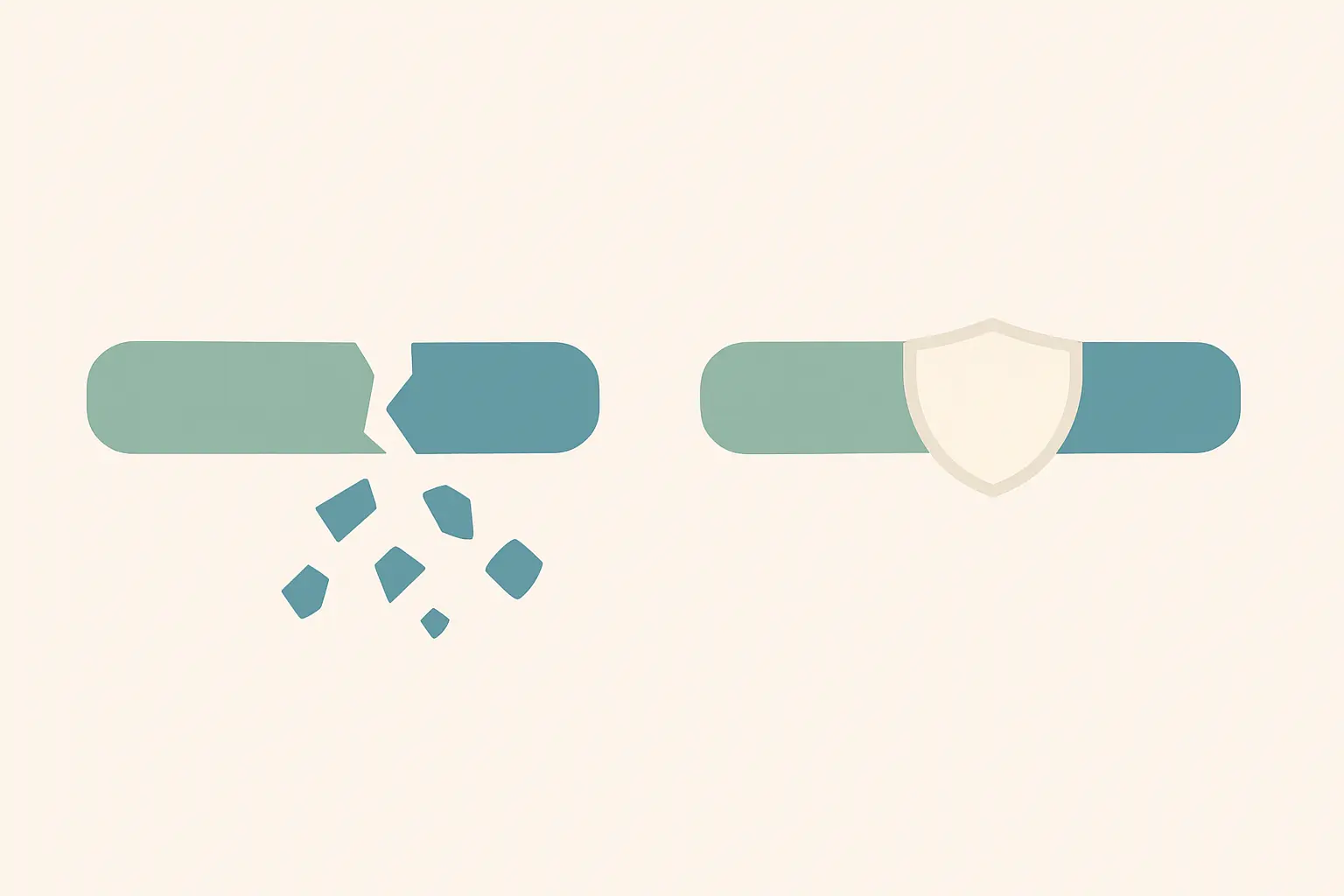
Streak counters are the most anxiety-generating feature in the category, and almost nobody says so. A long streak motivates right up to the moment it becomes something you are afraid of losing.
The failure mode is predictable. One cigarette resets the number to zero, the zero reads as a verdict, and the app is deleted that evening. The quit usually goes with it. A single cigarette does not undo weeks of physical recovery, but a counter saying it does is persuasive at eleven at night.
Two iQuit features exist for this. Streak shields let a lapse sit against your run without wiping it, and slip recovery treats a slip as information about a trigger rather than the end of the attempt. The NHS is blunt that even one cigarette can pull you back into the craving cycle, so this is not permission to smoke. It is a way of making the response to a slip logging it and carrying on, instead of deleting the evidence.
Tools You Can Use in Ninety Seconds
An urge rises, peaks and falls, and the falling part happens whether or not you smoke. The practical problem is that during the rise you are in no condition to go looking for something to do.
That is the argument for keeping the tools in one place. iQuit groups its SOS craving support into breathing exercises, grounding, distraction tips and craving timers, alongside craving surfing and a virtual cigarette you press and hold while the urge passes. It is offline-first, so none of it depends on reception, explained in why offline-first matters.
Two of these are things the NHS itself suggests for cravings. Its withdrawal page recommends a slow breath in through your nose and a gentle breath out through your mouth, repeated whenever you feel stressed or want a cigarette, and a quick burst of activity as a distraction. Our walkthrough of grounding exercises covers the attention-shifting side.
None of this is anxiety treatment, and it is not offered as any. It is a way of having something to do with your hands and your attention for ninety seconds.
Want the tools on your phone before the next hard evening? iQuit is free on Google Play and the App Store. Set your quit date, turn the notifications down to what you can handle, and leave the SOS tools where you can reach them.
Notifications That Do Not Spike Your Heart Rate
Here is the design problem nobody warns anxious quitters about. A quit app has to remind you about smoking, and a surprise reminder about smoking is functionally a cue to smoke. Get the tone wrong and the app starts your cravings.
Treat notification settings as a primary feature. iQuit lets you configure notifications, and the sensible move on day one is to turn them down to the minimum you will still read.
Craving forecasts sit in a different category. Because they are built from your own logged cravings, they learn which hours are risky for you and nudge ahead of them rather than at random. A prompt at an hour you already know is difficult reads as preparation. One out of nowhere reads as an alarm.
- Start silent. Turn notifications off entirely for the first two days if that is what it takes to install the thing.
- Add one. A single daily check-in at a time you pick, not a time the app picks.
- Kill anything that startles you. If an alert tightens your chest it is a net negative, whatever it says. Review the lot at day seven.
Using an App Alongside Therapy or Medication
If you have a diagnosed anxiety disorder, this section matters most, and the advice is the least app-shaped here: talk to your clinician before you set a quit date.
Two points belong in it. The first is timing. The Mental Health Foundation notes on its smoking and mental health page that if you are feeling unstable, in a crisis, or going through significant life changes, you are less likely to succeed at quitting. Choosing a steadier week is a strategy, not an excuse.
The second is medication, and it needs stating precisely. NICE guideline NG209 recommends that prescribers monitor people’s use of prescribed medicines affected by smoking or stopping smoking for efficacy and adverse effects, and adjust the dosage as appropriate. The medicines NICE names are clozapine, olanzapine, theophylline and warfarin. A second recommendation says people using secondary care and their carers should be told it might be possible to reduce the dose of some prescribed medicines when they stop smoking, and advised to seek medical advice if they notice side effects after changing how much they smoke.
Read that as written. It is an instruction to prescribers to monitor and adjust, not an instruction to you to change anything. Never stop, reduce or alter a prescribed medicine yourself because you are quitting smoking. Tell your prescriber your quit date and let them decide what needs watching. The full guidance is published as NICE NG209.
Where an app fits is narrow and real. A craving and mood journal gives you something concrete to bring to an appointment: which hours were worst, what set them off, how bad they got. That beats remembering a fortnight in a ten-minute slot. The same logic applies to stop smoking services, covered in using a quit app with your stop smoking service.
Setting Up a Low-Panic First Week
Ten minutes of setup, done on a calm evening rather than the morning of your quit date, removes most of the decisions you would otherwise make while feeling awful.
- Pick the method you will actually follow. Stopping outright and reducing gradually are both supported. Pick the honest answer, not the brave one.
- Set a real quit date, on a steadier week. Avoid the week of a deadline, a move or a family event if you have any choice.
- Turn notifications down before day one. You can always add them back.
- Open the SOS tools once while calm. Enter your real numbers too: cigarettes a day, cigarettes per pack, what a pack costs you.
- Log every craving, including the ones you smoke through. Trigger and intensity. A fortnight of that is a map.
- Decide now what a slip means. Write it down: log it, keep the app, carry on. Decide it while calm, because you will not decide it well at midnight.
Do not decide about the paid tier in week one. Spend a fortnight on the free version, then read our take on free versus Premium. Nothing in the calm-down toolkit sits behind the paywall.
Frequently Asked Questions
Can a quit smoking app help with anxiety?
Not as a treatment. No app diagnoses, treats or manages anxiety, and iQuit makes no such claim. What it can do is remove the parts of quitting that generate avoidable anxiety: streak counters that punish a slip, notifications you cannot control, and having nothing to reach for when an urge arrives. Anxiety itself is clinical territory.
Will quitting smoking make my anxiety worse?
The Cochrane review of 102 studies and more than 169,500 participants concluded that mental health does not worsen as a result of quitting, and found low to moderate certainty evidence of small to moderate improvements, including in people diagnosed with mental health conditions. Early withdrawal is the exception: anxiety commonly rises for a few weeks first (Cochrane, 2021).
How long does anxiety last after you stop smoking?
The NHS states that nicotine withdrawal can start within a few hours of your last cigarette, is usually strongest during the first week and especially the first three days, and lasts three to four weeks on average, although some people feel it for longer, sometimes a few months. Feeling anxious or tense is on its list of common symptoms (NHS, Managing nicotine withdrawal symptoms).
Is iQuit free, and are the calming tools behind a paywall?
iQuit is free to download on Google Play and the App Store. The craving log, the dashboard and the SOS tools, which include breathing exercises, grounding, distraction tips and craving timers, are part of the free app. There is an optional Premium tier with a seven-day trial, but none of those tools sit behind it.
Should I tell my doctor before quitting if I take medication?
Yes. NICE guideline NG209 recommends that prescribers monitor medicines affected by smoking or stopping smoking for efficacy and adverse effects and adjust the dosage as appropriate, naming clozapine, olanzapine, theophylline and warfarin. That is a decision for your prescriber. Never change or stop a prescribed medicine yourself because you are quitting (NICE NG209, recommendations 1.14.23 and 1.14.24).
Is an app enough if I have an anxiety disorder?
No, and it is not meant to be. Speak to your doctor, psychiatrist or therapist before setting a quit date, and use a stop smoking service if one is available to you. An app covers the hours between appointments and gives you a record to bring to the next one. It does not replace treatment, a prescriber or a helpline.
Start Your Quit Week Calmly
Set your quit date, turn the notifications down to what you can handle, and keep breathing, grounding and craving timers one tap away. Let a slip be a note in the journal rather than a reset to zero. Free on Google Play and the App Store.
Download iQuit Free on Google Play
Download on the App Store