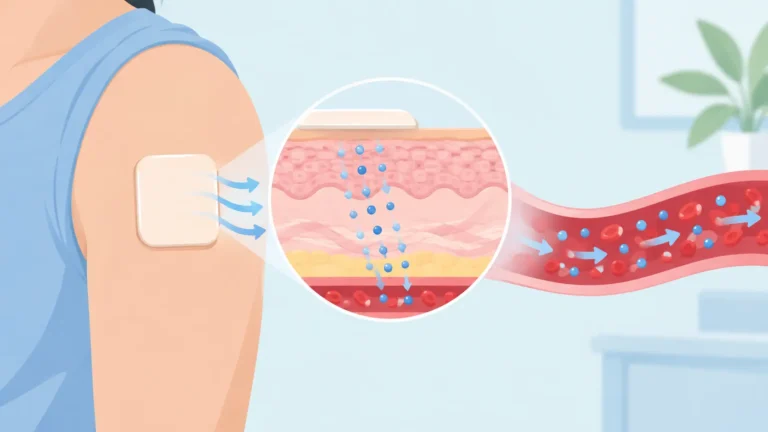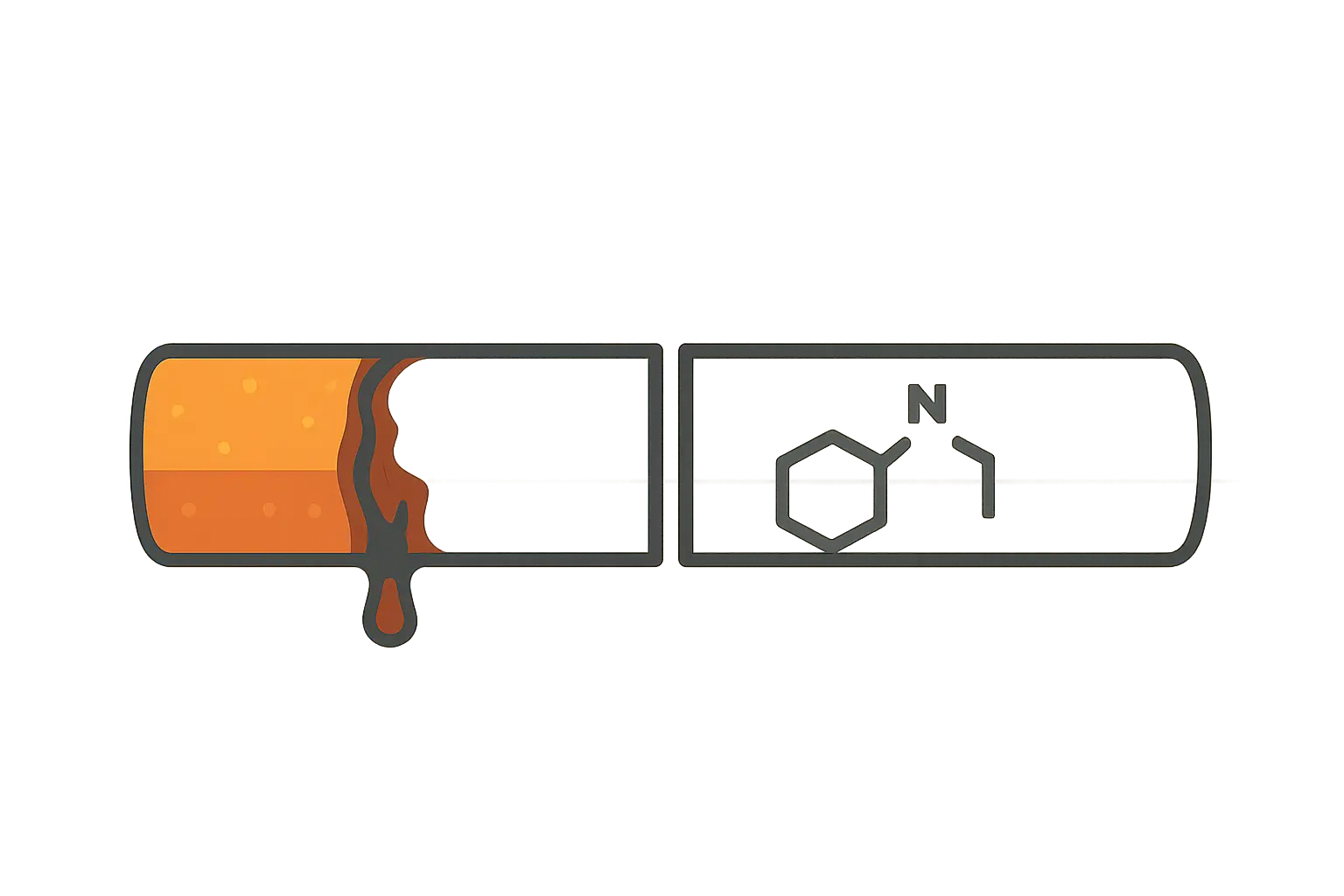
People often refuse nicotine patches or gum because they believe “nicotine causes cancer” — so why use more of it? Tar vs nicotine is the distinction that untangles this: tar is the sticky residue from burning tobacco that damages your lungs and drives cancer risk, while nicotine is the addictive chemical that keeps you smoking but is not, on its own, the thing causing most of that damage. Knowing which is which changes how you think about quitting aids.
Tar vs nicotine: what each one is
A burning cigarette produces thousands of chemicals, but two get most of the attention. Tar is the general name for the sticky, brownish residue left behind when tobacco burns — it is not one chemical but a mixture that includes many of the substances linked to cancer. Nicotine is a single chemical, the one responsible for the “hit” and for addiction, and it exists in tobacco whether or not it is burned.
That last point matters: nicotine can be delivered without burning anything — through gum, patches, lozenges, or sprays — while tar, by definition, only exists as a byproduct of combustion. See our full breakdown of what’s actually in cigarette smoke for the wider list beyond these two.
| Property | Tar | Nicotine |
|---|---|---|
| What it is | A mixture of residues left by burning tobacco | A single chemical compound found in tobacco |
| Exists without burning? | No — only produced by combustion | Yes — deliverable via gum, patch, lozenge, spray |
| Main harm | Airway damage, strongly linked to cancer risk (NCI) | Addiction; dose-related increases in heart rate and blood pressure (FDA labeling) |
| Cause of smoking-related cancer, per the NHS? | Yes, among the combustion byproducts | No, “on its own” |
| Used in approved stop-smoking medicines? | Never | Yes — NRT patches, gum, lozenges, sprays |
What tar does to the airways
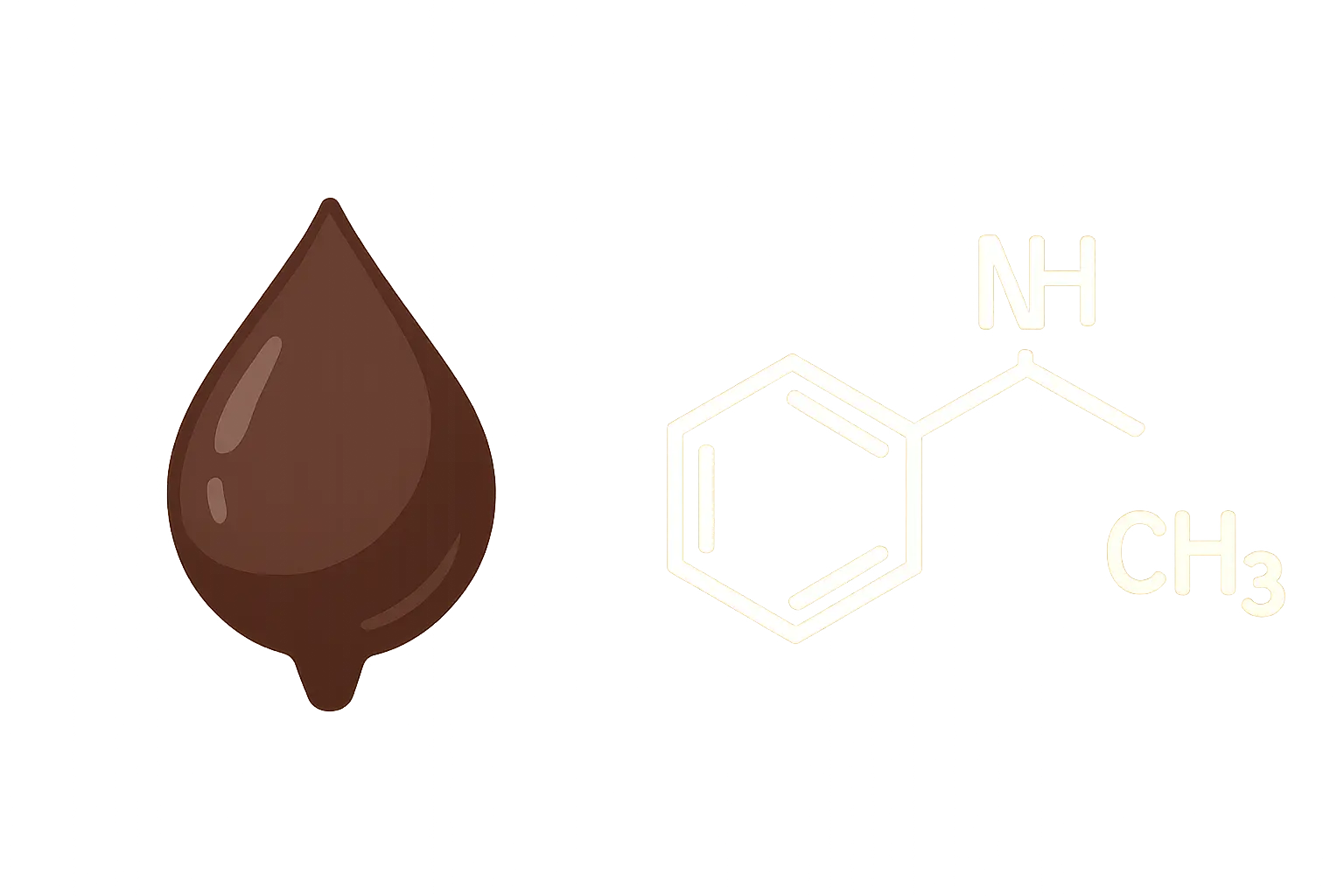
Tar coats the lining of the airways and lungs with the same brownish, sticky residue you would see staining a cigarette filter. It is not a single chemical but a catch-all name for the mixture of compounds condensed from tobacco smoke once it cools, and that mixture includes a large share of the substances public health bodies consider carcinogenic. Repeated exposure to that residue over years is what drives most of the airway damage and disease risk tied to long-term smoking.
For decades, the tobacco industry marketed “light” and “low-tar” cigarettes on the idea that less machine-measured tar meant less harm. The U.S. National Cancer Institute is direct about why that failed: cigarettes designed to score lower on a smoking machine used cellulose acetate filters, highly porous paper, and ventilation holes to dilute the smoke — but a machine cannot predict how much tar a real smoker actually inhales, and people compensate by taking longer, deeper, or more frequent puffs to get the dose of nicotine they are used to (National Cancer Institute).
The result: “tar exposure from a light cigarette can be just as high as that from a regular cigarette,” and switching to a lower-tar-rated brand does not meaningfully cut cancer risk. Every kind of cigarette, light or not, is linked to cancers of the lung, esophagus, larynx, mouth, throat, kidney, bladder, pancreas, stomach, and cervix, along with acute myeloid leukemia (NCI). The NCI’s own bottom line is blunt: there is no such thing as a safe cigarette, and the only way to reliably cut this risk is to stop smoking completely rather than switch brands. If you have been counting on a lower-tar brand to reduce your risk, our guide on what cancers smoking causes lays out why that strategy does not hold up.
This short explainer from a leading US cancer center shows how tar physically deposits in the lungs with every cigarette:
What nicotine does (and does not) do
Nicotine’s job in your body is almost entirely about the brain and the nervous system: it reaches the brain quickly, triggers a dopamine release, and creates the loop of craving and reward that makes smoking so hard to quit — a mechanism we cover in full in our piece on how much nicotine is in one cigarette and how that dose drives dependence. That speed is part of the problem: a cigarette delivers nicotine to the brain faster than most other routes, which is one reason cigarettes are harder to quit than, say, chewing tobacco or a patch delivering the same drug more slowly.
What nicotine does not do, according to the NHS, is cause the cancers, lung disease, heart disease, or strokes that are usually blamed on “smoking” as a whole. That distinction is exactly why nicotine replacement therapy exists as a treatment rather than a contradiction: “nicotine on its own doesn’t cause cancer, lung disease, heart disease or stroke. It’s the other chemicals in cigarettes that cause most of the damage” (NHS). That single sentence is doing a lot of work: it is the reason a doctor can recommend a nicotine patch to a person recovering from a heart attack’s underlying smoking-caused damage, while still being careful about the dose.
Why “it’s the smoke, not the nicotine” is the standard line
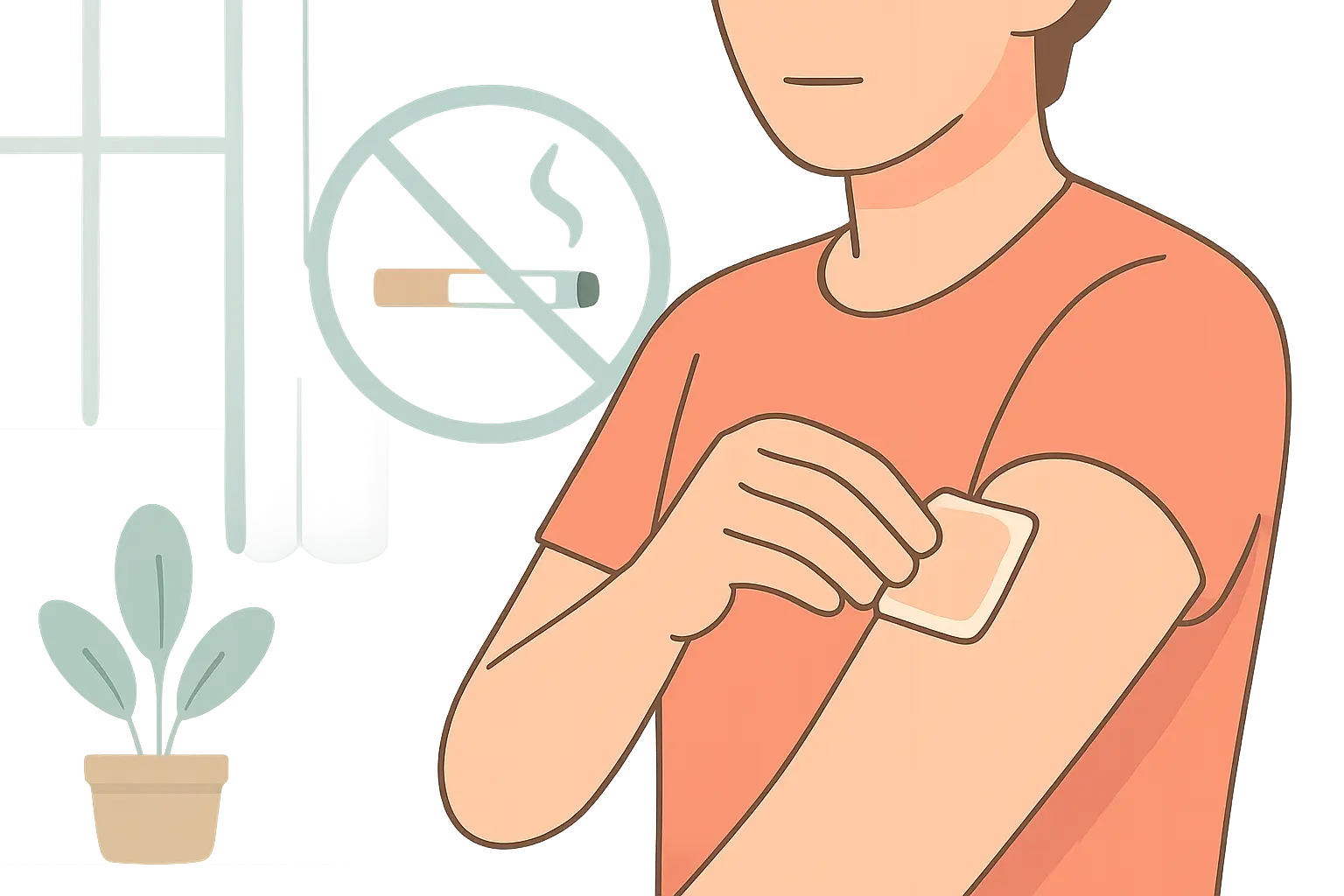
Public health bodies did not arrive at this framing to make nicotine sound harmless — they arrived at it because it is the most useful, accurate way to explain why quitting smoking while still using nicotine (through NRT) is a genuine improvement, not a swap of one danger for another. The tobacco and vaping harm-reduction field is built on exactly this separation: combustion is what turns tobacco leaf into thousands of new toxic and carcinogenic compounds, tar among them, while nicotine itself is a comparatively narrow, well-characterized drug that can be studied, dosed, and delivered on its own.
This is also why the same reasoning gets applied, cautiously, to nicotine vapes: removing combustion removes tar, even though the nicotine (and the vaping-specific unknowns) remain. It is a spectrum of risk, not a binary of “safe” and “dangerous” — tobacco harm reduction as a field exists specifically to rank these options by how much combustion, and therefore how much tar, they involve. If you want the fuller framework behind that idea, our explainer on what tobacco harm reduction actually means covers where this reasoning does and does not apply, and where it gets misused to sell products that are not actually lower-risk.
Where nicotine still carries risk
None of this makes nicotine risk-free, and no health body claims it does. The FDA-approved labeling for nicotine gum spells out real, dose-related cautions: nicotine can increase your heart rate and can increase your blood pressure, so anyone with heart disease, a recent heart attack, an irregular heartbeat, or high blood pressure that is not controlled with medication is told to check with a doctor before use. The same label advises using it only on a doctor’s advice during pregnancy or breastfeeding (DailyMed / FDA drug labeling, Nicotine Polacrilex).
Nicotine is also, straightforwardly, the reason cigarettes are so hard to give up — it is a genuinely addictive drug, and that addiction is a real cost independent of tar. “Nicotine is not the carcinogen” is not the same claim as “nicotine is safe for everyone at any dose,” and no legitimate source treats it that way. That is why NRT products come with dosing instructions and a tapering schedule rather than being sold as harmless — the goal is to eventually stop using nicotine altogether, not to replace one long-term nicotine habit with another.
What this means for choosing NRT
Once tar and nicotine are separated, the case for NRT stops looking contradictory: you are removing the combustion — and with it, the tar and the other toxic byproducts driving most of smoking’s disease risk — while managing withdrawal with a measured, medically studied dose of the one component, nicotine, that is not the primary cause of that damage. Used alongside a nicotine-free medicine, the NHS notes this combination approach makes people over five times more likely to quit for good, and recommends using stop-smoking products for at least 12 weeks rather than stopping early (NHS). Our comparison of the best NRT options walks through patches, gum, lozenges, and sprays side by side if you are deciding where to start, and if you have also wondered whether “light” cigarettes were a safer middle ground, our look at light cigarettes covers that dead end directly.
Logging cravings against what actually triggers them — rather than just white-knuckling through withdrawal — is one of the simplest ways to see whether NRT is doing its job. iQuit’s craving log and NRT-friendly tracking are built around exactly that kind of week-by-week comparison.
Frequently Asked Questions
Is tar or nicotine worse for you?
Tar carries most of the cancer and lung-disease risk from smoking. The NHS states nicotine on its own does not cause cancer, lung disease, heart disease, or stroke — it is the combustion byproducts, tar included, that cause most of the damage. Nicotine is still addictive and has its own dose-related cardiovascular cautions.
Does nicotine cause cancer?
According to the NHS, nicotine on its own does not cause cancer, lung disease, heart disease, or stroke. Cancer risk from smoking is driven primarily by tar and the other chemicals produced when tobacco burns, which is why nicotine replacement therapy is considered a safer way to manage cravings than continuing to smoke.
Why do “light” or low-tar cigarettes not reduce risk?
The National Cancer Institute explains that machine-measured tar ratings do not predict real-world exposure, because smokers compensate with longer, deeper, or more frequent puffs on cigarettes designed to test lower. Tar exposure from a “light” cigarette can end up just as high as from a regular one.
Is nicotine addictive even without tar?
Yes. Nicotine’s addictive potential comes from its effect on brain reward pathways, which has nothing to do with tar or combustion. That is why nicotine replacement products, though they remove tar entirely, still require a structured tapering plan to stop using safely.
Can nicotine alone raise your heart rate or blood pressure?
Yes. FDA-approved labeling for nicotine gum states that nicotine can increase heart rate and blood pressure, and advises anyone with heart disease, a recent heart attack, an irregular heartbeat, or uncontrolled high blood pressure to check with a doctor before use.
Does using NRT mean I am just “still smoking”?
No. NRT delivers nicotine without burning tobacco, so it removes tar and the thousands of combustion byproducts entirely. The NHS recommends using NRT, ideally alongside a nicotine-free medicine, for at least 12 weeks as part of a quit attempt.
Choose your quit method with a clear head
iQuit supports cold turkey, gradual reduction, and NRT-friendly quit plans, with craving logs that show what’s actually driving your urges.
Download iQuit Free on Google Play
Download on the App Store