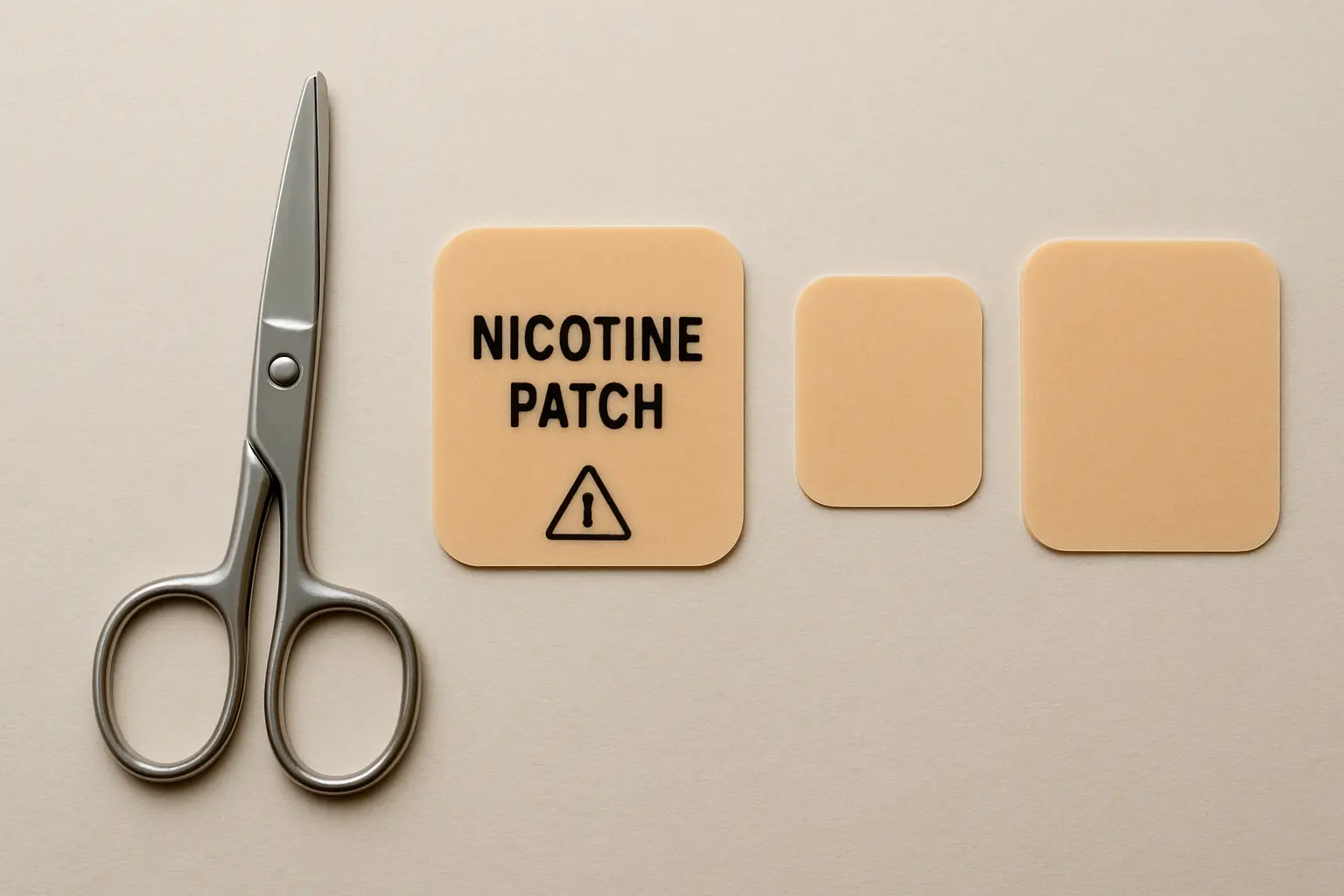
Cutting a nicotine patch in half seems like an obvious way to save money or step down your dose faster — half a patch, half the cost, half the nicotine, right? Every currently marketed nicotine patch label we checked says no, and the reason isn’t about money at all.
Can you cut a nicotine patch? The short answer
No. This isn’t a case where the answer depends on the brand — three separately manufactured, currently sold OTC nicotine patches (a generic from Rugby Laboratories, a store-brand version, and Habitrol) all carry the identical instruction on their Drug Facts label: “do not cut patch in half or into smaller pieces.” When products from different manufacturers all state the same restriction word-for-word, that’s a strong signal it reflects an FDA labeling requirement for the product category, not one company’s cautious extra.
That said, always check your own box’s leaflet rather than assuming — labeling can vary by product, and the honest answer for any specific patch you’re holding is whatever its own leaflet says, not a general rule from the internet.
What the label says
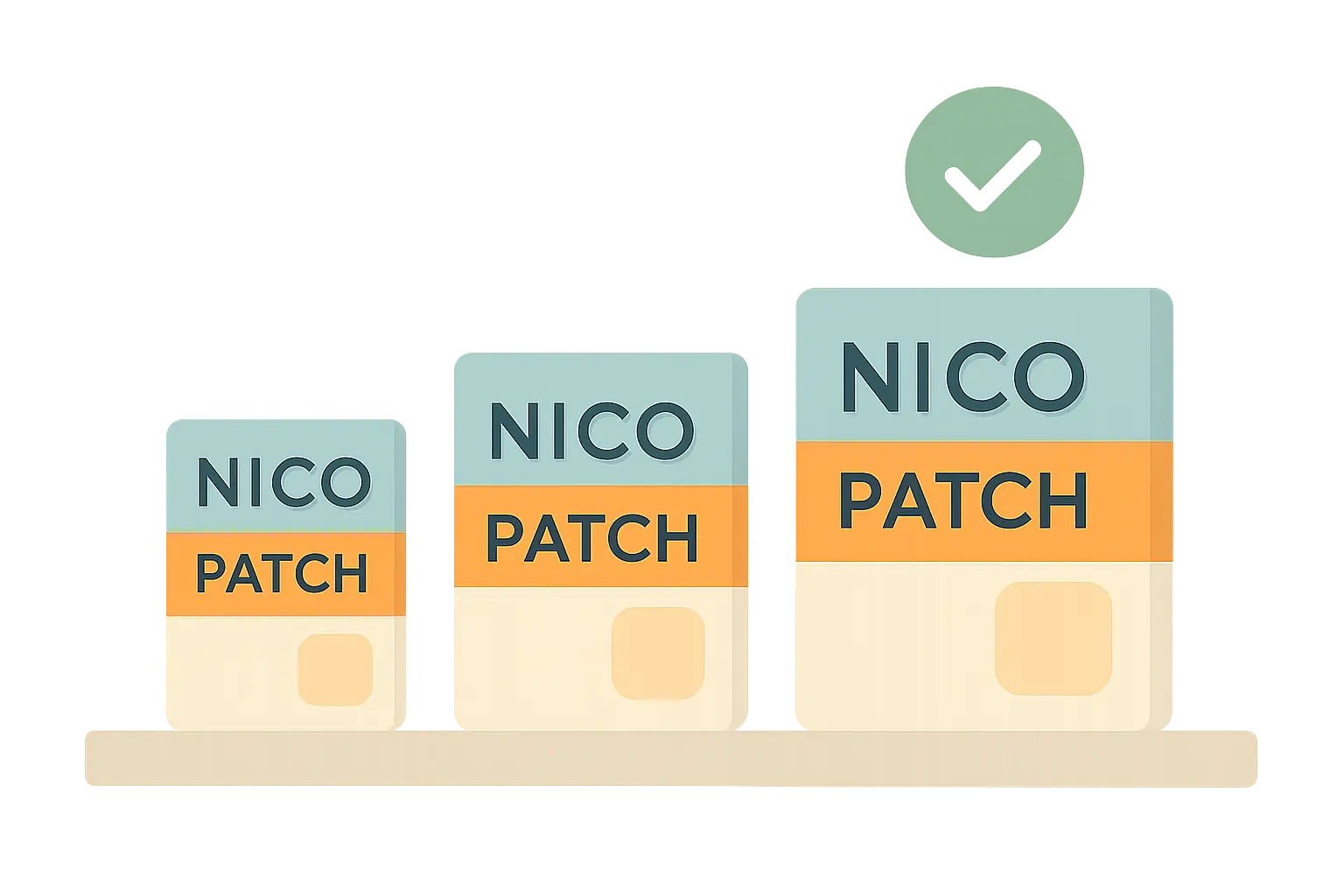
Beyond the cutting instruction itself, the same labels give useful context for why patches are engineered as complete, uncut units. They’re built as a 24-hour delivery system — the label states you should “apply one new patch every 24 hours” and warns “do not leave patch on for more than 24 hours because it may irritate your skin and loses strength after 24 hours.” The dosing schedule itself is designed around whole patches at fixed strengths: 21 mg, 14 mg, and 7 mg, used in a step-down sequence over roughly 8 to 10 weeks depending on how much you smoked before quitting.
Notice what that step design already does: the manufacturers built the exact “half strength” option you might be trying to create with scissors, and sold it as a separate, correctly formulated product (the next step down) rather than leaving it to you to divide a patch yourself. The gap between 21mg and 14mg, or between 14mg and 7mg, isn’t arbitrary either — those specific numbers reflect what’s been formulated and tested, not a rough midpoint that a cut patch would automatically land on even if cutting worked the way people hope.
It’s also worth noticing that none of the three labels checked describe an “if you must cut it, here’s how” fallback, the way some medications include specific guidance for splitting a pill along a scored line. There is no scored line on a nicotine patch, and no manufacturer instructions for how to do it “correctly.” That absence, on its own, is a reasonable signal that this isn’t a modification the product was ever designed to tolerate.
This short guide from Quit covers correct nicotine patch application and use.
What happens to the dose when you cut one
No fetched label or study for this article gives a specific number for how much nicotine you’d actually receive from half a cut patch — and that absence is itself the point. The label doesn’t say “cutting halves your dose” or give any adjusted-dose guidance for a cut patch, because cutting isn’t a tested or approved use of the product at all. A patch not cut and used exactly as labeled has a known, tested release rate; a patch cut in half is an unstudied modification, and nobody — not the manufacturer, not your pharmacist, not this article — can tell you with confidence what dose you’d actually be getting, whether it’s roughly half, unpredictably more, or unpredictably less depending on where the cut falls and how the adhesive and drug layer are affected at the exposed edge.
That uncertainty is the real reason to avoid it, more than any specific danger claim. You’d be trading a known, FDA-reviewed dose for an unknown one, for the sake of a shortcut the product wasn’t designed to support. It’s worth thinking about it this way: the FDA approval process for a nicotine patch isn’t just about the drug itself, it’s about the specific delivery system — that exact patch, at that exact size, releasing nicotine at a rate that’s been measured and reviewed. Cut it, and you’ve created a product nobody has measured or reviewed, even if the underlying drug is identical.
There’s also a practical problem beyond dosing: a cut patch has a newly exposed edge that wasn’t designed to be exposed. Whether that changes how quickly the adhesive dries out, how well it stays stuck to skin for a full 24 hours, or how evenly it releases nicotine over that period isn’t something any fetched source addresses, which is exactly why this article doesn’t speculate on a specific mechanism. The honest position is simpler: the product was tested as a whole unit, and a cut unit is something else.

Cheaper ways to step down properly
- Follow the labeled step schedule. If you smoke more than 10 cigarettes a day, the standard schedule is Step 1 (21 mg) for the first weeks, then Step 2 (14 mg), then Step 3 (7 mg). If you smoke 10 or fewer, labels typically start at Step 2. Comparing the 21mg, 14mg, and 7mg strengths in more detail can help you confirm which step you should actually be on.
- Buy the multi-week kits when available. Larger boxes generally cost less per patch than buying single weeks repeatedly.
- Check if your program or insurer covers NRT. Many stop-smoking services and some insurance plans provide patches at reduced cost or free, which is a bigger saving than cutting a patch could ever offer, without the dosing uncertainty.
- Consider a different NRT format if cost is the real driver. Comparing all NRT options — gum, lozenges, patches, and combinations — sometimes surfaces a genuinely cheaper option that doesn’t involve modifying anything.
- Ask about generic versus brand-name pricing. The generic and store-brand labels checked for this article carry identical instructions and active ingredients to the brand-name version, at typically lower shelf prices — a straightforward saving that doesn’t touch dosing at all.
- Don’t skip days to stretch a box either. Skipping a day for the same money-saving reason someone might cut a patch creates the same core problem: an unplanned, unstudied gap in nicotine delivery that can undermine the whole quit attempt rather than just save a few dollars.
Stacked together, these options can meaningfully reduce what a quit attempt costs without introducing a single unknown variable into your dosing. That’s a better trade than a lower, uncertain cost per patch in exchange for not knowing what you’re actually receiving.
If you’re cutting patches to save money
It’s worth naming the real motivation directly, because it usually isn’t idle curiosity — people cut patches to stretch a box further or to create a “custom” dose between two official strengths. Both are understandable instincts, especially mid-quit when every cost adds up. But the actual fix for “I want a lower dose than my current strength but the next step down feels too big a jump” is a conversation with a pharmacist about your options, not a pair of scissors. Pharmacists can advise on combining a patch with a faster-acting NRT like gum for breakthrough cravings, which is a labeled, studied approach, unlike cutting.
If nicotine patch side effects generally — not just cost — are part of why you’re considering a change, the fuller guide to normal versus concerning patch side effects is worth reading before you decide anything, and if sleep disruption specifically is the issue, the label’s own fix for vivid dreams (removing the patch at bedtime) solves a different, more common problem without touching the patch itself.
And if patches in general — cut or not — aren’t working for you, understanding what actually happens if you smoke while wearing one and whether combining two NRT types suits you better are both more productive next questions than how to divide the one you have.
Frequently Asked Questions
Can you cut a nicotine patch in half?
No. Every OTC nicotine patch label checked for this article — from different manufacturers — states “do not cut patch in half or into smaller pieces.” Always check your specific product’s own leaflet to confirm, since this article checked three products, not every product on the market.
Why can’t you cut a nicotine patch?
The label doesn’t explain the mechanism, but cutting is not a tested or approved use of the product. No source gives a reliable figure for what dose a cut patch actually delivers, which is itself the core reason to avoid it — you’d be using an unstudied, unpredictable modification instead of a dose the FDA has reviewed.
Does cutting a patch in half give you half the nicotine dose?
No fetched source confirms this. Labels do not provide adjusted dosing information for a cut patch, so the actual amount of nicotine delivered from a cut piece is not reliably known or guaranteed to be proportional to its size.
What should I do instead of cutting a patch to save money?
Use the correct lower-strength patch (21mg, 14mg, or 7mg) as designed, look into multi-week kits or covered NRT programs, or talk to a pharmacist about combining a patch with a faster-acting NRT format for breakthrough cravings, which is a studied and labeled approach.
Is cutting a nicotine patch the same across all brands?
The three brands checked for this article (a generic, a store brand, and Habitrol) all carry an identical “do not cut” instruction, which suggests a category-wide labeling requirement. Still, always confirm with your specific product’s leaflet rather than assuming every patch on the market is identical.
How do I choose between patch strengths without cutting?
Nicotine patches are labeled with a step schedule based on how much you smoked: typically Step 1 (21mg) if you smoke more than 10 cigarettes a day, moving to Step 2 (14mg) and then Step 3 (7mg), or starting at Step 2 if you smoke 10 or fewer cigarettes a day.
Track your real savings without the guesswork
iQuit’s money-saved tracker shows exactly what quitting is worth, without needing a shortcut that risks an unknown dose — free on Google Play and the App Store.
Download iQuit Free on Google Play
Download on the App Store