
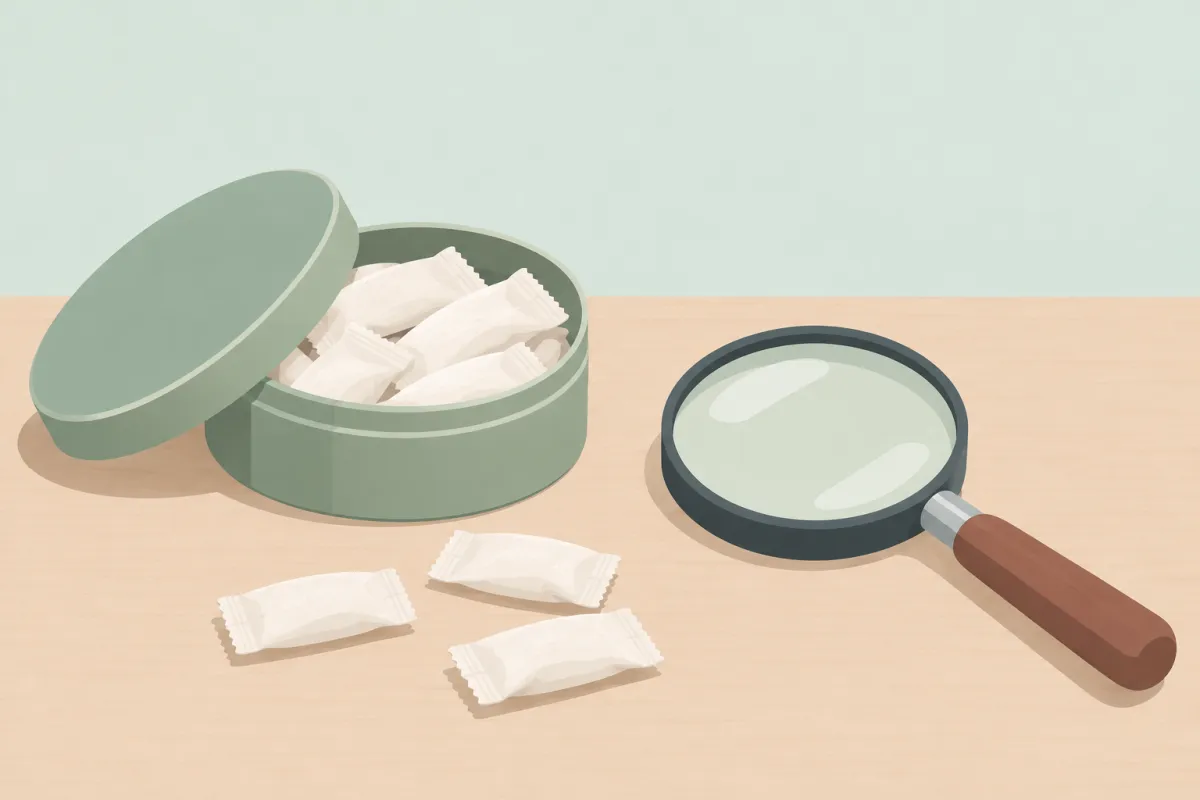
Does Zyn cause cancer? Nobody can answer that with a clean yes or no yet, and anyone who does is overstating the evidence. What can be said is more useful: Zyn pouches are described as tobacco-free, they contain far less of the cancer-causing chemicals found in cigarettes and traditional smokeless tobacco, and the US Food and Drug Administration has authorized a claim that using Zyn instead of cigarettes puts you at a lower risk of mouth cancer, among other diseases. What no one has is long-term data on people who use pouches for decades.
That leaves a real question for the person holding a can: is the risk low enough to stop worrying, or is this one more nicotine habit to quit? This guide walks through what is in a pouch, what testing has and has not found, what the FDA decisions do and do not mean, how Zyn compares with dip and cigarettes, and the one risk that is not in doubt.
Does Zyn cause cancer? The short answer
Separate three questions that tend to get blurred together:
- Is Zyn safer than cigarettes? According to the FDA’s review, the evidence supports a lower risk, and the agency has authorized a specific claim to that effect.
- Is Zyn free of cancer risk? Not proven. The pouches are new, and the long-term studies that would settle it do not exist yet.
- Is nicotine addictive? Yes, and that part is not in dispute.
So the fair summary is “lower than tobacco, unknown rather than zero.” If you are an adult who smokes and is weighing Zyn against cigarettes, the comparison favors Zyn. If you do not use nicotine at all, the best choice for your health is not to start. If you already use Zyn and want out, that is covered at the end.
What is in a Zyn pouch, and what is not
The FDA describes nicotine pouches as “small fiber pouches containing nicotine designed to be placed between a person’s gum and lip.” Nicotine pouches such as Zyn are described as tobacco-free: they contain nicotine but no tobacco leaf, although the nicotine itself can be derived from tobacco or made synthetically. That distinction drives almost everything in the cancer discussion, because most of the cancer-causing chemicals in smokeless tobacco come from the tobacco itself, and the cancer-causing chemicals in cigarettes come from burning it.
The products the FDA has authorized come in ten flavors, each in 3 milligram and 6 milligram strengths: Chill, Cinnamon, Citrus, Coffee, Cool Mint, Menthol, Peppermint, Smooth, Spearmint and Wintergreen. Those orders refer to those specific products, not to every nicotine pouch on the market, and not necessarily to look-alikes or imports. If you use a different brand or a strength outside that list, the FDA decisions described below do not apply to it.
Nitrosamines in nicotine pouches: what the evidence says
Tobacco-specific nitrosamines, or TSNAs, are the best-known cancer-causing compounds in smokeless tobacco. The American Cancer Society calls them the most harmful cancer-causing chemicals in smokeless tobacco and says that “TSNA levels vary by product, but the higher the level the greater the cancer risk.” It lists cancers linked to smokeless tobacco as head and neck cancers, cancer of the esophagus and pancreatic cancer.
Because tobacco-free pouches do not contain tobacco leaf, they are expected to contain much less. The FDA’s evaluation found that Zyn products have “substantially lower amounts of harmful constituents than cigarettes and most smokeless tobacco products, such as moist snuff and snus.” Lower is not the same as none, though. A 2023 review of oral nicotine products noted that traces of TSNAs and toxic chromium were detected in the pouch products it examined. Findings vary by brand and by batch, so a number from one product tells you little about another.
For this reason, you should be skeptical of both of the extreme claims you will see online. “Pouches are full of carcinogens” is not supported for tobacco-free pouches. “Pouches contain nothing harmful” is not supported either. The accurate version is that the exposure appears far lower than tobacco, it has been measured in trace amounts in some products, and what that means over twenty or thirty years of use is not known.
Mouth, gum and throat cancer: what the data can and cannot say
This is the section many readers came for, and the honest answer is a limited one. A 2026 scoping review of oral nicotine pouch research by Travis, Warner, Hartmann-Boyce and colleagues, covering 73 new studies, 12 of them industry-funded, concluded that “ONPs are considerably less toxic than cigarettes, but their long-term health impacts remain understudied.” That industry funding is one more reason to read any single study with care.
Cancers of the mouth, gums and throat develop over decades. Nicotine pouches are new on the US market: sales have grown quickly only in the last few years, and the FDA authorized its first pouches in January 2025. Even in the best case, there has not been enough time for cancer to show up or fail to show up in a population of long-term pouch users. That is why you see researchers saying “no evidence of harm yet” and “not proven safe” in the same breath, and both are right.
If you notice a white or red patch in your mouth, a sore that does not heal after a couple of weeks, a lump, or pain when swallowing, get it checked by a dentist or doctor rather than waiting for research to catch up. Our article on white patches in the mouth explains what leukoplakia is and why it deserves attention. A related caution: a 2023 review of pouches and gum health raised concern about periodontal effects, so gum irritation, recession or bleeding is also worth mentioning to a dentist.
What the FDA’s Zyn decisions mean
There were two separate FDA decisions, and the wording of each matters.
January 16, 2025: marketing authorization
The FDA authorized 20 Zyn products after reviewing them under the premarket tobacco product pathway. In its announcement, the agency said the authorized products “pose lower risk of cancer and other serious health conditions” than cigarettes and most smokeless tobacco products such as moist snuff and snus. It also said plainly that the authorization “does not mean these tobacco products are safe, nor are they ‘FDA approved.’” The correct phrase is authorized for sale to adults 21 and older, and the agency added that there is no safe tobacco product.
June 30, 2026: modified risk orders
On June 30, 2026, the FDA issued modified risk granted orders for the same 20 products. On its Zyn page, the agency says the products may be marketed with this claim: “Using ZYN instead of cigarettes puts you at a lower risk of mouth cancer, heart disease, lung cancer, stroke, emphysema, and chronic bronchitis.”
Read the claim carefully. It compares Zyn with cigarettes. It does not say Zyn is safe, it does not compare Zyn with using nothing, and it does not say that a person who has never used nicotine is better off starting. The FDA’s own statement accompanying the orders says: “There is no safe tobacco product, and those who do not use tobacco products should not start.” It adds that for adults who smoke cigarettes, fully quitting all tobacco products would most benefit their health, while switching completely from cigarettes to authorized pouches may reduce exposure to many harmful chemicals. The orders also expire in five years, and the agency can withdraw them, for example if youth uptake rises significantly.
In this short video from Houston Methodist, primary care physician Dr. Gabriela Zambrano Hill explains what Zyn pouches do in the body, including their side effects.
Zyn vs dip vs cigarettes: relative risk
| Product | Contains tobacco leaf? | What is known about cancer risk |
|---|---|---|
| Cigarettes | Yes, burned | Highest harm; the benchmark the FDA claim is measured against |
| Dip, chew and moist snuff | Yes, unburned | Linked to head and neck, esophageal and pancreatic cancers (American Cancer Society) |
| Snus | Yes, heat-treated | Still tobacco, but it has decades of study behind it, unlike pouches |
| Zyn and other nicotine pouches | No | Substantially fewer harmful constituents (FDA); trace TSNAs reported in some products; long-term effects understudied |
| No nicotine product | No | No product-related cancer risk |
Two cautions on that table. First, Swedish snus has a long record of study, but it is not Zyn, and its data should not be pasted onto pouches. Our comparison of snus vs Zyn sets out the differences. Second, the ordering is about relative risk. It does not make dip safe to switch to, and our piece on chewing tobacco versus smoking shows why.
If you came from vaping, the same structure applies. Our evidence review on whether vaping causes cancer is worth reading alongside this one, and our guide to whether Zyn is bad for you covers the gum, heart and dependence side.

The risk that is certain: nicotine addiction
Whatever the final answer on cancer, the dependence risk is not uncertain. The American Cancer Society page notes that all smokeless tobacco “has nicotine, which can lead to addiction,” and nicotine is the active ingredient in pouches too. The 2026 scoping review cited above found that nicotine pouches generally contain a higher proportion of freebase nicotine than other oral nicotine products, and that nicotine uptake from higher-strength pouches typically exceeds that from cigarettes in adult smokers. Pouches are easy to use anywhere, which makes frequent dosing easy and the habit hard to see.
Nicotine itself is not classed as a cancer-causing agent. Our article on whether nicotine causes cancer goes through what agencies say and where the evidence has gaps. That should be reassuring about nicotine as a molecule, and it should not stop you from taking addiction seriously.
If you want to stop
A common trap is telling yourself you will stop when the can runs out, then buying another. If you already quit smoking with Zyn and now want to quit the pouches, the principle is the same as any nicotine quit: choose between stopping outright and stepping down gradually, expect a couple of rough weeks, and plan for the cues that go with the habit (the pocket, the break, the drive). Our step-by-step guide to how to quit nicotine pouches has a taper plan you can adapt.
iQuit, free on Google Play and the App Store, supports both ways of quitting: you can quit your way, cold turkey or gradual reduction. You can log each craving with its trigger and intensity, use SOS craving support when an urge hits, and keep going after a slip with streak shields and slip recovery.
Frequently Asked Questions
Does Zyn cause mouth cancer?
There is no direct evidence yet, but there is also no long-term data. The FDA has authorized the claim that using Zyn instead of cigarettes puts you at a lower risk of mouth cancer, which compares Zyn with cigarettes and is not a statement that Zyn is risk-free.
Is Zyn safer than dip?
The FDA found that authorized Zyn products have substantially lower amounts of harmful constituents than cigarettes and most smokeless tobacco such as moist snuff and snus, and pose lower cancer risk than those products. That is a relative finding. Zyn is not safe, and no tobacco product is.
Does nicotine cause cancer?
Major health agencies do not classify nicotine itself as a cause of cancer. The cancer risk in tobacco comes mainly from other chemicals, such as tobacco-specific nitrosamines. Nicotine is still highly addictive and has other health effects, so it is not harmless.
Do nicotine pouches cause gum disease?
Gum irritation is a plausible concern, and a 2023 review of oral nicotine products raised worries about periodontal effects, but long-term evidence is limited. If you notice bleeding, recession or sore patches where you place the pouch, mention it to a dentist.
Is Zyn FDA approved?
No. The FDA authorized 20 Zyn products for sale to adults 21 and older in January 2025 and granted modified risk orders on June 30, 2026, but it stated that authorization does not mean the products are safe or FDA approved.
Should I quit Zyn if I already quit smoking with it?
Switching completely from cigarettes was a large step, and the FDA says fully quitting all forms of tobacco products would most benefit the health of adults who smoke. Some people plan a second step off pouches once they feel stable. A taper or an outright stop both work, so choose the one you can keep.
Quit your way, with support
iQuit is free on Google Play and the App Store. Quit cold turkey or by gradual reduction, log each craving with its trigger and intensity, and use SOS craving support when an urge hits.
Download iQuit Free on Google Play
Download on the App Store