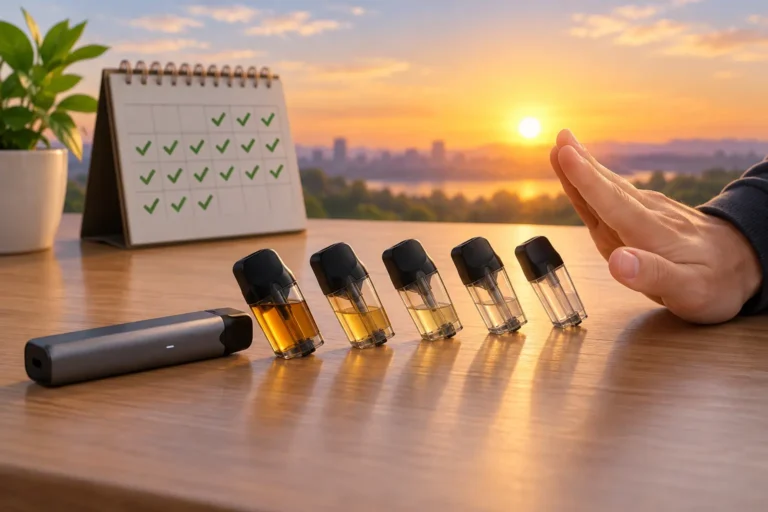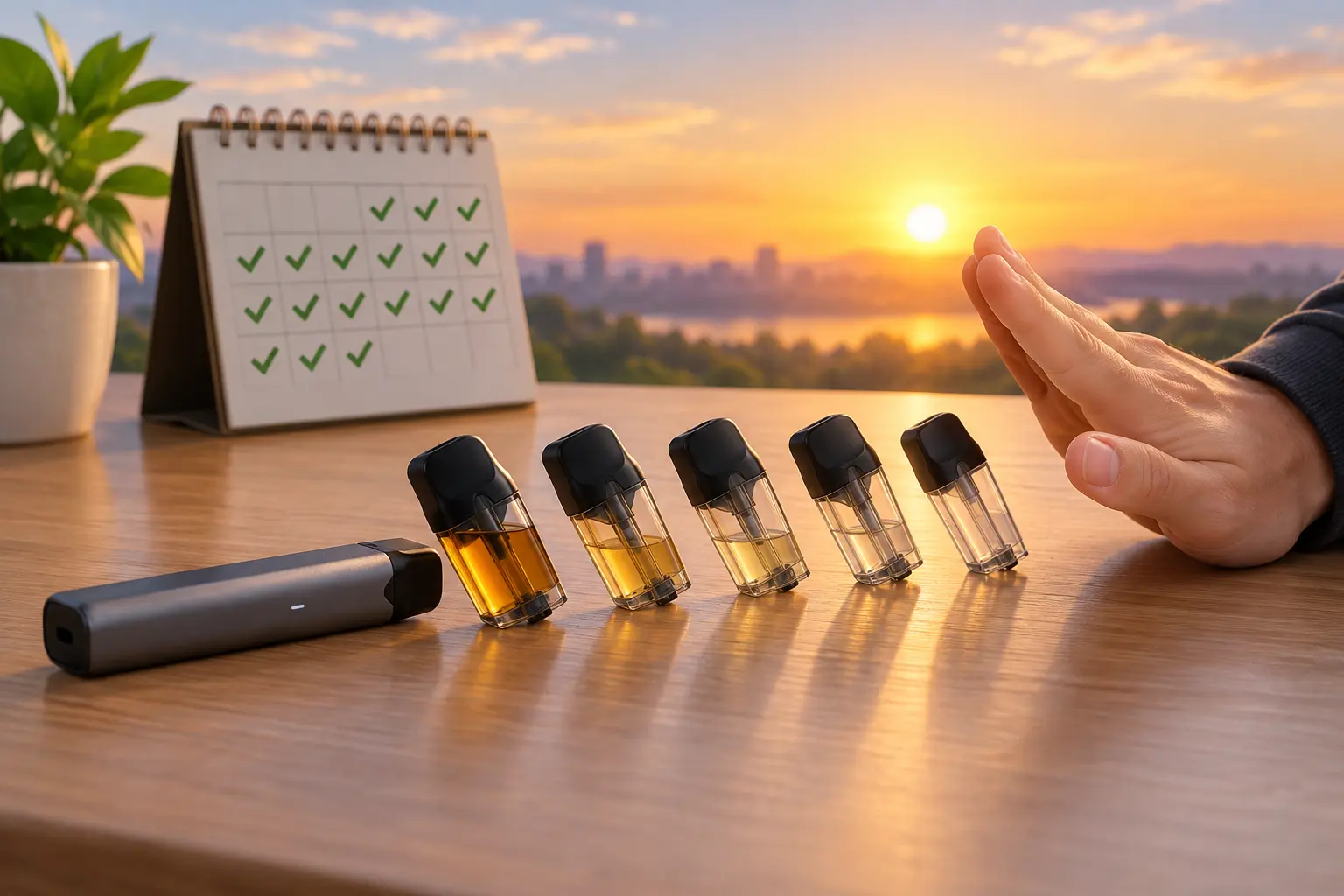
To learn how to quit JUUL, start by counting your pods for one week, then step down from 5% to 3% pods, cut your pods per day on a fixed weekly schedule, and set a quit date within four to six weeks. Heavy users can add nicotine replacement, and a free text program or quit app helps you get through withdrawal.
JUUL is different from disposables. You can measure exactly how much you use (pods) and choose your strength (5% or 3% in the US), which makes it well suited to a structured step-down. This guide turns that into a week-by-week plan. If you also use other products, our broader guide on how to quit nicotine covers cigarettes, pouches and more.
At a glance
- Total time: 4–6 weeks of tapering, then 2–4 weeks of withdrawal support
- Difficulty: Moderate to hard, depending on how many pods you use
- You need: A pod log, 3% pods (optional), a quit date, a support plan and, for heavy users, NRT
Why JUUL Is Hard to Quit
JUUL pods use nicotine salts, which let high nicotine concentrations feel smooth to inhale. The standard US pod is 5% nicotine, and a 3% option is also sold. That smoothness, combined with how easy it is to take a hit anywhere, means many users puff far more often than they realize.
The CDC notes that most e-cigarettes contain nicotine, which is highly addictive, and that nicotine can harm the developing adolescent brain, which keeps developing until about age 25. When you stop, your brain needs time to readjust, which is what causes cravings, irritability and trouble concentrating in the first weeks.
The good news: withdrawal is temporary, and a planned reduction can take the edge off it.
Before You Start: The Baseline Week
Step 1: Count your pods for 7 days (7 days, easy)
Do not change anything yet. Just record when you open each new pod. Most people are surprised by the number. Note the date and time each pod runs out, and divide by seven to get your average pods per day.
Step 2: Log your top triggers (2 minutes a day)
Each time you reach for your JUUL, note why: boredom, stress, after meals, driving, gaming, with friends, or first thing in the morning. A quit app like iQuit lets you log triggers and intensity in seconds and shows patterns after a few days.
Step 3: Pick your quit date (5 minutes)
Choose a date four to six weeks out if you are tapering. If you use more than one pod a day, give yourself the full six weeks. Write it down and tell one person you trust.
How to Quit JUUL: The Pod-by-Pod Step-Down Plan
This plan combines two levers: lowering strength and lowering volume. Adjust the numbers to your baseline. The example below starts at 1 pod per day of 5%.
| Week | Pod strength | Daily limit | Key action |
|---|---|---|---|
| Baseline | 5% | No limit (just track) | Count pods, log triggers |
| Week 1 | 3% | Same number of pods as baseline | Switch strength only; do not puff more |
| Week 2 | 3% | About 75% of baseline | Remove one trigger situation (e.g., no vaping in bed) |
| Week 3 | 3% | About 50% of baseline | Add vape-free zones: car, bedroom, work |
| Week 4 | 3% | About 25% of baseline | Delay every hit by 10 minutes |
| Week 5 | 3% | Quit date | No pods; NRT if needed |
Step 4: Switch from 5% to 3% pods (week 1, easy)
Swap strength but keep the same number of pods. The trap here is compensation: puffing harder or more often to get the same hit. Keep logging. If your pods per day rise, stick with 3% but set a hard daily limit.
Step 5: Cut pods by about a quarter (week 2, moderate)
Reduce your daily allowance to about 75% of your baseline. A simple method: if you used one pod a day, make each pod last a day and a third. Mark the date on the pod with a marker so you know when it has to last until.
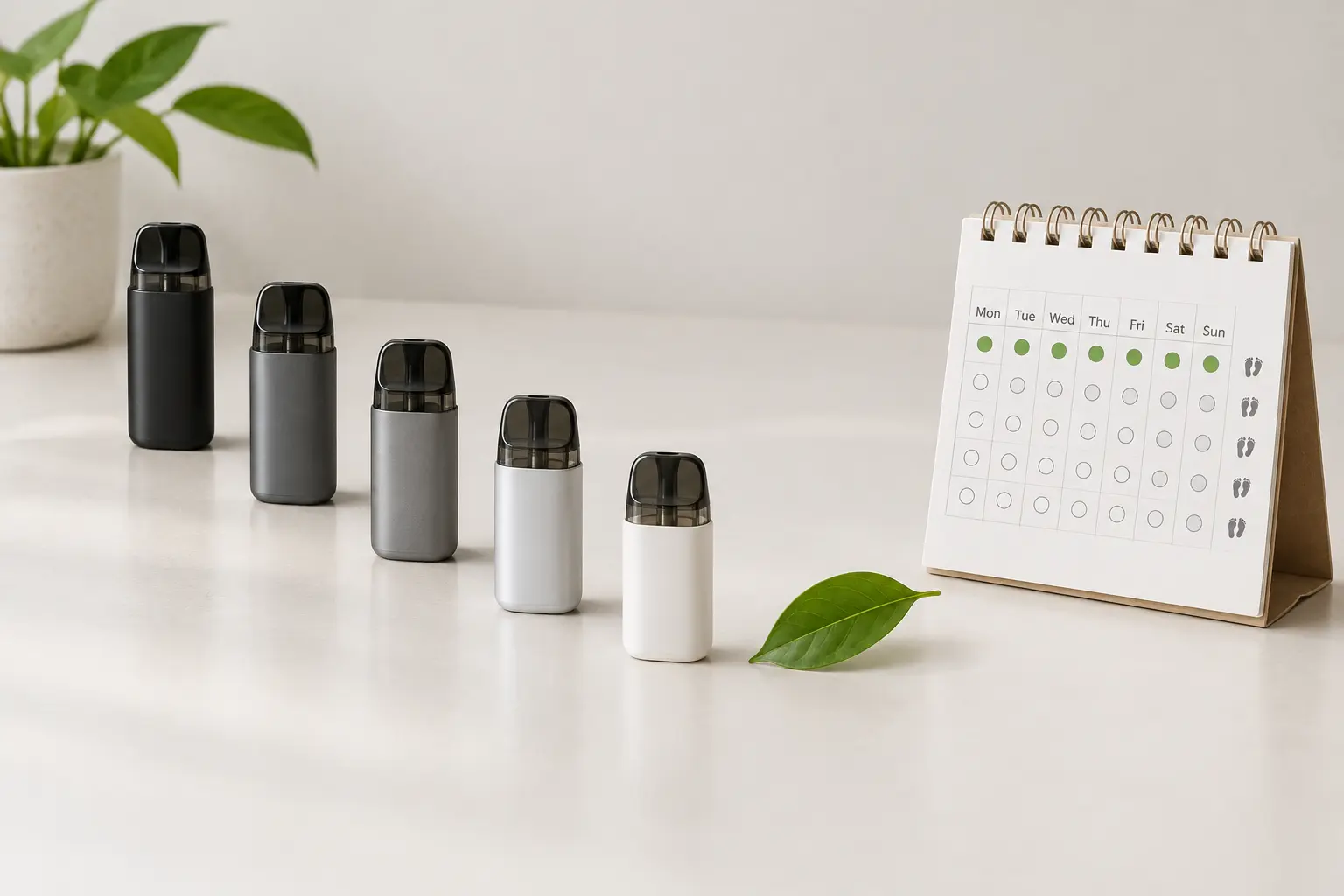
Step 6: Create vape-free zones (week 3, moderate)
Halve your baseline and add rules that break automatic use: no vaping in the car, in bed, or at your desk. Keep your JUUL in a bag or another room instead of your pocket. The extra friction gives you a moment to decide rather than react.
Step 7: Delay every hit (week 4, hard)
Drop to about a quarter of your baseline. When you want a hit, wait 10 minutes first. Cravings often fade during the wait. Use the time to drink water, walk, or do a quick breathing exercise.
Step 8: Prepare your quit day (end of week 4)
- Use up or set aside your last pods.
- Remove chargers from your car, desk and bag.
- Stock up on gum, mints, water and snacks.
- Tell friends who vape that you are quitting and ask them not to offer.
When to Add NRT While Quitting JUUL
Nicotine replacement therapy (NRT) delivers nicotine more slowly and without the hand-to-mouth habit, which can ease withdrawal while your brain adjusts. It is widely used for adults quitting vaping, although NRT products are formally approved for quitting smoking.
Step 9: Decide if NRT is right for you
Consider NRT if any of these apply:
- You use more than one 5% pod a day.
- You vape within 30 minutes of waking.
- You have tried quitting before and withdrawal made you go back.
Adults can buy patches, gum and lozenges over the counter. Ask a pharmacist or doctor to match the dose to your usage. Teens should talk to a doctor before using NRT.
Step 10: Combine a patch with a short-acting product
A common approach is a daily patch for steady nicotine plus gum or lozenges for sudden cravings. If you miss the hand-to-mouth feel of vaping, compare options in our guide to the nicotine inhalator vs vape.

Quit Day and the First Two Weeks
Step 11: Start quit day with a plan for your first craving
Your first morning is usually the hardest. Decide in advance what you will do in that moment: a shower, a glass of cold water, a walk, or your NRT.
Step 12: Expect withdrawal, and know it passes
Common symptoms include irritability, anxiety, restlessness, trouble concentrating, poor sleep and increased appetite. They are usually strongest in the first few days and ease over two to four weeks.
| Symptom | Quick fix |
|---|---|
| Craving | Delay 10 minutes, drink water, change location |
| Irritability | Short walk, slow breathing, tell people you are quitting |
| Trouble sleeping | Cut caffeine after noon, keep a screen-free wind-down |
| Brain fog | Break tasks into short chunks, get outside |
| Hunger | Keep crunchy, healthy snacks on hand |
Step 13: Sign up for free text support
Truth Initiative’s This is Quitting is a free text program for people who want to quit vaping; you can join by texting DITCHVAPE to 88709. Teens can also find tools at Smokefree Teen, and adults can call 1-800-QUIT-NOW for free coaching.
Step 14: Dispose of your device and pods safely
Do not throw pods or your JUUL device in the trash or recycling. They contain nicotine and a lithium battery. Our guide on how to dispose of vapes explains where to take them.
The Cold Turkey Option
Some people do better with a clean break than a taper. Quitting cold turkey means picking a date and stopping completely. It can work well if you use less than a pod a day, if tapering keeps stalling, or if you know you are an all-or-nothing person.
If you go cold turkey, still do the baseline week so you understand your triggers, line up your support in advance, and consider NRT if you are a heavy user. If you quit disposables as well, see our plan for how to quit disposable vapes.
Staying JUUL-Free
Step 15: Plan for social situations
Parties, nights out and friends who vape are the biggest relapse risks. Have a script ready (“I quit, I’m good”), keep a drink or gum in your hand, and step away if the urge spikes.
Step 16: Treat a slip as data, not failure
If you take a hit, do not buy a new pack of pods. Note what triggered it, adjust your plan and keep going. iQuit’s slip recovery is built on the same idea: a slip triggers a recovery plan rather than wiping out your progress. For more on how the app supports vapers, see how iQuit helps you quit vaping.
Step 17: Celebrate milestones
Mark one day, one week, one month. Spend part of the money you would have used on pods on something you enjoy.
How to Quit JUUL: FAQ
What is the best way to quit JUUL?
Pick a quit date, track how many pods you use, step down from 5% to 3% pods, cut pods per day each week, and use support such as a text program, a quit app or NRT. Some people prefer to quit cold turkey on a set date instead.
Is switching from 5% to 3% JUUL pods helpful?
It can be, as long as you do not compensate by puffing more. Track pods per day after switching; if usage rises, keep the 3% pods but set a daily pod limit.
How long does JUUL withdrawal last?
Nicotine withdrawal symptoms are usually strongest in the first few days and ease over two to four weeks. Cravings can pop up longer, but they get weaker and less frequent.
Can I use nicotine patches to quit JUUL?
Many clinicians recommend nicotine replacement for adults quitting vaping, especially heavy users. Ask a doctor or pharmacist for a dose that matches your usage. Teens should talk to a doctor first.
Should I quit JUUL cold turkey or taper?
Both can work. Cold turkey suits people who want a clean break; tapering suits heavy users who want to reduce withdrawal. The most important thing is setting a date and having support.
What do I do with my leftover JUUL pods?
Do not throw pods or the device in household trash. Take them to a hazardous waste or e-waste drop-off, or a take-back program, because they contain nicotine and a lithium battery.
Is there free help to quit vaping?
Yes. Truth Initiative’s This is Quitting text program, Smokefree.gov resources and state quitlines at 1-800-QUIT-NOW all offer free support for quitting vaping.
This guide is for general information and is not medical advice. If you are under 18, pregnant, or have a health condition, talk to a healthcare professional before using NRT.