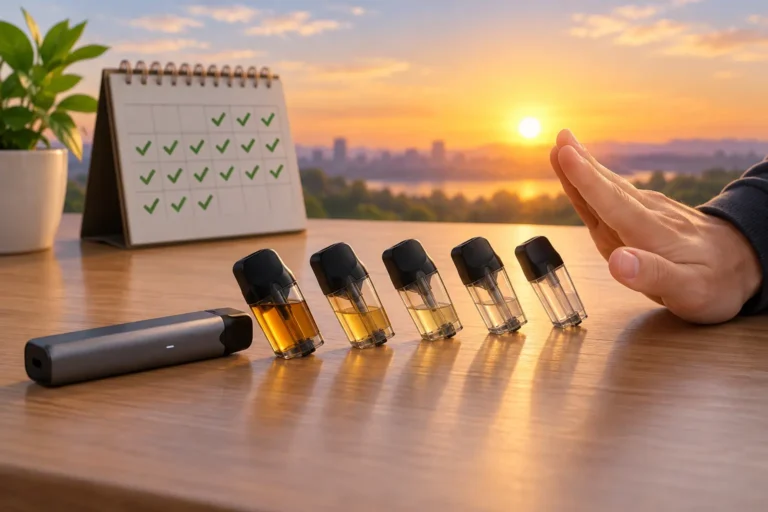
If you have tried to stop before and failed within days, learning how to quit vaping when addicted starts with accepting something: a heavy habit needs a heavier plan. Vaping all day, reaching for the device within minutes of waking, waking at night to take a few puffs: those are the signs of high dependence, and the advice written for casual vapers (“just cut back a little”) was never designed for you.
The good news is that the research on quitting vaping has moved quickly. Randomized trials have now tested a prescription quit-smoking medicine in people who vape, and the early results are encouraging. This guide walks through a short dependence check, a plan scaled to heavy use, the medical options to raise with your doctor, and what to do in the first two weeks and if you slip.
Signs you’re a heavy vaper: a 2-minute dependence check
You do not need to guess where you fall. The Penn State Center for Research on Tobacco and Health publishes the Penn State Electronic Cigarette Dependence Index, a 10-item questionnaire scored from 0 to 20. The bands it lists are 0 to 3 for not dependent, 4 to 8 for low dependence, 9 to 12 for medium dependence and 13 or more for high dependence.
The questions are worth reading even if you do not score yourself, because they describe heavy use well. They include:
- How many times per day do you usually use your e-cigarette? (The index counts one “time” as roughly 15 puffs or about 10 minutes of use.)
- How soon after you wake up do you first use it? Within 5 minutes scores highest.
- Do you sometimes wake at night to use it, and how many nights a week?
- Do you use it now because it is really hard to quit?
- Do you have strong cravings, and how strong have the urges been over the past week?
- Is it hard to keep from using it where you are not supposed to?
- Do you feel irritable, nervous, restless or anxious when you cannot use it?
If you answer “yes” to most of these, treat yourself as a heavy user. That is not a judgment, just the signal to build a stronger plan and bring a professional in early. If you want a wider look at how your device compares, see how much nicotine is in your vape.
Why high-strength vapes are so hard to quit
Three things stack up for heavy vapers. First, a device you can use anywhere, at any time, with no lighting-up ritual, means nicotine is never more than a few seconds away. Second, high-strength pods can deliver a lot of nicotine per session, so the body adapts to a high baseline, and the drop at quitting can feel steep. Third, because there is no pack to run out of, there is no natural stopping point: you do not notice how much you use until you try to stop.
That last point is why many people only discover how dependent they are when they try to quit. Our comparison, why vaping can be harder to quit than smoking, goes deeper on this. The takeaway for planning is simple: do not use a plan sized for light use. If you have gone cold turkey in the past and relapsed within days, that outcome is predictable for heavy dependence and says nothing about your character.
How to quit vaping when addicted: the heavy-user plan
- See a clinician before your quit date. A heavy habit is exactly the case where medical support makes a difference, and the CDC’s advice is to talk to your health care provider about tools and resources to help you quit.
- Measure your use for a week. Count pods or refills, note the first and last vape of each day and any night-time use. Real numbers drive the plan.
- Pick a quit date 1 to 3 weeks out. Far enough to line up medication and support, close enough to keep your motivation.
- Add counseling. The CDC says to consider using counseling and medication together, and both trials discussed below paired medication with counseling. A quitline coach, a clinic or an app-based program all count.
- Get rid of the hardware. A charged device within reach makes a slip far too easy. See quitting disposable vapes for tips on clearing out devices and refills.
- Plan your trigger hours. Morning, after meals, driving, drinking, stress. Decide what you will do instead in each one.
- Allow more time. Heavier use may mean a rougher adjustment. Give the quit weeks, not days, before judging it.
If a gradual route appeals to you, weaning off vaping gradually is an option, though for heavy use it works best with a firm end date and professional backup. For the general framework that this heavy-user plan builds on, read the full quit-vaping plan.
Replacement nicotine for a heavy habit
Nicotine patches, gum and lozenges are approved to help people quit smoking, not vaping, so using them to quit vaping is off-label. The CDC’s page on quitting e-cigarettes says the FDA has not approved any e-cigarette products to help people quit smoking and that scientists are still studying the best ways to help people quit vaping. Cochrane’s November 2025 living review of interventions for quitting vaping (15 studies, 5,800 people) describes the data on combination nicotine replacement as inconclusive because of risk of bias and imprecision.
So replacement nicotine is a reasonable thing to discuss, not a proven recipe. If your clinician suggests it, two points apply to a heavy habit in particular:
- Under-dosing is a real risk. A low starting dose for a high-nicotine habit can leave cravings uncontrolled, and people then conclude that replacement “did not work.” Ask the pharmacist how your starting dose was chosen and what to do if cravings stay strong.
- Do not invent a conversion. There is no official formula that turns pod strength into patch or gum milligrams. Bring your measured use to the pharmacist and let them make the call.
Our guide to using nicotine patches to quit vaping explains the patch side of that conversation.
Prescription options: what to ask your doctor
No medicine is FDA-approved specifically to quit vaping, but varenicline, a prescription quit-smoking medicine, has now been tested in randomized trials of people who vape, including the two below. Any use for vaping is off-label, so it is a conversation for a doctor who knows your health history.
| Trial | Who took part | Result (varenicline versus placebo, both with counseling) |
|---|---|---|
| Caponnetto and colleagues, BMC Medicine, 2023 | 140 people who vaped daily and did not smoke | Continuous abstinence, weeks 4 to 12: 40.0% versus 20.0% (odds ratio 2.67). Weeks 4 to 24: 34.3% versus 17.2%. Serious adverse events were infrequent and not treatment-related. |
| Evins and colleagues, JAMA, 2025 | 261 people aged 16 to 25 who vaped daily or near-daily and did not regularly smoke tobacco | Continuous abstinence, weeks 9 to 12: 51% versus 14% (adjusted odds ratio 6.5) |
Read those carefully. Both measured abstinence with biochemical verification, and both combined the medicine with counseling, so the results do not apply to medicine alone. The second trial enrolled youth and young adults only. Cochrane’s review reached the cautious conclusion that varenicline may help more people stop vaping than placebo, and that more information is still needed.
Questions to bring to the appointment:
- Is varenicline or another prescription option suitable for me, given my health and other medicines?
- What side effects should I watch for, and when should I call you?
- How long would treatment last, and how do we pair it with counseling?
- If I also use cigarettes or cannabis, does that change the plan?
The first two weeks: night cravings, mood, sleep
The Penn State dependence index asks about irritability, nervousness and waking at night because those are what heavy withdrawal feels like. Our vape withdrawal timeline covers the stages. For the practical side:
Night cravings
- Keep the device out of the bedroom, and ideally out of the house.
- Have a glass of water and a simple routine ready for a 3 a.m. wake-up: sit up, drink, breathe slowly, then go back to sleep.
- If you use a nicotine patch, the label says to remove it at bedtime if you get vivid dreams or other sleep disturbances. Ask your pharmacist before changing how you wear it.
Mood
- Expect irritability and restlessness in the first days and tell the people around you.
- Short walks and regular meals help. If low mood or anxiety feels heavy or lingers, speak to a clinician.
Craving spikes
Cravings rise and fall in minutes. Our techniques for vape cravings has a dozen ways to ride them out. A Mayo Clinic podcast conversation about kicking a nicotine dependency covers the same ground from a clinician’s perspective.
A tool that records the pattern can help you plan. iQuit is free on Google Play and the App Store; you can log each craving with its trigger and intensity, so you can spot whether your high-risk times are the morning, after meals or late at night, and use SOS craving support with breathing exercises and a craving timer when one hits.
If you slip: getting back on track the same day
For heavy vapers a slip is common, and the research above should reassure you: even in the trials where medicine worked, abstinence was far from universal, which means plenty of people with good support still struggled along the way. What matters is what happens next.
- Stop at the first slip. One puff is not a relapse unless you treat it as one.
- Write down what happened. Time, place, feeling, who was there. That is the trigger to prepare for.
- Tell your support person. Telling someone the same day blunts the shame that drives “might as well continue.”
- Remove the device again. If you bought more, discard it today.
- Call your clinician if the slips continue. It may mean a dose or approach needs adjusting, not that you lack willpower.
iQuit offers streak shields and slip recovery for exactly this moment.
Frequently asked questions
How do I quit vaping if I’m really addicted?
Plan it with a doctor or pharmacist: set a quit date, add counseling, discuss replacement nicotine or a prescription option, remove your devices and prepare for night cravings. The CDC advises talking to your provider and considering counseling and medication together.
What counts as a heavy vaper?
There is no single cutoff, but the Penn State e-cigarette dependence index treats a score of 13 or more out of 20 as high dependence. Vaping within minutes of waking, waking at night to vape and feeling it is really hard to quit all point that way.
Is it better to quit vaping cold turkey or slowly?
There is no vaping-specific trial that settles it. If you have relapsed after unsupported attempts before, a supported quit with a firm date, counseling and a medical plan gives you more to work with than willpower alone. A gradual taper can work if it has an end date.
Can a doctor prescribe something to quit vaping?
A doctor can discuss options, but no medicine is FDA-approved for quitting vaping. Varenicline has been tested in randomized trials of people who vape and, combined with counseling, improved abstinence compared with placebo; using it for vaping is off-label. Cochrane says more evidence is needed.
How long does vape withdrawal last for heavy users?
It varies, and heavier use may mean a rougher adjustment, so judge the quit over weeks, not days. Symptoms are generally strongest in the first days to weeks and ease with time. See the vape withdrawal timeline guide for the stages, and speak to a clinician if symptoms are severe or last.
Start your quit attempt today
Track the pattern, beat the cravings
iQuit is free on Google Play and the App Store. Log cravings with their triggers and intensity, use SOS craving support in the hard moments, and lean on streak shields and slip recovery to get back on track after a slip.