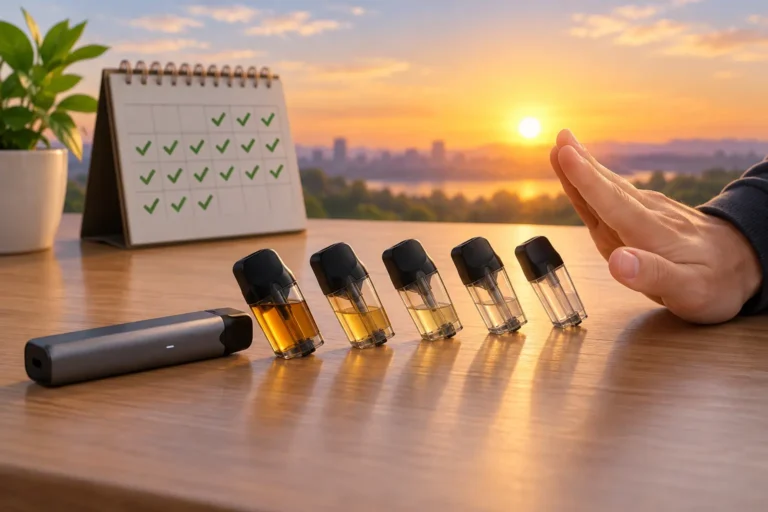
If you are looking up how to wean off vaping, you probably want to quit without the all-at-once shock of cold turkey. A step-down plan can work, as long as it has an end date, clear numbers, and a rule for what happens when a step feels too big. This guide gives you that structure: how to measure what you use now, how to lower nicotine strength, how to cut sessions, and how to keep cravings from pulling you back up the ladder.
One honest note before the plan. The best trial evidence on tapering comes from people who smoke cigarettes, not from vapers, and in that trial quitting abruptly did slightly better than cutting down first. That does not make weaning a bad idea. It means the plan below is built to be short and finite, so a taper does not turn into months of vaping at a slightly lower strength.
How to wean off vaping vs. quitting cold turkey
Both routes are legitimate, and the choice is partly about temperament. Some people do best with a hard stop on a chosen day. Others know that a sudden stop would send them straight back to the device by lunchtime, and a gradual route is the only one they will actually start.
The strongest evidence comes from a randomized trial of 697 adult smokers in England, published in Annals of Internal Medicine in 2016. Both groups received behavioral support from nurses and used nicotine replacement. One group quit abruptly; the other cut down by 75% in the two weeks before quitting. At six months, 22.0% of the abrupt group and 15.5% of the gradual group were abstinent. The authors concluded that quitting abruptly was more likely to lead to lasting abstinence than cutting down first (Lindson-Hawley et al., 2016).
Two caveats matter here. First, that trial studied cigarettes, and there is much less rigorous research on tapering vaping specifically. Second, participants who preferred a gradual approach did worse at four weeks than those who preferred abrupt quitting, which tells you that how you cut down matters as much as whether you do. A taper with no end point is the pattern to avoid.
If you have already tried a sudden stop and relapsed within days, a taper is a reasonable next experiment. If you want to compare, our guide to quitting vaping cold turkey instead walks through the first week of an abrupt quit, and the complete plan to quit vaping covers both approaches in one place.
Who a taper suits best
- People who vape throughout the day and would face many withdrawal hours at once if they stopped suddenly.
- People who have relapsed after an abrupt quit and want a different structure.
- People who use a high-strength liquid or pod and want to step down to a lower strength before stopping.
Who should be cautious about a long taper
- People who tell themselves they will cut back later but never choose a finish date.
- People who drop strength but vape far more often to compensate, so total nicotine intake barely changes.
Step 1: Measure your current use for three days
You cannot cut what you have not counted. Before you change anything, spend three ordinary days recording how you vape. Do not try to vape less during this window; the goal is an honest baseline.
For each day, note these four things:
- Sessions. How many separate times you picked the device up, regardless of how many puffs.
- Triggers. What was happening right before each session: coffee, a work break, scrolling, driving, stress, boredom, a social moment.
- Strength. The nicotine strength printed on the liquid or pod, in mg/mL. If you use a disposable, check the packaging and write down what it says.
- Volume. How long a pod, bottle, or disposable lasts you. This is a rough proxy for how much nicotine you take in.
Within three days a pattern usually appears. Many people discover that a handful of sessions are real nicotine hunger, while the rest are habit: the vape comes out because the hands are free. Those habit sessions are the easiest to cut first, and they are the ones you will want to find before you start lowering strength.
A written log also protects you from a common trap. If you lower your strength and then vape more, the log shows it. Without it, the extra sessions feel invisible. If you would rather not use a notebook, the craving log in using an app to quit vaping explains how an app can hold the same information.
Step 2: Step down nicotine strength
Lowering the nicotine strength of your e-liquid is the backbone of most tapering plans. The NHS advises that you check your e-liquid’s nicotine content in mg/mL and gradually reduce it over time, paying attention to how you feel (NHS: how to quit vaping). Bristol City Council gives a similar steer: lower the strength slowly over weeks or even months, at a pace that feels manageable (Bristol City Council).

How big should each step be?
A practical step size is roughly one third to one half off the current strength. As an example only, a person starting at 50 mg/mL might move through 35, then 20, then 10, then 0. A person starting at 20 mg/mL might go 12, 6, 3, 0. Neither is a prescription. Strengths on the market vary by country, by product type, and by whether the liquid uses nicotine salts or freebase nicotine, and the same number can feel very different in different devices.
How long to stay on each step
Stay on a step until the first few days of extra irritability or craving settle, which often takes one to two weeks. If you are still struggling after two weeks, do not jump to the next step. Hold, or move back up half a step, and tighten the session rules in Step 3 instead.
The compensation warning
Bristol City Council notes that it is normal to vape a bit more immediately after lowering your strength. The NHS goes further and says that vaping more can be a sign you have cut too fast. A small bump for a few days is expected. A lasting rise in sessions means the step was too big, so go back to the previous strength and try a smaller drop.
If you can, ask a specialist vape shop or a stop smoking service for the lower-strength option of the exact product you use. Mixing in a zero-nicotine liquid is another way to make smaller steps, but only if you are using refillable liquids and are comfortable doing so safely.
Curious what a 0 mg vape can and cannot do for you at the end of the ladder? The evidence summary in what 0 mg vapes can and can’t do explains why the finish line should be no vaping at all, not an indefinite nicotine-free habit.
Step 3: Cut sessions, not just strength
Strength is only half of nicotine intake. The other half is how often you dose. The NHS suggests stretching the gaps between sessions, for example moving from every 20 minutes to every 40 minutes, and setting vape-free places or times and widening them gradually. Bristol City Council likewise suggests increasing the time between vaping and cutting down on the number of puffs you take.
Here is a practical way to apply that:
- Cut the habit sessions first. Using your three-day log, remove the sessions that were pure routine, such as the vape in the car or in front of the TV.
- Add a delay. When you reach for the device, wait ten minutes first. Drink water, stand up, walk to another room. Often the urge fades or drops in intensity.
- Create vape-free zones. Start with one room or one activity, such as meals, and add another every week.
- Shorten the sessions. If you usually take a dozen puffs, take half and put it away.
- Keep the device out of reach. Store it in a bag or drawer rather than in your pocket. Friction works.
Combine the two levers in a single weekly step. For example, week one: drop one strength level and add one vape-free zone. Week two: hold strength and lengthen the delay. This alternation keeps each change small enough to survive.
Step 4: Add nicotine replacement if withdrawal spikes
Lowering nicotine from a vape can bring irritability, poor sleep, restlessness, trouble concentrating, and strong urges. If these become hard to manage, nicotine replacement therapy (NRT) can help, and it is worth asking a pharmacist or clinician which product suits your situation. Do not guess at amounts yourself; follow the product label and professional advice.
The NHS guide to quitting vaping says that for a one-step quit you should ask a pharmacist or stop smoking adviser about switching to a suitable NRT product, and that right now Nicorette QuickMist is the only approved NRT for quitting vaping in the UK. It adds that you can combine it with a nicotine patch for steady cover. Approvals and availability differ by country, so a US reader should ask a pharmacist or doctor what is available locally.
In the United States, the CDC says that adults who smoke have the best chance of quitting for good when they combine counseling and medication, and its page on quitting e-cigarettes points to trained quit coaches at 1-800-QUIT-NOW, who offer confidential help at no cost to callers (CDC: quitting e-cigarettes). If you want to understand the patch option in more depth, see nicotine patches for vapers.
A word on timing: NRT does not have to wait until the last step. If your first strength drop causes a hard week, adding a replacement then can keep the taper going instead of ending it.
How long to taper off vaping: sample schedules
The honest answer to how long to taper off vaping is that no trial has tested a vaping-specific timetable, and the NHS gives no fixed timeline beyond going step by step. Bristol City Council says weeks or even months. The schedules below are examples of how to give a taper a hard edge, not medical prescriptions. Adjust them to your own product and speak to a pharmacist or clinician if you have a health condition or take medication.
| Week | 4-week fast taper | 8-week gentle taper |
|---|---|---|
| 1 | Cut habit sessions; drop one strength step | Cut habit sessions; add one vape-free zone |
| 2 | Hold strength; double the gap between sessions | Drop one strength step |
| 3 | Drop to the lowest strength; add a vape-free zone | Hold strength; lengthen the delay before each session |
| 4 | Stop completely on your finish day | Drop another strength step |
| 5–6 | Stay stopped; use cravings tools | Hold, then drop to the lowest strength |
| 7–8 | Stay stopped; review triggers | Stop completely on your finish day |
Whichever you choose, write the finish day on a calendar before you begin. In the Annals trial, even the gradual group had a fixed quit day built in. A taper with a date is a quit plan; a taper without one is a slower way of continuing to vape.
What if you stall?
If you have stayed on the same step for more than three weeks, do not push through on willpower alone. Look at the log: are the sessions up, are the triggers unchanged, is sleep poor? Fix one of those, then try the next step. If you stall twice, a shorter taper may suit you better than a longer one, because a prolonged plan gives cravings more chances to win.
Handling cravings during the taper
Every step down is a small withdrawal event. Expect a rise in urges for several days after each drop, then a settling. The vape withdrawal timeline in the vape withdrawal timeline lays out what usually happens, so a rough week does not read as failure.

A craving toolkit that works with a taper
- Delay and distract. Wait ten minutes, then reassess. Urges tend to rise, peak, and fall.
- Change the setting. Step outside, wash your face, or walk around the block.
- Use your hands. Keep a pen, a stress ball, or a toothpick within reach.
- Breathe slowly. A few slow breaths in and out give the urge time to pass.
- Tell someone. The NHS notes that support from friends or family can make a big difference, and that if you know someone else who is trying to quit you can check in regularly.
- Plan around triggers. If coffee is your cue, change what you drink or where you drink it for a couple of weeks.
Where an app fits
iQuit is free on Google Play and the App Store and includes a gradual-reduction mode, craving logging with triggers and intensity, and SOS craving support. You can log each urge, spot your riskiest hours, and tap the SOS tools when a craving hits during a step-down week. It supports whichever method you choose; it does not replace advice from a pharmacist or clinician.
If you slip
A slip during a taper is common and is information, not a verdict. Write down what happened, return to the last comfortable strength, and continue. What matters is whether you restart the plan the same day, not whether it was perfect.
Frequently Asked Questions
How do I slowly taper off vaping?
Measure your use for three days, then lower your liquid strength in small steps while also stretching the time between sessions. The NHS advises checking the mg/mL on your e-liquid and reducing it gradually while paying attention to how you feel. Choose a finish date so the taper does not drift on indefinitely.
How long does it take to wean off vaping?
There is no trial-tested timetable. Bristol City Council says to lower strength over weeks or even months, and the NHS gives no fixed timeline. A four-to-eight-week plan with a written finish date is a practical middle ground, and you can adjust it if a step proves too big.
Is it better to taper or quit vaping cold turkey?
The best trial evidence comes from cigarette smokers. In a 2016 trial of 697 smokers, 22.0% of those who quit abruptly and 15.5% of those who cut down first were abstinent at six months. Vaping-specific evidence is thin, so choose the approach you will actually start and finish.
Why am I vaping more after lowering my nicotine strength?
Bristol City Council says it is normal to vape a bit more right after lowering strength, because your body is chasing the nicotine it expects. The NHS says vaping more can mean you cut too fast. If the increase lasts, return to the previous strength and take a smaller step.
Can nicotine replacement help me wean off vaping?
It can. The NHS says Nicorette QuickMist is currently the only approved NRT for quitting vaping in the UK and that it can be combined with a patch. Approvals differ by country, so ask a pharmacist or clinician what is available to you and follow the product label.
Where can I get free help to quit vaping in the US?
The CDC lists 1-800-QUIT-NOW, where trained quit coaches offer confidential help at no cost to callers. The same page recommends combining counseling with medication, and says a health care provider may suggest medications to help manage withdrawal symptoms and cravings.
Start your step-down today
Put your taper on a schedule
iQuit is free on Google Play and the App Store. Use its gradual-reduction mode, log each craving with its trigger and intensity, and reach for SOS craving support when a step down gets hard.
Download iQuit Free on Google Play
Download on the App Store