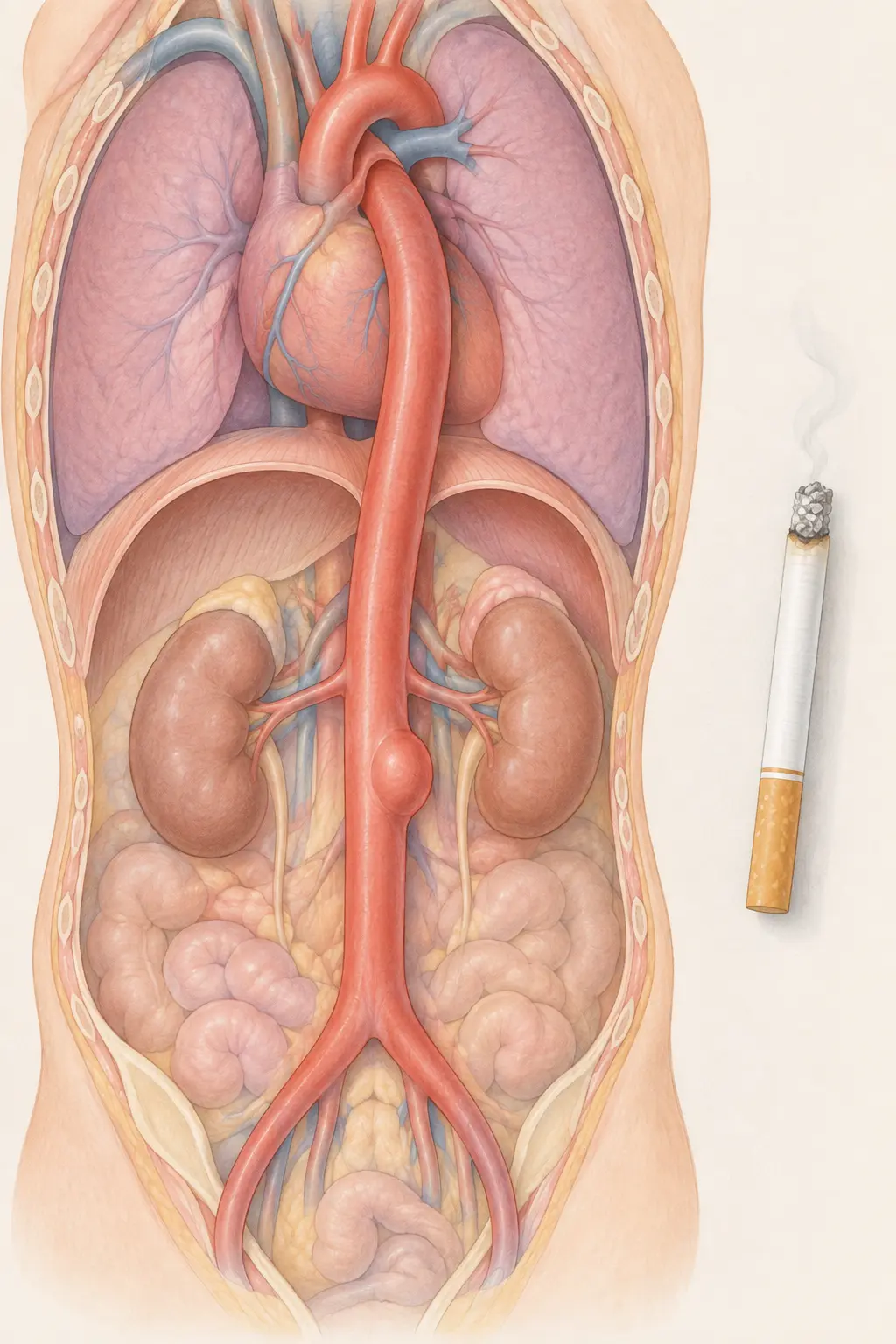
An abdominal aortic aneurysm, or aortic aneurysm, is a swelling in the main artery that carries blood from the heart to the belly. It usually causes no symptoms until it becomes dangerous, and smoking is the strongest risk factor the evidence points to. If you smoke, or ever did, that makes a one-time ultrasound scan one of the simplest preventive checks available. This guide explains who should be screened in the US and the UK, what the scan involves, and how stopping smoking fits in.
What an AAA is
The NHS describes an abdominal aortic aneurysm as a swelling in the aorta, the artery that carries blood from the heart to the tummy (abdomen). Most aneurysms do not cause any problems, but they can be serious because there is a risk they could burst (rupture).
The US Preventive Services Task Force (USPSTF) defines an AAA as aortic enlargement with a diameter of 3.0 cm or larger. It notes that most AAAs are asymptomatic until they rupture, and that the risk of death with rupture is as high as 81%. That figure is the reason screening exists: it is much safer to find a swelling on a scan than during an emergency.
The NHS says an abdominal aortic aneurysm often has no symptoms and that you usually find out through a screening test or tests for another condition. If it grows, you might notice tummy or back pain or a pulsing feeling in your tummy. Those symptoms can have many causes, but persistent ones are worth a GP visit.
Emergency signs
The NHS says to call 999 if you or someone else has sudden, severe pain in the tummy or back, is struggling to breathe or has stopped breathing, has pale or grey skin, or loses consciousness. These could be signs of an aneurysm bursting, which is a life-threatening emergency that needs hospital treatment as soon as possible.
Smoking as the strongest risk factor
The USPSTF recommendation statement says indirect evidence shows that smoking is the strongest predictor of AAA prevalence, growth and rupture rates, and that there is a dose-response relationship, meaning greater smoking exposure is associated with greater risk. It also reports that the prevalence of AAA has declined over the past two decades among screened men aged 65 or older in countries including the United Kingdom, New Zealand, Sweden and Denmark, and that the reduction is attributed to the decrease in smoking prevalence over time.
Population studies in men older than 60 have found an AAA prevalence ranging from 1.2% to 3.3%, according to the same document. That sounds small, but it is a large number of people in absolute terms, and the consequences of a rupture are severe.
The NHS lists other risk factors too: being male and aged 65 or over, smoking or having smoked, high blood pressure, high cholesterol, a close relative who has had an AAA, coronary or peripheral artery disease, chronic obstructive pulmonary disease (COPD), and conditions such as Marfan syndrome. The USPSTF says a family history of AAA in a first-degree relative doubles the risk.
Smoking also harms the arteries in other places. If your legs hurt when you walk, see our guide to smoking peripheral artery disease leg pain, and for a rarer smoking-linked blood-vessel disease, read Buerger’s disease and smoking.
Who should be screened
Screening rules depend on your country, your sex and your smoking history. Here is how the two main sources set out the rules, and the table summarizes them.
| Group | USPSTF (2019) | NHS England |
|---|---|---|
| Men 65 to 75 who have ever smoked | One-time ultrasound screening recommended (Grade B) | Invited the year they turn 65 |
| Men 65 to 75 who have never smoked | Selectively offer screening (Grade C) | Invited the year they turn 65 |
| Women who have never smoked, no family history | Recommends against routine screening (Grade D) | Not usually offered |
| Women 65 to 75 who have ever smoked or have a family history | Evidence insufficient (I statement) | Not usually offered; talk to a GP if higher risk |
The US definition of “ever smoked”
The USPSTF notes that an “ever smoker” is commonly defined as someone who has smoked 100 or more cigarettes. That is a low bar. Someone who smoked socially in their twenties and stopped decades ago may technically count. If you are unsure how much you smoked over the years, our explainer on pack-year calculator what it means shows how doctors tally exposure for different screening decisions.
The NHS approach in England
The NHS says screening is offered to all men over the age of 64, and that all men living in England are invited in the year they turn 65. It is recommended for anyone assigned male at birth. It is not usually offered to people with a lower risk, including men under 65, women, and people who have already had treatment for an AAA. You have the test once, unless an aneurysm is found. If you are not eligible but think you are at higher risk, for example because you smoke, the NHS says to talk to a GP about the possibility of a scan.
Rules in other countries differ again, so check your own national program or ask your doctor. The table covers only the two sources I reviewed.
This Mayo Clinic video features a vascular surgeon explaining abdominal aortic aneurysm screening and treatment.
What screening involves
The main test is an ultrasound scan of your tummy. The NHS says it usually takes around 10 to 15 minutes and is painless. A small handheld probe is placed on your tummy, images appear on a screen, and the person doing the test checks for bulges or swelling of the aorta. You usually get the result at the end of the scan.
The USPSTF describes abdominal duplex ultrasonography as the standard approach for AAA screening, and the recommended frequency for those it recommends screening is a one-time scan.
If no aneurysm is found, the NHS says you do not need to do anything and will not need more scans. If one is found, what happens next depends on its size.

If a small or large aneurysm is found
The NHS gives these categories and what they usually mean.
| Result | What happens next |
|---|---|
| Small (3cm to 4.4cm) | A scan every year to see if the aneurysm has got bigger, and a specialist nurse for advice |
| Medium (4.5cm to 5.4cm) | A scan every 3 months, and a specialist nurse for advice |
| Large (5.5cm or bigger) | Referral to a vascular surgeon for more tests and possible treatment |
The NHS notes that surgery may be done if an AAA is large (5.5cm or bigger), is quickly getting bigger or is painful, and that surgery has risks and side effects your surgeon should discuss with you. Aneurysms often get bigger over time, which is why regular scans are needed.
Quitting slows growth
For a small or medium aneurysm, the NHS says the specialist nurse will talk to you about medicines you may need, having your blood pressure checked more often, and things you can do to slow the growth of the aneurysm, such as quitting smoking if you smoke, losing weight if you are overweight, and eating a healthy, balanced diet. The NHS also lists “do not smoke” among its lifestyle advice for lowering your risk of getting an AAA or stopping one from getting bigger.
I have not found a source in what I reviewed that gives a precise figure for how much quitting slows growth, so I will not quote one. What the sources support is the direction: smoking is the strongest predictor of growth and rupture, and stopping is the recommended step.
Quitting also helps your blood pressure, which matters because the NHS lists high blood pressure as an AAA risk factor. See our article on blood pressure after quitting smoking and the heart recovery timeline after quitting smoking 2026. For the full picture of recovery, start with our what happens when you quit smoking complete health recovery guide.
Other screening if you smoke
An aortic scan is not the only screening conversation smokers should have. Lung cancer screening uses a different test and different eligibility rules, which our guide to lung cancer screening eligibility former smokers explains. If cost is part of what is stopping you from quitting or from checking in with a doctor, see the true cost of smoking per year country data 2026 breakdown.
A practical plan
- Check your own screening eligibility using your national program or ask your doctor.
- If you are a man aged 65 or older who has ever smoked and have never had a scan, ask about one.
- If you are younger, female or have a family history of AAA, ask your GP whether a scan makes sense.
- Set a quit date and tell someone.
- Treat any sudden severe tummy or back pain as an emergency and call 999 or your local emergency number.
The free iQuit app can help you stop. You can quit cold turkey or by gradual reduction, follow a health-recovery timeline as smoke-free days accumulate, log cravings with their triggers, and use SOS breathing and grounding tools when one hits. Streak shields and slip recovery mean a slip does not wipe out your progress. iQuit supports quitting; it does not screen for, diagnose or treat an aneurysm.
Frequently Asked Questions
Does smoking cause aortic aneurysm?
Smoking is the strongest predictor of AAA prevalence, growth and rupture rates, according to the US Preventive Services Task Force, which also reports a dose-response relationship: more smoking exposure goes with more risk. It is a strong association rather than the only cause (USPSTF, 2019).
Who should get an AAA screening scan in the US?
The USPSTF recommends one-time ultrasound screening for men aged 65 to 75 who have ever smoked (Grade B), and selective offering for men of that age who never smoked. For women the evidence differs by smoking history and family history (USPSTF, 2019).
What does ever smoked mean for AAA screening?
The USPSTF says an ever smoker is commonly defined as someone who has smoked 100 or more cigarettes. That is a low threshold, so even people who quit long ago may be counted as ever smokers for screening decisions (USPSTF, 2019).
When does the NHS offer AAA screening?
The NHS invites all men in England for abdominal aortic aneurysm screening the year they turn 65, and anyone assigned male at birth over 64 can have it. It is a one-time ultrasound unless an aneurysm is found (NHS).
Does AAA screening hurt?
No. The NHS describes screening as an ultrasound scan of the tummy that usually takes around 10 to 15 minutes and is painless. A small handheld probe is placed on your tummy and you normally get the result at the end of the appointment (NHS).
Can quitting smoking shrink an aortic aneurysm?
The sources reviewed do not say it shrinks one. The NHS says quitting smoking is among the things that can help slow the growth of a small or medium aneurysm, alongside blood pressure checks, weight loss and a healthy diet (NHS).
What size AAA needs surgery?
The NHS says surgery may be done if an AAA is 5.5cm or bigger, is quickly getting bigger or is painful, and refers people with a large aneurysm to a vascular surgeon. Smaller ones are monitored with regular scans (NHS).
What are the warning signs of a ruptured aneurysm?
The NHS says to call 999 for sudden, severe pain in the tummy or back, struggling to breathe, pale or grey skin, or loss of consciousness. These can signal a burst aneurysm, which is a life-threatening emergency (NHS).
Quit Now to Protect Your Arteries
Smoking drives aneurysm growth and rupture risk, and stopping is the step within your control. iQuit helps you quit your way, ride out cravings with SOS tools and watch your smoke-free progress grow.