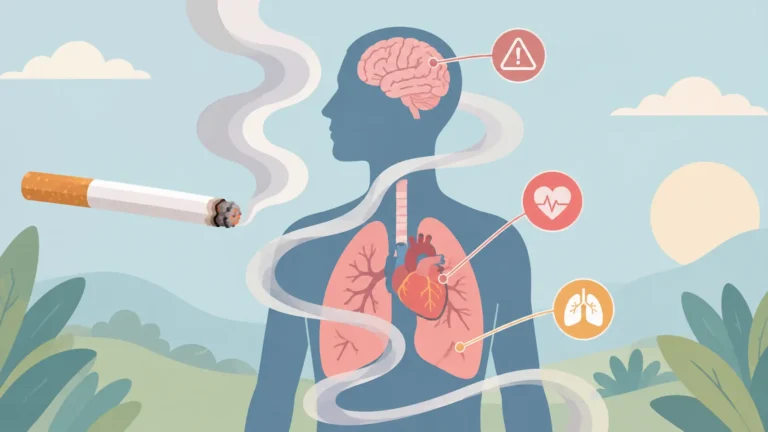
You put the patch on, you followed the leaflet, and you still feel restless, irritable or desperate for a cigarette. Searching for withdrawal symptoms on nicotine patch usually starts right there, with the worry that the patch is not working or that you are doing it wrong. Often neither is true. A patch is designed to do one job well, and that job is not the whole of withdrawal.
This guide explains what a patch does and does not cover, the most common reasons symptoms get through, and practical adjustments to discuss with a pharmacist. It is general information and does not replace advice from a clinician who knows your health and medicines.
What a patch does and does not do
The NHS describes patches as a slow-acting product that gives a steady dose of nicotine through your skin, worn for about 24 hours or about 16 hours while you are awake. Heavier smokers are advised to start on a higher strength. For sudden cravings, the NHS recommends a fast-acting product such as a spray, inhaler, gum or lozenge.
That description explains most of the experience of still feeling withdrawal on a patch. A slow, steady background dose cannot rise quickly to meet a sudden urge. And a patch does nothing about the routines built around smoking: the coffee, the break, the step outside. If you want the full explanation of how the delivery works, our article on how nicotine patches work goes through dose and timing.

Withdrawal symptoms on nicotine patch: common reasons
Several different things can be going on, and more than one can be true at once.
The patch alone may be doing a job meant for two products. Research supports combining. A 2023 Cochrane review found high-certainty evidence that combination NRT, meaning a fast-acting form plus a patch, results in higher long-term quit rates than a single form (risk ratio 1.27, 95% CI 1.17 to 1.37, 16 studies, 12,169 participants). That review measured quitting rather than symptom scores, but it is the clearest reason to ask whether you should be using both.
The strength may not match how much you smoked. The NHS says heavier smokers should start on a higher strength. If you started low to be cautious, that is worth raising with a pharmacist, and our guide to patch strengths explains the usual thresholds.
You may be in the expected peak. A research review by Dr. John Hughes in 2007 found that anger, anxiety, depression, difficulty concentrating, impatience, insomnia and restlessness peak within the first week and last two to four weeks. The review was not specific to patch users, so treat it as a general guide, but the first week being hard does not by itself mean the patch has failed.
The trigger may be habit rather than nicotine. A craving that arrives with your morning coffee or at the end of a meal may have more to do with the routine than the level of nicotine in your blood. A patch cannot remove that association.
A dose change may be recent. Stepping down to a lower strength can bring symptoms back for a while. That experience is widely reported by patch users, though it is not something clinical guidance puts a number on.
Something else may be contributing. Poor sleep, extra caffeine, alcohol, or a stressful period can all mimic or amplify withdrawal. It is worth looking at what else changed the week you quit.
What to try, with your pharmacist
The NHS advises speaking to a healthcare professional before using NRT so they can help you choose the right product or combination. These are good questions to bring to that conversation.
- Should I add a fast-acting product? The NHS says using a combination of slow-acting and fast-acting products can give you the best results.
- Is my patch strength right for how much I smoked? Ask for a specific answer rather than guessing.
- Am I using it as directed? Check the leaflet in your pack for how to apply the patch, where to put it and how often to replace it.
- Is a 16-hour or 24-hour patch better for me? Sleep problems can be one reason to ask. Our article on nicotine patch vivid dreams covers the label advice.
- Would a different medicine suit me better? Prescription options exist, and a clinician can tell you whether one is appropriate.
Please do not put on a second patch or change your dose on your own. Too much nicotine can make you feel unwell, and the right adjustment depends on your health, your other medicines and how you smoked.
While you sort out the dose, it helps to have something to do with the craving itself. Delay, change your location, go for a short walk or use a breathing exercise. The CDC reminds people that a craving will always pass, and that withdrawal symptoms fade as long as you stay smokefree.

Withdrawal or a side effect?
Some patch reactions overlap with withdrawal, which is why people often cannot tell which they are having. Skin irritation at the site, for example, points to the patch rather than withdrawal, and disturbed sleep or vivid dreams can come from either. Our guide to nicotine patch side effects sets out what is normal and when to stop and seek advice.
A rough way to think about it: symptoms that follow the classic withdrawal pattern, such as irritability, restlessness and trouble concentrating, are more likely to be withdrawal, while symptoms that start soon after applying a patch, or that are worse at the patch site, are more likely to be the product. That is a starting point for a conversation, not a diagnosis.
Speak to a doctor promptly if you have chest pain, a racing or irregular heartbeat, severe skin reactions, or a mood that drops sharply. If you ever have thoughts of harming yourself, seek help at once. In the US you can call or text 988 at any time.
How long symptoms tend to last
There is no separate timeline for people on patches. The Hughes review puts the core symptoms at a peak in the first week and a duration of two to four weeks, and our broader guide to how long withdrawal lasts gives more detail.
The patch itself is meant to be used for longer than that. The NHS says NRT is recommended for about 12 weeks or for as long as needed to stop you from smoking again, gradually lowering the dose when you feel ready. Stopping early because the worst seems over is a common temptation. Our article on how long to use nicotine patches compares what different labels and services advise.
Frequently Asked Questions
Is it normal to have withdrawal symptoms on a nicotine patch?
It is common. Patches deliver a steady dose of nicotine slowly through the skin, so they do not deal with sudden cravings the way faster products do, and they do not replace the habit of smoking. If your symptoms are severe or worsening, ask a pharmacist or doctor.
Should I add a second patch if I still have cravings?
Do not change your dose on your own. The NHS advises speaking to a healthcare professional about which products and strengths to use. A pharmacist can tell you whether a fast-acting product added to the patch or a different strength suits you.
Does combining a patch with gum or a lozenge help?
Combining them improves long-term quit rates. A 2023 Cochrane review found high-certainty evidence that a patch plus a fast-acting form works better than one form alone (risk ratio 1.27, 16 studies, 12,169 participants). It measured quitting, not symptom scores.
How long should I keep using the patch?
The NHS recommends using NRT for about 12 weeks or for as long as needed to stop you from smoking again, gradually lowering the dose when you feel ready. Check the leaflet in your pack and ask a pharmacist if you are unsure.
How long do symptoms last when using the patch?
There is no patch-specific timeline. A research review by Hughes in 2007 found that core withdrawal symptoms peak within the first week and last two to four weeks, and that time course is a useful general guide.
Get through the cravings the patch does not catch
iQuit is free on Google Play and the App Store. Log cravings with their triggers and intensity to show your pharmacist the pattern, and open SOS craving support (breathing exercises, grounding and craving timers) when an urge breaks through.