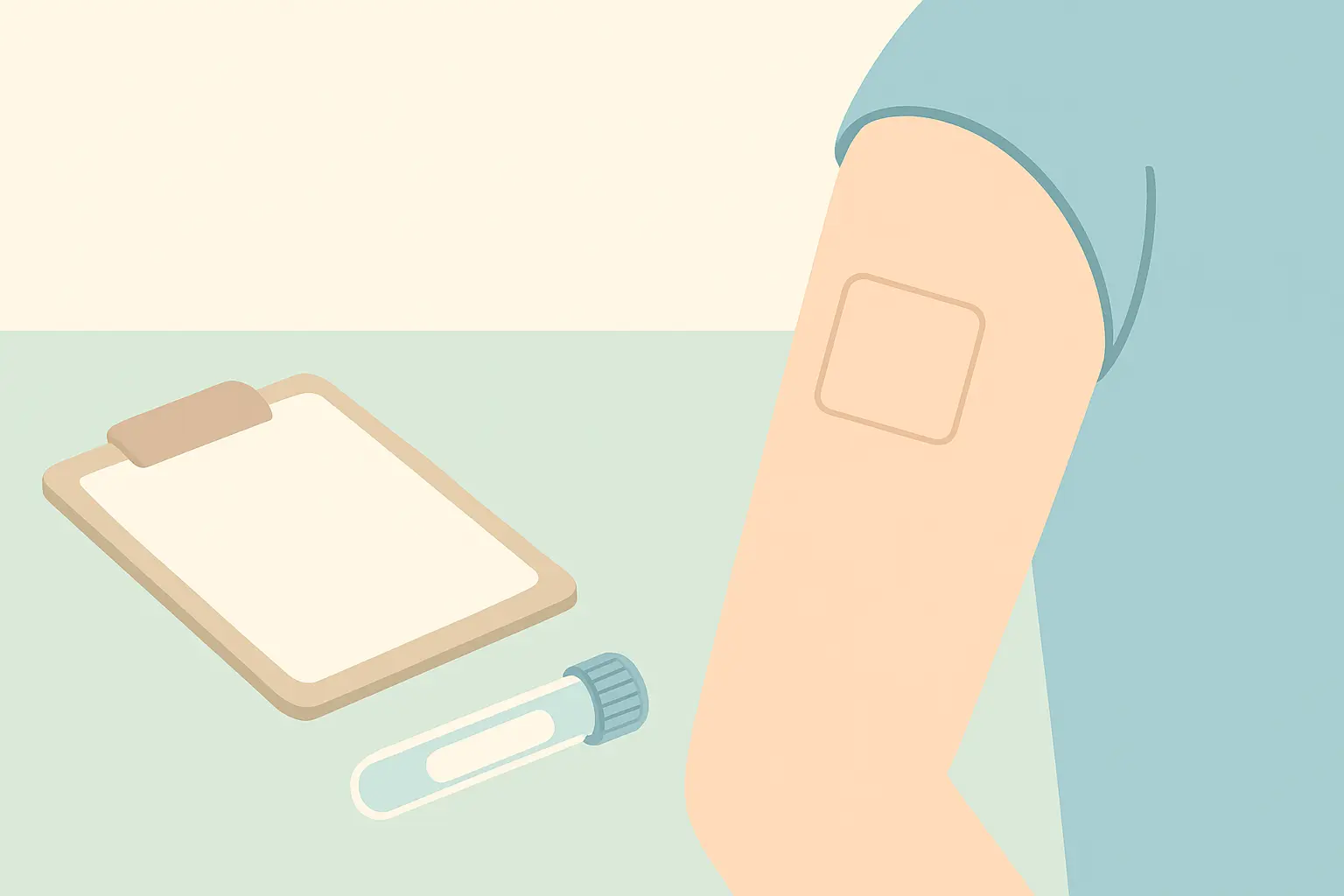
Yes. If you are asking do nicotine patches show up on a nicotine test, the answer is that they almost certainly will, because the standard test measures cotinine and cotinine cannot tell where the nicotine came from. A patch, a piece of gum, a lozenge, an inhalator, a vape and a cigarette all produce it. What separates them is a second, less common measurement that most people have never heard of.
This guide explains why nicotine replacement therapy registers, which marker distinguishes tobacco from medicinal nicotine, the published cutoffs and clearance times, and what to say to an insurer, an employer or a surgical team before the sample is taken.
The short answer
A nicotine test is nearly always a cotinine test, and cotinine is indifferent to the source. The 2019 update to the Society for Research on Nicotine and Tobacco biochemical verification report states the point plainly: nicotine and cotinine reflect exposure to nicotine regardless of its source, and its summary table lists cotinine as detecting exposure to nicotine from all sources, including combustible, noncombustible and NRT.
So a patch will not be mistaken for abstinence from nicotine. What it can be distinguished from is tobacco, and that takes a different test.
Why nicotine replacement therapy shows up at all
Your liver converts nicotine into cotinine no matter how the nicotine arrived. Testing.com, the patient resource from the Association for Diagnostics and Laboratory Medicine, is explicit that nicotine patches, gum, lozenges, inhalers and e-cigarettes all produce cotinine.
That is not a flaw in the test. It is the point of it. Cotinine is used precisely because it is a stable, source-blind measure of how much nicotine has been in your system, which is why it is also the marker cessation researchers use to check nicotine intake. Our guide to how long nicotine stays in your body covers the clearance side in more detail.
The practical consequence is that starting a patch does not put you in a grey area. It puts you clearly in the nicotine-positive column, and your job is to make sure the person reading the result knows why.
This short explainer from an NHS trust walks through how the different nicotine replacement products work and what each one is for.
Cotinine vs anabasine: the tobacco-specific marker
This is the whole answer, and it is worth understanding properly.
Tobacco leaf contains nicotine plus a family of chemically related compounds called minor alkaloids. Pharmaceutical-grade nicotine is derived from tobacco but purified far more thoroughly, so those minor alkaloids are largely stripped out. The SRNT report explains that because they are present in negligible amounts in pharmaceutical-grade nicotine, two of them, anabasine and anatabine, were developed as biomarkers for tobacco use during nicotine replacement therapy.
In other words: cotinine says you have had nicotine. Anabasine says the nicotine came from tobacco.
The separation is sharp. In the validation work the SRNT report cites, urine samples from 35 non-smokers were tested and, using a cutpoint of 2 ng/mL for both alkaloids, specificity for cigarette smoking was 100%. Among 99 cigarette smokers, mean urine concentrations of both anabasine and anatabine were around 22 ng/mL. That is not a marginal difference.

Two caveats matter. First, these alkaloids are measured in urine by mass spectrometry, so they are a deliberate extra order, not something that appears automatically on a cotinine result. Second, the SRNT report notes an exception: some e-liquids have been reported to contain synthetic nicotine, so the logic that ties minor alkaloids to tobacco does not map neatly onto every vaping product.
The published cutoffs and clearance times
The SRNT report’s summary table is the most useful single thing you can read before a test, because it gives both the cutoff and the approximate time after stopping at which an average person falls below it.
| Marker | What it detects | Cutpoint | Average half-life | Approximate time to reach the cutpoint |
|---|---|---|---|---|
| Free cotinine (plasma, saliva, urine) | Nicotine from all sources, including NRT | 3-10 ng/mL in plasma and saliva; 30-50 ng/mL in urine | 16 hours | 80-100 hours |
| Exhaled carbon monoxide | Combustible products only, so not patches or gum | 5-6 ppm | 2-8 hours | 12-24 hours |
| Anabasine (urine) | Tobacco-derived nicotine products | 2 ng/mL | 16 hours | 80 hours |
| Anatabine (urine) | Tobacco-derived nicotine products | 2 ng/mL | 10 hours | 50 hours |
| NNAL (urine) | Exposure to cured tobacco | 10-40 pg/mL | 10-40 days | 2-3 months |
Three things jump out of that table. Carbon monoxide clears within a day, which is why a breath test is a poor way to catch occasional smoking but a good way to give someone same-week feedback. Cotinine takes roughly three to four days to fall below the cutoff for an average person. And NNAL, a tobacco-specific nitrosamine, lingers for months, which is why it is used in research rather than in employment screening.
Individual variation is wide. The report notes that the half-life of cotinine can vary from 8 to more than 30 hours because of genetic, hormonal and other factors, so treat the average as a planning figure, not a guarantee.
What insurers actually screen for
Insurance underwriters are among the parties Testing.com lists as ordering cotinine testing. Because cotinine cannot separate a patch from a cigarette, an underwriter running a plain cotinine screen will see NRT as nicotine use unless you tell them otherwise.
Be careful with what you assume here. Insurers publish very little about their internal underwriting rules, and we could not verify any specific company’s policy on nicotine replacement therapy in writing. The safe approach is simple and it is the same everywhere: answer the application questions truthfully, state that you are using NRT and when you started, and ask in writing which marker the test measures and how NRT is treated. Our breakdown of what smokers pay for life cover shows why the answer is worth chasing down rather than guessing at. The related question of who tests for nicotine and why covers the wider picture.
Employer and pre-surgical testing
Employer screening for tobacco is uncommon and is restricted in many US states, but where it exists it is usually a cotinine test, with the same blind spot.
Surgical and transplant teams are a different case, because their concern is physiological rather than contractual. The American Society of Anesthesiologists lists breathing problems during and after surgery, a greater risk of pneumonia, a much higher chance of needing a ventilator, slower healing and a more infection-prone incision, and a higher chance of a heart attack around the time of surgery. Its advice is that the earlier you quit the better, preferably a week or more before surgery.
Testing.com notes that a cutoff of 10 ng/mL of cotinine is frequently used for surgery qualification purposes in serum or plasma testing. Some reconstructive and elective procedures require a nicotine-free result rather than a tobacco-free one, because nicotine itself constricts blood vessels and affects healing. If that applies to you, a patch is not a workaround, and the surgical team needs to tell you which standard they are applying well before the date.
Declaring your NRT before the test
Say it first, in writing, and keep a copy. A declared patch is an unremarkable piece of clinical information. An undeclared one that surfaces as an unexplained cotinine result looks like something else entirely.
Four things are worth putting in that message:
- Which product and dose you are using, and the date you started it.
- Your last cigarette date, which is the fact most testers actually care about.
- Whether you can be tested for minor tobacco alkaloids rather than cotinine alone, if you need to show you are off tobacco while still on NRT.
- A request for the cutoff they apply, so you know what the result will be compared against.
If you are choosing a product at the same time, our comparison of patches versus gum, spray and lozenges and our head-to-head on which NRT works best cover the trade-offs. The NHS recommends pairing a fast-acting source such as a mouth spray with a slow-acting patch, and advises using stop smoking products for at least 12 weeks, or longer if needed. Stopping NRT early to beat a test is usually the wrong trade.
How long to stop NRT if you must be clear
Sometimes the requirement really is zero nicotine, most often before certain surgery. In that case, work from the table rather than from hope.
For cotinine, the SRNT figure is roughly 80 to 100 hours after your last nicotine to fall below the cutpoint, so about four days for an average metabolizer, and longer if your cotinine half-life sits at the slow end of the 8 to 30 hour range. A week gives you a real margin. A day does not.
Before you stop, though, ask whether you have to. Coming off NRT in the days before a stressful procedure is exactly when a quit attempt tends to collapse, and the stages of nicotine withdrawal are unpleasant enough without a surgery date on top. If the requirement is tobacco-free rather than nicotine-free, an anabasine test can demonstrate that while you stay on the patch. Our guide to the main NRT options is a good starting point if you are rethinking the plan.
Whatever you decide, keep a dated record. iQuit, free on Google Play and the App Store, lets you log NRT use alongside cravings with their triggers and intensity, so the taper has a timeline you can show someone rather than a number you are trying to remember.
Nicotine Patches and Testing FAQ
Do nicotine patches show up on a nicotine test?
Yes. Standard nicotine tests measure cotinine, which reflects exposure to nicotine from all sources including nicotine replacement therapy. Patches, gum, lozenges, inhalers and e-cigarettes all produce cotinine, so a patch will register as nicotine use (SRNT biochemical verification update, 2019; Testing.com).
Can a test tell the difference between a patch and a cigarette?
Only if it measures minor tobacco alkaloids. Anabasine and anatabine are present in negligible amounts in pharmaceutical-grade nicotine, so they were developed specifically as biomarkers of tobacco use during nicotine replacement therapy. A plain cotinine test cannot make that distinction (SRNT, 2019).
How long does it take for cotinine to clear after stopping NRT?
The SRNT report gives an average of about 80 to 100 hours after the last nicotine to fall below the cotinine cutpoint, with an average half-life of 16 hours. Because individual half-lives range from 8 to over 30 hours, allow a week rather than four days if the result matters (SRNT, 2019).
Will nicotine gum fail a pre-employment test?
If the employer runs a cotinine test and treats any nicotine as a positive, yes. If the policy is about tobacco rather than nicotine, a urine test for anabasine can show you are off tobacco. Ask which marker is used and what the policy covers before you take the test.
Does a carbon monoxide breath test detect patches?
No. Exhaled carbon monoxide detects consumption of combustible products, so patches, gum and lozenges do not raise it. Its cutpoint is around 5 to 6 ppm and levels fall below that within roughly 12 to 24 hours of stopping smoking (SRNT, 2019).
Should I tell my insurer I am using nicotine patches?
Answer every application question truthfully, state that you are using NRT and when you started, and ask in writing which marker the test measures. Insurers publish little about internal underwriting rules, so get the answer from them rather than assuming how NRT will be treated.
Do vapes count the same as patches on a nicotine test?
For cotinine, yes: e-cigarettes produce cotinine like any other nicotine source. For minor tobacco alkaloids the picture is less clean, because the SRNT report notes that some e-liquids have been reported to contain synthetic nicotine, which breaks the usual link between those alkaloids and tobacco.
Is it worth stopping NRT early to pass a test?
Usually not. The NHS advises using stop smoking products for at least 12 weeks, or longer if needed, and stopping early is a common reason cravings return. If the requirement is tobacco-free rather than nicotine-free, ask for an anabasine test instead of quitting the patch.
Keep a dated record of your quit, not just a memory
Log your NRT alongside cravings with their triggers and intensity, and watch the smoke-free days add up. iQuit is free on Google Play and the App Store.
Download iQuit Free on Google Play
Download on the App Store